Bet they look good on the dancefloor: Mark McNulty’s party people – in pictures
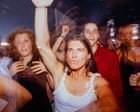
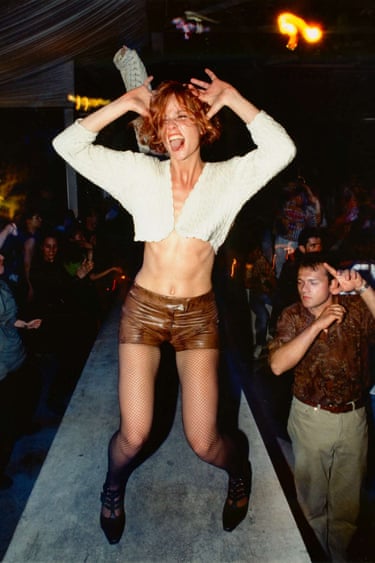
Rimini, Arcadia, 1992
From Liverpool’s iconic Quadrant Park and Berlin’s Tresor to The Hacienda and numerous impromptu after-parties in car parks, renowned photographer Mark McNulty has been an eyewitness to the rise of dance culture. His new book offers a glimpse into rave culture spanning four decades of music, fashion and youth freedom. In Clubland: 35 Summers of Love is available to pre-order now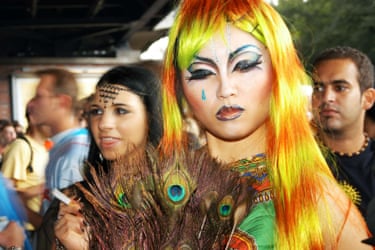
Berlin Love Parade, 2003
Mark McNulty: ‘I’ve photographed a lot of parties in Berlin over the years, and there’s none bigger or better than the original Love Parade. In the middle of a crowd of nearly 1 million people, I bumped into Mark Reeder and his friends. Born in Manchester, Mark moved to Berlin in 1978 and became the Factory Records and Joy Division representative in the city before going on to found the trance label MFS. Mark’s still in Berlin and heavily involved in the electronic music industry’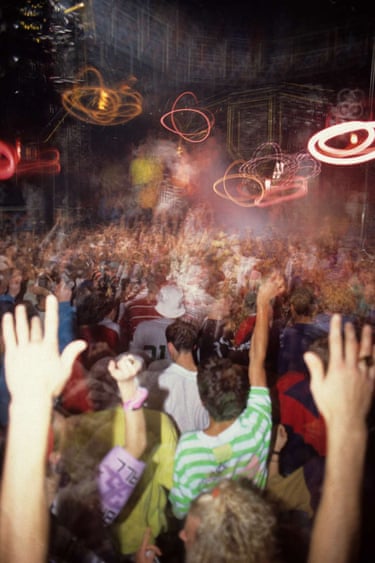
Quadrant Park, Bootle, 1990
‘Quadrant Park was my introduction to the rave scene, and it was like falling in at the deep end. I’d never really photographed people dancing before, and it wasn’t easy to find the dancefloor as people were dancing on every single flat surface in the venue. The club, held in Bootle just north of Liverpool, was the UK’s first legal all-nighter and existed due to some loophole in the licensing laws that allowed them to operate on a weekly basis as long as they didn’t serve alcohol’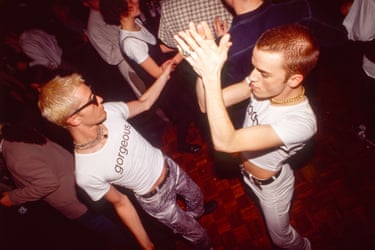
Garlands, Liverpool, 1990s
‘Nick Simpson and Craig Parr at Garlands, which was Liverpool’s premier LGBT+ club in the 90s. Craig made clothes for both of them and had these T-shirts printed with the words Babe and Gorgeous on them. By the mid-90s Liverpool was becoming one of the best places in the UK for clubbing, with Cream bringing coachloads of clubbers in every weekend, but Garlands had its own massive crowds. This photograph also features in the Tate Britain show The 90s’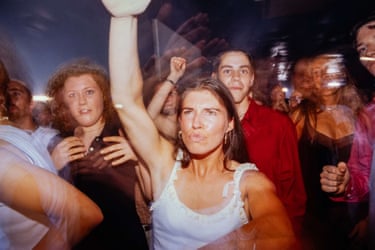
Full on all-nighter at Cream, early 90s
‘When house music culture took over every city by the early 90s, most clubs had a 2am closing policy and all-nighters were few and far between. But once a month, and always on a Friday, some clubs got to host an all-nighter. Full On was Cream’s longer version of their classic Saturday night. Before the all-nighters, clubs had to turf people out at 2am, and it was always a mad rush for taxis home. Some people were just getting started at 2am, so the extended hours always came in handy with house music and rave culture’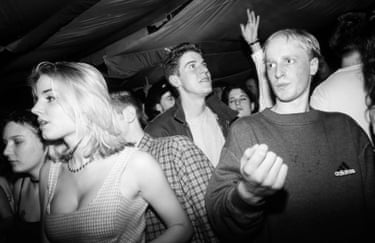
Revolution, the Lakota, Bristol
‘Revolution at the Lakota was peak Saturday night Bristol for me, though my first introduction to the venue was when DJ Nick Warren took us to a night he was involved in called Duck You Sucker. The monthly all-nighters at the Lakota were off the scale, as coachloads of clubbers came over from South Wales and took the party to a whole new level’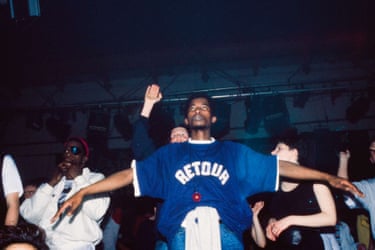
Pirate Club, North London Polytechnic
‘At the start of the 90s I spent a lot of weekends travelling with singers from a Liverpool record label called 8. They were performing at raves up and down the country, from Universe in Bath, to soul weekenders on the east coast, Rockshots up in Newcastle and Golden in Stoke. In London we got to visit clubs like Love Ranch on Leicester Square, Trade at Turnmills and the Pirate Club at North London Polytechnic, where some of the clubbers had taken to wearing eye patches’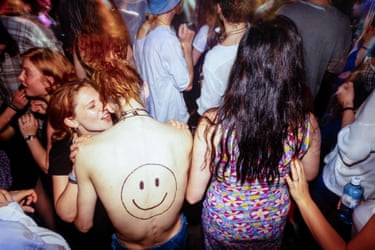
Pandora’s Box, Leicester
‘I did this night with the DJ Steve Butler, who was hanging out a lot in Liverpool in the 90s and had a gig on a Saturday night in Leicester. It was at the University from what I remember, as by the mid-90s I’m pretty sure all of the major universities were hosting their own raves and Pandora’s Box was Leicester’s. Could have been anywhere really, but someone talking away about who knows what in the middle of a packed-out dancefloor to someone with their top off, showing a hand-drawn smiley face tattoo is as 90s a picture for me as any’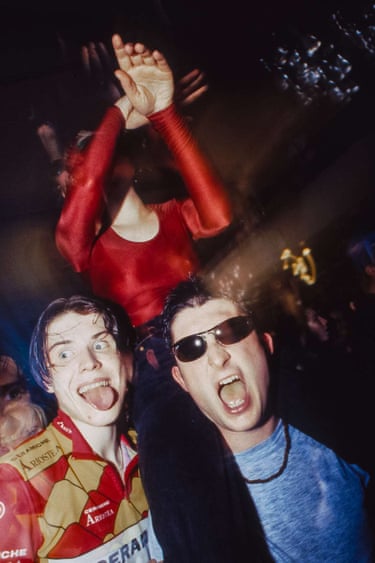
Kaos in Leeds, 1992
‘Some weekends we’d go to different cities and see as many clubs and bars as we could fit in, and this visit to Kaos in Leeds was on one of those adventures that included a night with Jeremy Healey and MC Kinky at Arcadia and a Saturday night at Back II Basics – the Leeds club that is still going 35 years later’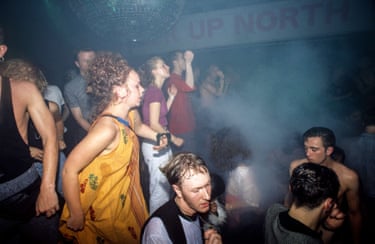
Flesh at The Haçienda, Manchester, 1992
‘The banner says “It’s Queer Up North”, and the photo says they’re having the best Saturday night out ever, only they’re not, because Flesh was held on a Wednesday! The Haçienda’s Flesh was a monthly party hosted by Paul Cons and Lucy Scher and featuring legendary DJs like Paulette and Kath McDermott. And while the Haçienda was key to the 90s image of everything Manchester, Flesh itself was instrumental in changing the LGBT+ scene in the city’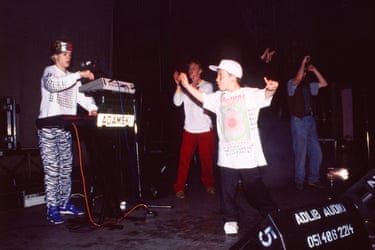
Adamski at The Royal Court, Liverpool, 1990
‘April 1990, not long after Adamski had re-recorded his instrumental version of Killer with an unknown young artist called Seal. Adamski was known on the rave circuit, but hadn’t crossed over to the charts, when some wise A&R man suggested the track needed a vocal hook. The photo was taken at an all-ages rave in the Royal Court Theatre in Liverpool. Killer had come out as a single the week before and went on to become the biggest-selling dance track of that year’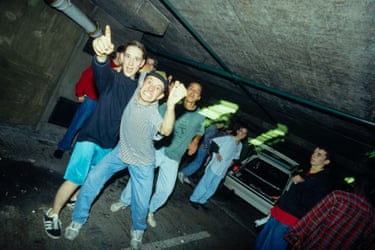
After-hours party in a car park in Birmingham, 1992
‘A weekend in Birmingham in the early 90s probably meant visits to Cream, Wobble and Full of Beans. At 2am on a Saturday night, we all ended up in a car park under the Holiday Inn, which at the time was a regular after-party session.’ All quotes by Mark McNulty. Photographs courtesy Mark McNultyKioskNews shows a cleaned-up reading view extracted from the publisher’s page — the original always lives on their site, not ours.