‘Monster: The Lizzie Borden Story’ Star Breaks Down Crime Series’ Most Brutal Moments

Taylor Gates is an Indiana native who earned her BFA in Creative Writing from the University of Evansville. She fell in love with entertainment by watching shows about chaotic families like Full House, The Nanny, Gilmore Girls, and The Fosters.
After college, she moved to Los Angeles to pursue a career as a writer, editor, and filmmaker. Today, she’s a sucker for dramedies — especially coming-of-age stories centering around complex female and LGBTQ+ characters. She has been with Collider since May 2022.
Sign in to your Collider account
This interview contains spoilers for the first two episodes of 'Monster: The Lizzie Borden Story.'
Summary
- In an exclusive with Collider, Ella Beatty reveals the research she did to prepare for her leading role in Monster: The Lizzie Borden Story.
- Beatty also breaks down her excellent chemistry with Vicky Krieps and Rebecca Hall.
- The star revealed how the show's intense violence and gore informed her performance.
Ella Beatty is the definition of a rising star. Coming onto the scene just two years ago, she’s already racked up an impressive resume, including Appropriate on Broadway, the Oscar-nominated If I Had Legs I'd Kick You, the upcoming The Bell Jar film, and Feud: Capote vs. The Swans. She’s staying in the Ryan Murphy family for her newest TV project, taking on the lead role of Lizzie Borden in the newest season of Monster.
You know the haunting nursery rhyme: “Lizzie Borden took an ax, gave her mother 40 whacks. When she saw what she had done, gave her father 41.” It's based on a true tale of a young woman accused (and eventually acquitted) of murdering her parents in Fall River, Massachusetts, in 1892. Of course, there’s almost always more to the story than meets the eye, and Monster offers a fictionalized exploration of what could have driven Lizzie to madness, including a hyper-critical stepmother, unsupportive father, and steamy dynamic with the family maid. Beatty does a magnificent job capturing both Lizzie’s natural sweetness and fury at the injustices of the world, delving into her female rage.
Collider got the chance to speak to Beatty about her work on the show. During the conversation, she discussed the research she did to prepare to take on the famous figure, working with Vicky Krieps and Rebecca Hall, how the show’s intense gore informed her performance, and more.
Ella Beatty Reveals How She Relates to Lizzie Borden
“That was really surprising to me and was a big way in for her physicality and also her connectivity — or lack thereof — to people around her.”
COLLIDER: Lizzie Borden is a legendary figure. Clearly, there were some creative liberties taken, but I'm curious what sort of research you did to prepare for this and if there was anything you found out that was especially surprising or memorable to you.
ELLA BEATTY: Right away, when I found out I had the part, I listened to every single podcast and video that's ever been published in the world. I couldn't be stopped if I had a WiFi connection. But I started to hone in and get a little bit more specific, and I did feel that my responsibility was to what was on the page. And then I also had my dreams — I had my imagination — and [I started to] combine all those things to create a real person and hope that someone would emerge from that process. I read the book The Trial of Lizzie Borden, which is a great book. I really recommend it. It's a really great analysis of her case, her trial, and also her as a person. And she loved animals. That was really surprising to me and was a big way in for her physicality and also her connectivity — or lack thereof — to people around her. She loved animals, and I was surprised and very connected to that.
That leads really well into my next question, because I love those moments of catharsis when she is with her doves and when she's with nature. I'm curious if you can talk about playing those scenes because they are pretty silent — you don't really have any dialogue to lean on — but you can really feel the freedom running through her during those moments.
BEATTY: Yes, absolutely. I think there's something really visceral about those moments, and sometimes, the most impactful moments in a script are ones that don't have any dialogue. I think Ian is so tactful, smart, and intelligent about creating those moments that are so fun to play as an actor.
Ella Beatty on Working With Vicky Krieps and Rebecca Hall in ‘Monster: The Lizzie Borden Story’
“Her ability to oscillate between comedy and drama is to be studied in a lab.”

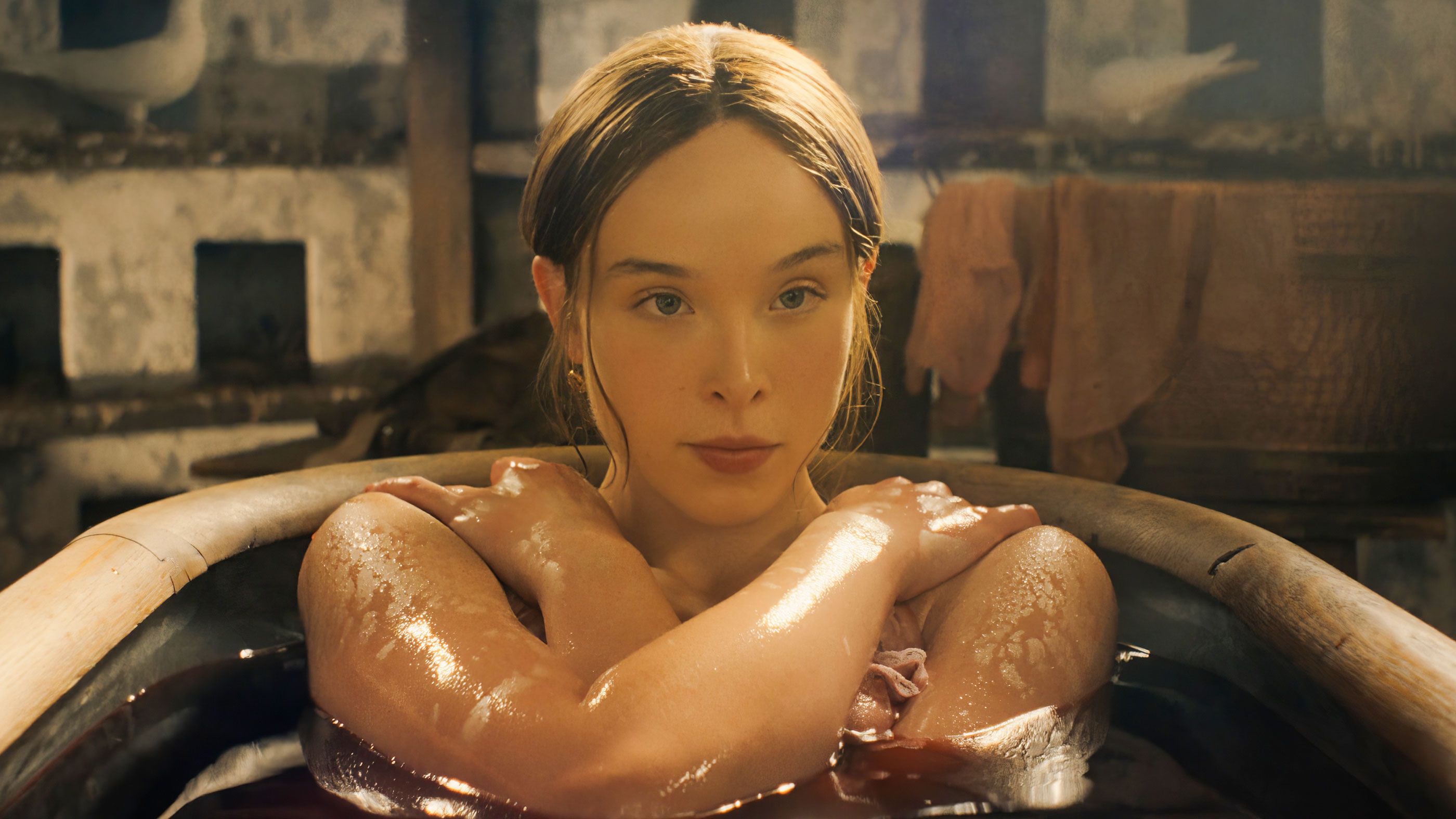
I absolutely loved you and Vicky's chemistry — I feel like it really shined through as a queer woman. We love this representation that’s a little bit messy. I'm curious how you developed your dynamic with her and then how you found these moments of sensuality in the cherry bath, the couch cleaning — stuff that maybe you wouldn't originally be like, “Yeah, this is so hot.”
BEATTY: We loved each other right away, and she's such an incredible collaborator. She's so fierce and also spontaneous, playful, and fun. She's a dream, so it really wasn't very hard to sort of build that connection. Her wildness and worldview are so similar, in some ways, to the dynamic of the characters, because she's not like anybody I've really met before, and I think that's true for Lizzie, so it was just fun and easy.
Collider Exclusive · Horror Survival Quiz Which Horror Villain Do You Have the Best Chance of Surviving? Jason Voorhees · Michael Myers · Freddy Krueger · Pennywise · Chucky
Five killers. Five completely different ways to die — if you're not smart enough, fast enough, or self-aware enough to avoid it. Only one of them is the villain your particular set of instincts gives you a fighting chance against. Eight questions will figure out which one.
🏕️Jason
🔪Michael
💤Freddy
🎈Pennywise
🪆Chucky
01
Something feels wrong. You can't explain it — you just know. What do you do? First instincts are the difference between the survivor and the first act casualty.
02
Where are you most likely to find yourself when things go wrong? Setting is everything in horror. Where you are determines which rules apply.
03
What is your most reliable survival asset? Every survivor has a quality the villain didn't account for. What's yours?
04
What kind of fear is hardest for you to fight through? Knowing your weakness is the first step to not dying because of it.
05
You're with a group when things start going wrong. What's your role? Horror movies are brutally clear about who survives group situations and who doesn't.
06
What's the horror movie mistake you're most likely to make? Honest self-assessment is a survival skill. Denial is not.
07
What's your best weapon against something that can't be stopped by conventional means? Every horror villain has a weakness. The survivors are always the ones who find it.
08
It's the final scene. You're the last one standing. How did you make it? The final survivor always has a reason. What's yours?
Your Survival Odds Have Been Calculated Your Best Chance Is Against…
Your instincts, your strengths, and your particular way of thinking under pressure point to one villain you actually have a fighting chance against. Everyone else — good luck.
Jason Voorhees
Jason is relentless, but he is also predictable — and that is the gap you would exploit.
- He moves in straight lines toward his target. He doesn't strategise, doesn't adapt, doesn't outsmart. He simply pursues.
- Your ability to keep moving, use the environment, and resist the panic that freezes most victims gives you a genuine edge.
- The Crystal Lake survivors were always the ones who stopped running in circles and started thinking about terrain, water, and distance.
- You think like that. Which means Jason, for all his indestructibility, would face someone who simply refused to be where he expected.
Michael Myers
Michael watches before he moves. He is patient, methodical, and almost impossible to detect — until it's too late for anyone who isn't paying close enough attention.
- But you are paying attention. You notice the shape in the window, the car parked slightly wrong, the silence where there should be sound.
- Michael's power lies in the invisibility of ordinary suburbia — the fact that nothing ever looks wrong until it already is.
- Your spatial awareness and instinct to map every room, every exit, and every shadow before you need them is precisely the quality Laurie Strode had.
- You are not a victim waiting to happen. You are someone who already suspects something is wrong — and acts on it.
Freddy Krueger
Freddy wins by getting inside your head — using your own fears, your own memories, your own subconscious as weapons against you. That strategy requires a target who can be destabilised.
- You are harder to destabilise than most. You've faced uncomfortable truths about yourself and you haven't looked away.
- The survivors on Elm Street were always the ones who understood what was happening and chose to face it rather than flee from it.
- Freddy's greatest weakness is that his power evaporates in the presence of someone who refuses to give him the fear he feeds on.
- Your psychological resilience — the ability to stay grounded when reality itself becomes unreliable — is exactly the quality that keeps you alive here.
Pennywise
Pennywise is ancient, shapeshifting, and feeds on terror — but it has one critical vulnerability: it cannot function against someone who genuinely stops being afraid of it.
- The Losers Club didn't survive because they were braver than everyone else. They survived because they faced their fears together, and faced them honestly.
- You ask the questions others avoid. You look directly at what frightens you rather than turning away.
- That directness — the refusal to let fear fester in the dark — is Pennywise's worst nightmare.
- It chose the wrong target when it chose you. You are exactly the kind of person whose fear tastes like nothing at all.
Chucky
Chucky's greatest advantage is that nobody takes him seriously until it's already too late. He exploits the gap between how something looks and what it actually is.
- You don't have that gap. You take threats seriously regardless of how they present — and you never make the mistake of underestimating something because of its size or appearance.
- Chucky relies on surprise, on the delay between recognition and response. You close that delay faster than almost anyone.
- Your instinct to treat every unfamiliar thing with appropriate scepticism — rather than dismissing it because it seems absurd — is the exact quality that keeps you breathing.
- Against Chucky, not laughing is already winning. You are very good at not laughing.
Speaking of incredible scene partners, the way that you and Rebecca Hall play off of each other… I mean, that dialogue is so clever. It's so nasty in ways. How was it to shoot those scenes? There are some zingers thrown back and forth.
BEATTY: She is the most incredible actress. Her facility — I keep saying this, so I know I'm probably repeating myself over and over — but her facility as an actress is so tremendous. Her ability to oscillate between comedy and drama is to be studied in a lab. She has such ease as an actress, but she's very direct and clear, and she executed that dialogue more brilliantly than I think I've ever seen anybody execute. She's the best.
It was surgical. She had that rhythm.
BEATTY: I'm in awe of her in every capacity. She's completely remarkable.
And you do, too. It was like watching a tennis match.
BEATTY: I love working with her so much. I think at one point, we were singing “For Good” between takes.
That feels right, honestly.
BEATTY: It felt right. There would be so much going on, and we'd be like, “[Singing] For good.” She's the best.
Ella Beatty Breaks Down ‘Monster: The Lizzie Borden Story’s Intense Gore
“It was…such a feat of filmmaking.”

The scene where Abby kills the doves is so heartbreaking, but I will say, we get kind of an iconic image out of it with her covered in blood and feathers. I’m curious how the gore informs your performance because you have this incredible makeup and imagery going on.
BEATTY: It’s really visceral. Blood, feathers — it's all information for you, as an actress, about how it feels to be that person. That scene was really intense, and also cruelty or violence towards animals is so hard to stomach as a person. It's really intense, but of course, it's the story of our show and is a really integral moment for Lizzie, so it was so important to get right.
A different sort of gore, I would say, is the dinner scene, which has the vomiting and the diarrhea. What's it like being like an observer in that scene? Because you obviously don't have to be the one doing things, but it's still probably pretty gnarly to be witnessing and reacting to that.
BEATTY: I think from where I'm sitting, which was literally clean and not with a vomit rig, I don't have anything to complain about. I had the best day. I was just watching them, and they were so remarkable in the scene, and so funny. It was also just such a feat of filmmaking. The vomit rigs were incredible, and it smelled really crazy in there.
I heard it was tomato soup. Is this correct?
BEATTY: You know what, I can't say. Not that it’s a secret — I just don’t know. I've never smelled that smell before, so I can't tell you. But it was pungent.
This is the fourth installment in the Monster anthology. I'm curious, are there any stories you think would make for a good next season of the show?
BEATTY: Oh, wow. Oh my gosh, so many. You know, that's something I'd have to think about more. But I think that the enduring question of what pushes a person to the point of violence will continue to be really interesting and enduring.
Monster: The Lizzie Borden Story is now streaming on Netflix.

- Release Date
- September 17, 2026
- Network
- Netflix
- Directors
- Max Winkler, Sarah Adina Smith
Cast
-

Vicky Krieps
Bridget Sullivan
-
Ella Beatty
Lizzie Borden
-

Aileen Wuornos
-

Andrew Borden
KioskNews shows a cleaned-up reading view extracted from the publisher’s page — the original always lives on their site, not ours.