‘Starship is in orbit’: cheers go up as huge SpaceX rocket circles Earth for first time
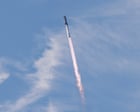
SpaceX has sent its enormous Starship rocket into Earth’s orbit for the first time on a milestone flight intended to pave the way for future missions to the moon and Mars.
The rocket, the largest and most powerful ever built, blasted off from SpaceX’s Starbase launch facility in Texas at 7.48am local time (1.48pm BST) marking its 14th test flight and first attempt to circle the planet before falling back to Earth.
Despite an engine failure on ascent that threatened to prevent Starship from reaching orbit, mission controllers decided it was safe to press ahead with a burn that pushed the ship on to a planned trajectory to take it around the planet.
Cheers and applause broke out at SpaceX after initial suggestions the orbit attempt might be abandoned were quashed and the decision to go ahead was announced. Moments after the orbit burn, Daniel Hewitt, who was narrating a live stream of the launch declared: “Starship is in orbit.”
Elon Musk’s company has flown Starship in its full form since 2023, but previous test flights have only sought to put the rocket into suborbital trajectories, which are simpler and carry fewer risks for the public.
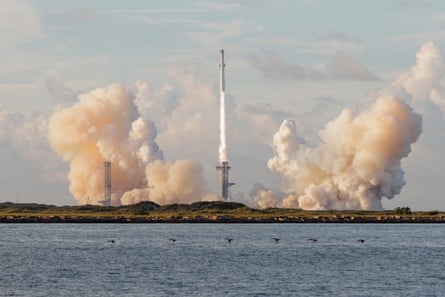
For suborbital flights, the trajectory is such that if the rocket explodes or malfunctions mid-flight, the remnants come down in the Indian Ocean far from populated areas. The risks are harder to control when rockets are on full orbital paths around the planet.
The mission saw Starship propelled to an altitude of about 171 miles (275km) with the original aim of completing six loops of the Earth in nearly 10 hours before splashing down in the Pacific Ocean somewhere west of Chile. More than an hour into the mission however, SpaceX said Starship would come back early, aiming for a landing three hours after launch.
“This is an important milestone for SpaceX, with Starship successfully reaching orbit, and at the first attempt,” said Martin Barstow, professor of astrophysics and space science at the University of Leicester.
The achievement “marks the beginning of the transition from the testing and development phase to becoming a working vehicle able to deliver the large payloads needed to return to the moon,” he added. “Congratulations to the whole SpaceX team. Having this large launch capability will also be transformational for the whole space industry.”
On the launchpad, the rocket stands more than 120-metres tall with the Starship upper stage sitting on the “Super Heavy” booster stage. To remain in orbit, the rocket is required to travel at about 28,000km/h (17,400mph).
A successful mission will be a relief for SpaceX and Nasa, who hope to use Starship to carry astronauts to the moon as part of a new era of lunar expeditions. It will also cheer investors after the company’s high-profile launch on the stock market in June. The company’s stock price rose sharply in the initial public offering before falling back down again. It has since recovered some of those losses.
During the mission, which has been cut short to three hours from the 10 hours initially scheduled, SpaceX staff will want to see the booster launch, ascend and separate from the Starship upper stage, then return to an offshore landing point in the Gulf of Mexico. The company does not intend to catch the booster in giant mechanical arms, as it did after a previous test flight in 2024.

Engineers modified the rocket’s hardware and software to overcome some glitches that emerged during the last test flight. After stage separation, the booster should flip over and fire its engines to send it back to Earth, but on the last test flight, the manoeuvre was ended early because three engines started to clog up with ice. The booster then attempted a landing burn with only eight of 13 planned engines reigniting, leading to a hard landing in the water.
On the latest test flight, Starship deployed next-generation Starlink satellites, which will unfold their antennas, deploy their solar arrays and then raise their orbits using onboard thrusters. Three of the satellites are carrying cameras to capture images of Starship’s heat shield that will feed into testing for future missions.
Musk has set himself the ambitious target of developing fully reusable rockets to speed up mission turnaround times and reduce the costs of future space travel. But several Starship test flights have ended in failure. In March last year, the rocket exploded soon after launch and scattered debris over the Bahamas. Two months later, Starship span out of control shortly after separating from its booster. A month after that, the rocket exploded during preparations for a test flight.
KioskNews shows a cleaned-up reading view extracted from the publisher’s page — the original always lives on their site, not ours.