Adriana Mater – a keening cry for hope and redemption amid the brutalities of war

For her second opera, Kaija Saariaho took a conscious step back from the medievalism of her operatic debut, L’Amour du loin. “I felt the need to write an opera reflecting the world around me,” she said ahead of the 2006 premiere, admitting that her relationship with music as an intimate and protected universe had broken down after the events of 9/11. Collaborating once again with Lebanese-French author Amin Maalouf, Adriana Mater draws on the librettist’s experience as a former war correspondent and the composer’s memories of her first pregnancy.
It is a confronting tale set in an unspecified war zone, likely the Balkans. Adriana becomes pregnant after being raped by Tsargo, a man from her own community. Her sister, Refka, tries to persuade her to have an abortion, but Adriana refuses, choosing to raise her son Yonas in ignorance of his paternity. Learning the truth aged 17 (in this English National Opera production, changed to 20), he seeks Tsargo out. Unable to kill the old man, who he discovers is blind, Yonas is overwhelmed by a sense of failure. Adriana, however, declares they have been redeemed as he has not become a killer like his father.
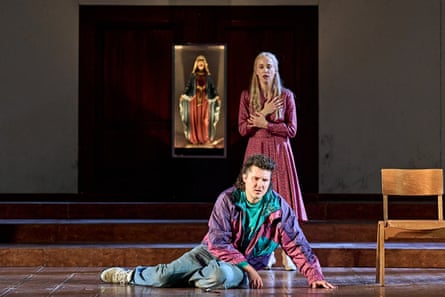
On the surface, Saariaho’s music is impressionistic rather than tightly bound to the dramatic arc but beneath the surface it seethes with colour and original ideas, including an omnipresent sense of the heartbeats of mother and child. In the first act, sinuous woodwind hint at the eastern European setting cocooned in shimmering strings, celesta and tuned percussion. In act two, the music becomes more overtly expressionistic. When it rouses itself, as in the music signifying the rape (intensified here by horns and timpani placed in side boxes), it can be overwhelming.
Annilese Miskimmon’s non-interventionalist staging introduces actors and children to create a sense of community, at first struggling to survive in Rosanna Vize’s bombed-out concert hall, later laying wreaths to commemorate the fallen. Evie Gurney’s 1980s costumes occasionally stray into cliche, but Lee Curran’s atmospheric lighting is highly effective.
André de Ridder is in full command of Saariaho’s substantial forces, balancing the orchestra deftly against the voices, especially the keening and growling wordless offstage chorus that Saariaho asks to be electronically embedded in the mix and served up in atmospheric surround sound.
Mezzo-soprano Kristina Stanek is both visceral and gentle in the title role, ably supported by Lauren Fagan, whose bright soprano and crystalline diction brings her protective sister into sharp focus. Caspar Singh sings well but his Yonas comes across as too old and too physically aggressive. Leigh Melrose brings a frightening complexity to the contemptible Tsorgas.
Adriana Mater may feel a little long, but it’s rare to encounter a work with this kind of emotional clarity coming from a place of such deep compassion.
KioskNews shows a cleaned-up reading view extracted from the publisher’s page — the original always lives on their site, not ours.