Vivian Bercovici: Benjamin Netanyahu will not go quietly after indecisive election
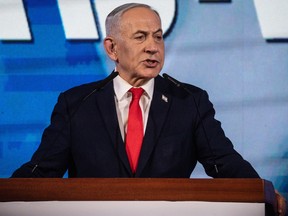
Israel’s much anticipated election results are anything but clear; the political equivalent of a Rohrschach test. One can see what they wish in the results, which will not be final until Friday afternoon, when all votes will be tallied.
Sign In or Create an Account
Meanwhile, both Prime Minister Benjamin Netanyahu and the unofficial leader of the change bloc, Yashar! leader Gadi Eizenkot each claimed to have emerged as the front-runner early Wednesday morning.
A few hours later the sands had shifted, dramatically.

Columnist Jesse Kline keeps you up to date with what’s happening in Israel and the effects of antisemitism on life here in Canada. Friday mornings.
By signing up you consent to receive the above newsletter from Postmedia Network Inc.
A welcome email is on its way. If you don't see it, please check your junk folder.
The next issue of Channel Israel will soon be in your inbox.
We encountered an issue signing you up. Please try again
To reach a majority of 61 Knesset seats always entails the formation of a coalition led by a dominant party, historically the one with the largest number of seats. At the moment that is Netanyahu and his Likud party.
In the coming days, Israeli President Isaac Herzog will meet with each party represented in the new Knesset. They will make their case, either as to why they should lead, or who they would support to head a coalition government. A critical part of this effort requires Herzog to sift through the irreconcilable competing interests of the various parties. It is a challenge demanding Solomonic wisdom and extreme fortitude.
Netanyahu’s Likud faction holds 27 seats. Eizenkot commands 20, as of midday Wednesday, Israel time. The gap between them widened significantly since the earliest reports that were based on exit polls.
And it appears that they were very rough numbers.
Shortly after 1 a.m., Eisenkot took to the stage with unmitigated energy. Jubilation. “We made history,” he told his supporters. “The public voted in favour of change…(and) against Netanyahu’s continued tenure as Prime Minister of Israel.”
Soon after Eisenkot’s remarks, Netanyahu told his supporters that “the right-wing bloc has a clear, strong majority among the Zionist public, the Jewish public, and all those who support the Jewish state.”
Both men were right, then.
Hours later, things look quite different.
Netanyahu leads what has come to be known as the right-wing bloc in the Knesset, which until now included the ultra-orthodox parties. His claim of dominance and clarity is based on the assumption that all parties included in the previous coalition will constitute a part of his bloc going forward. It is a flawed presumption, because the ultra-orthodox are furious with Netanyahu for having failed to pass a law exempting ultra-orthodox men from military or national service. That was their primary reason for supporting his coalition and they have very publicly denounced him as a “liar” who they no longer trust.
What Netanyahu does have, however, is a commanding lead with 27 seats, which is a huge advantage in negotiations.
Eisenkot claimed victory because late Tuesday night, the parties supporting a change government reportedly held more Knesset seats than Netanyahu. When he made his speech, the tally was 52 to 50 for the change bloc.
By Wednesday evening, the situation is proving to be much more fluid with 53 seats for the right and 48 for change.
And the surprise wedge holding the balance of power? Two parties representing the Arab voters — 20 per cent of the Israeli population. They turned out to vote in record numbers — 80 per cent — and were motivated to do so in large part due to what they consider to be the racist tendencies of Netanyahu’s Minister of National Security, Itamar Ben Gvir.
He controlled the Israeli police force and transformed it into an institution that many believe has been soft on a wave of Jewish terrorism in the West Bank, and done nothing to address an alarming crime wave in Israeli Arab cities and towns. The irony of the Arab vote holding the balance of power in this country is not lost on anyone. Nor was the need for disjunctive comic relief.
Just a half hour after the polls closed at 10 p.m. Tuesday and early results were being reported, Israel’s most-watched television station — channel 12 — pivoted to Eretz Nehederet (“My Beautiful Country”). The show is Israel’s Saturday Night Live and it is masterful. For 25 minutes or so they delivered hilarious parodies on the various party leaders and possible outcomes, giving us all a much-needed laugh. At one point in the sketch, the actor playing hardliner Avigdor Lieberman, who insists that he will never sit with a coalition that includes Arab or ultra-orthodox parties, is cuddling up to Mansour Abbas, leader of the Arab Ra’am party.
Lieberman is perceived to be ideologically resolute, while Abbas is generally regarded as being a pragmatic politician who will consider supporting either bloc, with the right terms, of course. In fact, following the closing of the polls, Abbas disclosed that both the Netanyahu and Eisenkot camps had been in contact with him regarding the upcoming negotiations.
The Arab Joint List — an amalgam of several small parties, is projected to win 12 seats. Together, with Abbas’ Ra’am party, Israeli Arabs may soon command 19 seats, an unprecedented game-changer. Due to their make-up of communists and overtly anti-Zionist interests they are a far less palatable option for any coalition to include.
Add to all of the above the fact that there are 650,000 uncounted votes, totalling 15 Knesset seats. Included in this cohort are diplomats, soldiers and reservists, Israelis displaced domestically by October 7 and ensuing conflict, election workers (an astonishing 100,000), police officers, prison employees and others.
What many are seeing in this murky outcome is a need for national unity. Finessing that is somewhat unfathomable, given the conflicting priorities and deep domestic schisms roiling Israel.
A coalition headed by Netanyahu and including change parties led by Eisenkot, former Prime Ministers Naftali Bennett and Ya’ir Lapid comes to 58. After that, it gets very tricky. Each of the smaller parties has set out intransigent conditions. Then again, Israeli politicians have been known to adapt key principles when in exchange for power. Meaning — that nothing should or can be ruled out.
Netanyahu is highly unlikely to submit to the leadership of another. He is already being described as “defiant”, in spite of the indecisive outcome.
Eisenkot is sticking to his assertion that Israel voted for change. Should Netanyahu resist relinquishing power, Eisenkot would demand significant concessions from the prime minister which he would be unlikely to accept.
The scenarios are endless. One example would have Netanyahu revive key elements of the highly controversial judicial reform that set off unprecedented domestic unrest before October 7. For the change bloc, they would have to negotiate some form of State Commission of Inquiry into October 7 that would be less comprehensive than what 71 per cent of Jewish Israelis (and 52 per cent of their Arab compatriots) demand.
Netanyahu is highly unlikely to submit to the authority of an inquiry that he does not control.
It is difficult to see a resounding mandate for anyone in this outcome. Everything will turn on the final tally and subsequent negotiations. Those are the only certainties. Vivian Bercovici is a former Canadian ambassador to Israel.
Join the Conversation
This website uses cookies to personalize your content (including ads), and allows us to analyze our traffic. Read more about cookies here. By continuing to use our site, you agree to our Terms of Use and Privacy Policy.
KioskNews shows a cleaned-up reading view extracted from the publisher’s page — the original always lives on their site, not ours.