Vessel donation to Manila would not harm fishers: OAC
By Esme Yeh / Staff reporter


Ocean Affairs Council (OAC) Minister Kuan Bi-ling (管碧玲) on Wednesday said decommissioned coast guard vessels were given to the Philippines to enhance regional rescue capacity and would not affect Taiwanese fishers’ rights and benefits.
Kuan made the remarks after confirmation on Tuesday that a 500-tonne Coast Guard Administration (CGA) patrol and rescue vessel would be given to the Philippine Coast Guard.
The donation ceremony was reportedly done in Manila, but whether the vessel — previously numbered “CG123” and named Kinmen (金門) — has been handed over has yet to be confirmed.
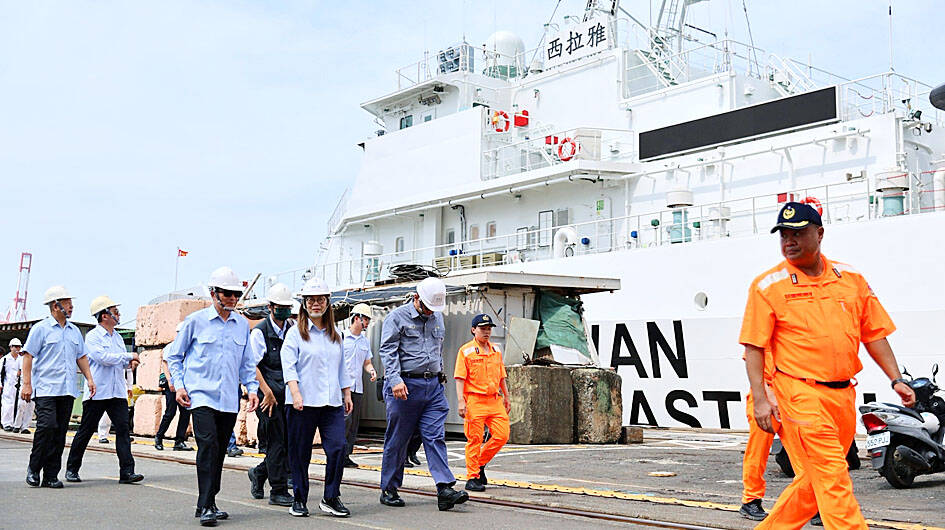
Ocean Affairs Council Minister Kuan Bi-ling, fifth left, inspects the nearly completed high-latitude offshore patrol vessel Siraya on Wednesday.
Photo courtesy of the Ocean Affairs Council
China’s Taiwan Affairs Office (TAO) on Wednesday criticized the donation for “taking the side of the evildoer,” China Central Television reported.
TAO spokesperson Zhu Fenglian (朱鳳蓮) called for cross-strait cooperation on safeguarding territorial sovereignty for “the Chinese nation,” it reported.
Zhu criticized the donation for “increasing the risk of undermining Taiwanese fishermen’s rights and benefits,” as the Philippines and Japan had initiated maritime boundary negotiations involving waters east of Taiwan proper, it added.
Kuan on Wednesday in a Facebook post said the donation aimed to boost regional rescue capacity and maritime safety.
Taiwan has the right to cooperate with nearby countries and dismisses Beijing’s uninvited opinions, she said.
CGA authorities have long supported local fishery workers’ operations, Kuan said.
That included expelling Chinese vessels that trespass into Taiwanese waters, delivering life-saving medicines to fishers in distant waters, and helping with marine emergencies such as fishing boat grounding, fires on the ship or crew members overboard, she said.
Neighboring countries could more promptly help rescue a Taiwanese boat that encounters danger within their rescue zone if they are equipped with better vessels and rescue capabilities, Kuan said.
International maritime search and rescue is mutual assistance as well as a humanitarian action, Kuan said, adding that to boost a neighboring country’s rescue capacity would enhance Taiwanese fishers’ safety.
To establish a transparent, reliable regional maritime order, Taiwan has signed the Taiwan-Japan Fisheries Agreement, as well as the Agreement Concerning the Facilitation of Cooperation on Law Enforcement in Fisheries Matters with the Philippines, she said.
In contrast, China constitutes a more urgent risk to Taiwan’s fishers, Kuan said.
It arbitrarily conducts military drills around Taiwan, approaches and inspects Taiwanese vessels for so-called law enforcement, and detains Taiwanese boats and fishers for long periods without a transparent handling process, she said.
The donation’s agreements specify that the vessel must not be used in law enforcement against Taiwanese fishing boats, Kuan added.
KioskNews shows a cleaned-up reading view extracted from the publisher’s page — the original always lives on their site, not ours.