Kieron Dyer making waves at Southend after leaving ‘hooligan’ days and ‘deathbed’ behind

Kieron Dyer is recounting a tale from his time in Japan at the 2002 World Cup. “You have a lot of time on your hands,” he begins from behind his desk at Southend United’s training ground.
Dyer, a chess fan, was looking for an opponent in the England squad. “Sol Campbell was a deep thinker, and I asked if he played. He said yes, and I told him I’d pummel him. I’m not joking, we played for an hour and he’d moved two pieces. If that was how much he was thinking so early …” Dyer belly laughs. “I was like: ‘Sol, I’m not sitting here for five hours playing chess with you, mate!’”
Dyer admits he lost to Campbell by default. He then speaks proudly of his youth playing chess at school, at Boys’ Brigade and for Suffolk: “The only person I couldn’t beat was Mr Sharples – if you’re reading, I want a rematch.” His rating on Chess.com – the app “everyone who plays is on” – is an impressive 1380 and he is trying to find Arsenal’s Eberechi Eze on it.
Chess is an unexpected passion, another layer peeled back and more proof that public perception and real-life personality can be far removed. Young Dyer had a well-earned reputation for being party-prone, hitting headlines for, among other things, holidaying in Ayia Napa and high-stakes gambling on England trips.
“Twenty-year-old Kieron Dyer was a hooligan. Let’s not get it wrong,” he says in a brutally honest self-appraisal. But he always ignored the external noise. “If the people who know you know that you’ve got a kind heart and spirit, that’s all it needs.”
Dyer’s chess aptitude and the pleasure he takes from thinking in patterns, tactical tweaks and in-game judgment calls are good indications as to why he, aged 47, has made his foray into management.
He began coaching soon after retiring in 2013, first with Ipswich’s academy and under-23 teams, then on Paul Cook’s first team staff at Chesterfield. The top job had not been on his radar, but last season he found himself clashing, in a loving way, with Cook, who encouraged him to test the water.
Dyer’s tenure has begun swimmingly, one defeat in nine leaving Southend second in the National League. The aim, with the club financially stable two years after Justin Rees’s consortium completed its takeover, is a Football League return.
Guardian Sport’s conversation with Dyer is politely interrupted by regular door knocks. His squad must complete an online wellness check on waking and are required to report to Southend’s management office by 9am to sign in. Tardiness is not tolerated.
“If you’re late for a meeting, you don’t come into the meeting,” Dyer says. “And if you’re late for training you go home. A £10 or £20 fine doesn’t mean anything – it has to hurt.” It is a tactic he has borrowed from his former teammate Craig Bellamy, who himself took it from Vincent Kompany. “I always say coaches are thieves. You steal things from other people that fit how you want to build your culture.”
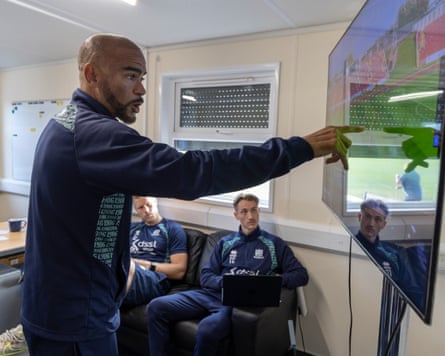
At 8.15am the small office Dyer shares with his assistant Adem Atay is packed with seven staff. The mood is jovial; rewatching clips from the weekend’s 6-1 win at Gateshead makes happy viewing.
“I’m watching Real Madrid here,” Dyer jokes before purring at Southend’s fourth goal. Particular pleasure is taken in a freeze frame showing five of his players in the penalty area and two more lurking outside it.
Suddenly Dyer lunges at the screen, gesticulating wildly. “Complete the run. Don’t stop. You’re stretching them,” he bellows. He knows the run was not completed but his appetite for improvement is obvious.
Yet he is also aware just how difficult a game football is. Perfection is impossible, and in a later team meeting he tells his squad to ignore external mutterings that, having been six up at half-time, they should have scored more. Dyer knows maintaining intensity in such games is tough, particularly at the back end of a three-game week involving 1,200 miles on a coach. “No negatives from the game,” he concludes.
The Gateshead trip returned Dyer to Newcastle, whom he joined for £6m in 1999. Leaving for West Ham eight years later, he had won 32 of his 33 England caps and played in the Champions League. He had also fought with his teammate Lee Bowyer on the St James’ Park pitch, nearly retired out of frustration at a misdiagnosed hamstring injury, and been turned upon by supporters for supposedly refusing to play on the right for Sir Bobby Robson at Middlesbrough in 2004. Robson was sacked shortly after.
“A lot of people don’t realise our relationship was more than a manager and player,” he says of Robson. “Honestly, it was like father and son. We used to bicker at each other, hug each other, kiss each other.”
after newsletter promotion
The reality of what was portrayed as a major fall-out was more nuanced. Dyer had seen others push back on playing out of position and get their way: “Because of what happened to me as a kid I was thinking: ‘I won’t be taken advantage of.’”
Dyer is referring to being sexually abused by his now deceased great-uncle Kenny during his pre-teens, something he wrote candidly about in his autobiography, Old Too Soon, Smart Too Late.
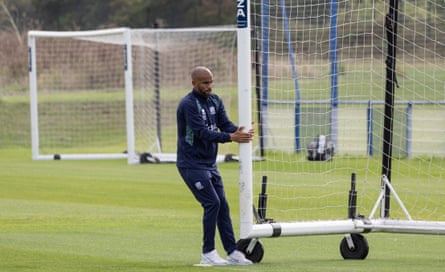
With training approaching, Dyer is outside on his own, wheeling goalframes into position, meticulously placing discs on the grass. He enjoys the solitude, describing himself as “very guarded”. Atay, who worked with Dyer at Ipswich, confirms that on their shared car journeys one of them drives while the other sleeps. Dyer says: “I’m just: football club, home. I don’t go out; I don’t really have a life outside of football. I’m happy with it.”
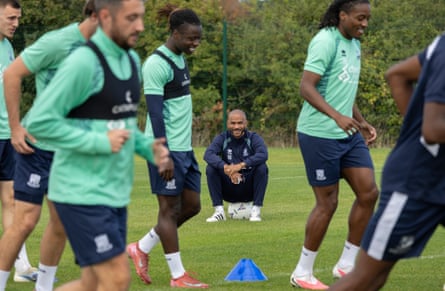
And yet, once the session begins, introverted Dyer becomes extroverted Dyer. He enthusiastically explains a trio of complex drills, splitting 24 players into six teams. He encourages; he admonishes; he joins in.
The electric pace may be long gone – Dyer has so much metal in his legs that for a time he carried his own X-rays to speed up his passage through airport security – but the touch and deftness of pass remain.
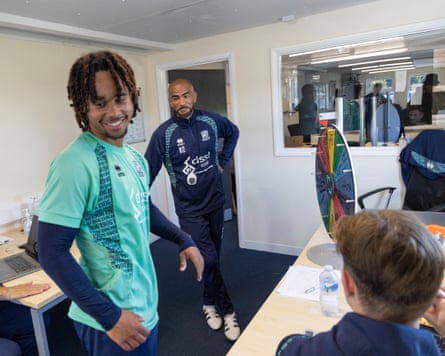
Post-training the losing team must spin a wheel of misfortune; punishments include burpees, collecting equipment and a week without pool and darts. “That one devastates them,” Dyer says. “I particularly enjoy it when they have to make the staff hot chocolate.”
Dyer’s day is thereafter peppered with meetings, phone calls and planning. He still speaks regularly to Cook and turns for advice to people such as the former England caretaker manager Peter Taylor, a frequent visitor to training, Bellamy and Tony Mowbray.
He can draw on myriad experiences, within and outside the game, too, most recently life-saving surgery. In 2015 Dyer was diagnosed with primary sclerosing cholangitis. By 2023 he required a liver transplant. During an overnight stay in a Chesterfield hotel, Dyer woke in agony and went by taxi to Addenbrooke’s hospital in Cambridge, 130 miles away. Three months later he was still waiting. “That was mentally challenging,” he says. “They sent me home for my own sanity.”
Within two days Dyer was recalled for surgery, the operation taking place three years ago last Saturday. “Being on your deathbed certainly humbles you,” Dyer says. “Not many people get second chances.”
KioskNews shows a cleaned-up reading view extracted from the publisher’s page — the original always lives on their site, not ours.