Why Taste, worth Rs 15,000, is more than just a coffee table book

In India, Rs 15,000 can buy a decent phone, a weekend in Goa, or a box set of two volumes of cultural criticism that takes the reader down a rabbit hole, a literary Russian nesting doll.
Inside Taste, edited by journalist Lakshmi Chaudhry, CEO of Splainer Media and co-founder of Firstpost, one finds essays on the politics of taste but also pages that unfold sideways or upwards into larger-than-life Bollywood posters, maps, postcards from a bygone world, and a sleeve of coloured lenses.
Graphic designer Kriti Monga designed the first volume; designer Tania Singh Khosla and her studio, TSK Design, designed the second.
Who determines taste
Dismissing Taste as a coffee-table book that happens to contain essays would be a mistake. It is a book about who gets to exercise cultural judgement and who is denied it.
The first volume opens with ‘Immortal Beloveds’ by Srinath Perur—author of the travelogue If It’s Monday It Must Be Madurai—a joyful account of Boney M’s Indian afterlife.
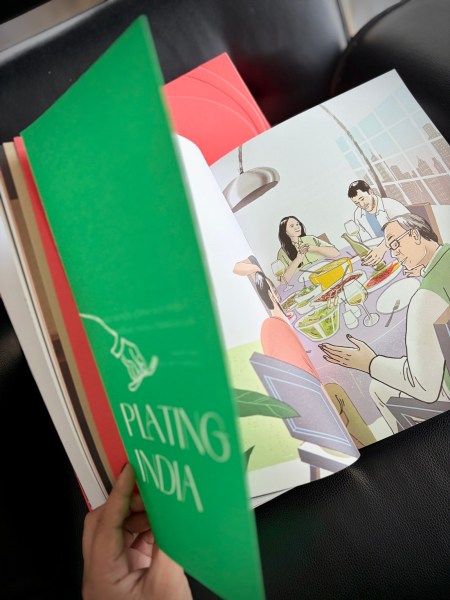 Abhijit Banerjee and chefs Garima Arora, Manu Chandra, Prateek Sadhu and Thomas Zacharias, reimagined at one table for the book’s “Plating India” conversation. (Illustration: Jasjot Singh Hans/Juggernaut)
Nobel laureate economist Abhijit Banerjee hosts a roundtable on the homogenisation of Indian food and the loss of regional traditions with four chefs: Garima Arora of the Michelin-starred Gaa in Bangkok, Bengaluru restaurateur Manu Chandra, Prateek Sadhu of Masque and Naar and Thomas Zacharias, founder of The Locavore.
Novelist and essayist Aatish Taseer dissects the death of the Delhi drawing room and the rise of the “Antilia effect”, a hotel-like luxury that severs the bond between a person and their home. Simran Lal, co-founder of the lifestyle brand Nicobar, writes an unexpectedly moving ode to the spittoon, an object “meant for bodily waste” that Indian artisans turned into a canvas for “creativity, innovation and aesthetic refinement.”
Story continues below this ad
Artist Subodh Gupta offers a visceral meditation on cow dung. His mother asked him to fetch it for daily rituals, and it was “sacred: used to cleanse our home, cook our food, anchor our prayers.”
Novelist Meenakshi Reddy Madhavan’s ‘The Solo Traveller’ is a wry account of a DDLJ-themed bus tour through Switzerland, where the Alps become a pilgrimage for Bollywood fans. Photographer Sujata Setia, whose project ‘A Thousand Cuts’ examines domestic abuse, asks why art made from the survivor’s gaze is deemed unpalatable by the market.
MacArthur-winning artist Shahzia Sikander recounts the beheading of her sculpture ‘Witness’ at the University of Houston, calling it “tasteless moral theatre.” Conceptual artist Mithu Sen takes her title from pao bhaji, and uses it to question highbrow taste itself.
Vivek Shanbhag, the Kannada writer behind Ghachar Ghochar, and The New Yorker critic Parul Sehgal discuss how translation works and how a new tongue alters who we are.
Story continues below this ad
The volume closes with ‘The Taste Keepers’, a witty take on the Bengali bhadralok by journalist and novelist Sandip Roy, and ‘Scarcity in India’ by Pakistani-American painter Salman Toor.
Chaudhry calls it a rebellion against the “benevolent aristocracy of algorithms.” In our techno-democracy of likes and shares, judgment has been replaced by the anodyne language of “preferences.”
A sensory feast
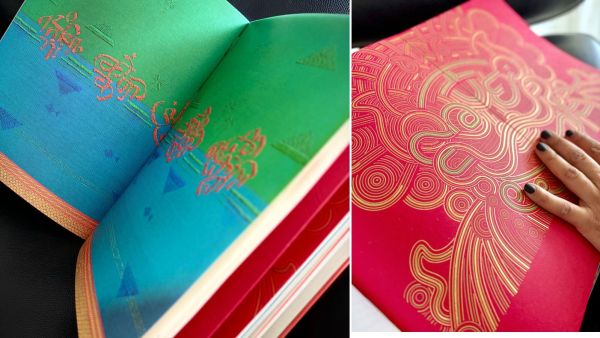 Reading Taste is a tactile texperience. (Photo; Juggernaut)
The second volume, ‘Time + Space’, turns the book into a sensory feast. It traces the global, often violent, histories of four motifs: the Pineapple, Madras Checks, the Cummerbund, and Bandhani. Pockets hold coloured lenses that reveal different chapters of the Madras checks story: a lungi, a traditional Igbo dress, Caribbean headwraps, and Ivy style. Double-sided foldouts echo the form of a waistband.
Original artworks combine charcoal, oil paint, and tie-dye. Vintage textile labels, maps and archival photographs are pasted, stitched, and foiled into a visual journey larger than its parts.
Story continues below this ad
In Georgian England, the pineapple would sit on the table as a status symbol until it began to rot, because “it’d be like eating a Gucci handbag,” as food historian Francesca Beauman puts it. The rotting pineapple is the perfect metaphor for the book’s central argument.
Chaudhry is a veteran journalist who cut her teeth at Wired during the dot-com boom and later covered the Obama campaign as a political writer. She says a heart attack, followed closely by a divorce settlement, forced her to reckon with a career spent in the churn of daily news.
Art for the sake of art
“Journalism has sort of collapsed because there’s no real financial model,” she says. “I just wanted to see what would happen if you decided to make something of extremely high quality, and say it’s okay if it doesn’t sell.”
The book cost Rs 50 lakh to produce. This tactile, analogue extravagance makes Taste a manifesto for print, one that’s “only possible on paper.” The anthology critiques the “Antilia effect” while being a luxurious, limited-edition artefact itself, with only 500 numbered copies, priced at Rs 15,000.
Story continues below this ad
“We’re not even covering a third of the cost,” Chaudhry counters. To bridge the gap, she has donated display copies to public spaces, bookstores, and galleries. “Every person who has a copy then has 15 people who get to see that book, engage with it, and encounter it,” she says.
The reception has been as multifaceted. Some readers treat it purely as an art object. Others complain that the visual “noise” overshadows the serious writing. But the praise has been formidable, including a letter from Congress leader Sonia Gandhi and an email from travel writer Pico Iyer.
As Chaudhry writes, taste is “above all sensual. It is to be held, seen, touched—much as this book.” Taste mocks our colonial hangover and our slavish devotion to Western models even as it revels in the glittering beauty of it all.
KioskNews shows a cleaned-up reading view extracted from the publisher’s page — the original always lives on their site, not ours.