Trump is fueling a culture of misogynistic impunity
Allegations against seven men at Cornell University come amid a climate of belligerent sexism
By Robert Reich / The Guardian


Last month, a young woman filed a lawsuit against Cornell University, alleging that two years ago the university had failed to protect her from being raped by seven men at a fraternity house near the university campus. She also sued the fraternity.
The lawsuit has plunged the university into a crisis and invited criticism of the district attorney, Matthew Van Houten, who decided there was not enough evidence to bring criminal charges against the seven men.
At this point, we can only guess why neither Cornell nor Van Houten did more in response to the young woman’s allegations. But there is little question that we are living through a time when men feel some impunity when it comes to attacking women.
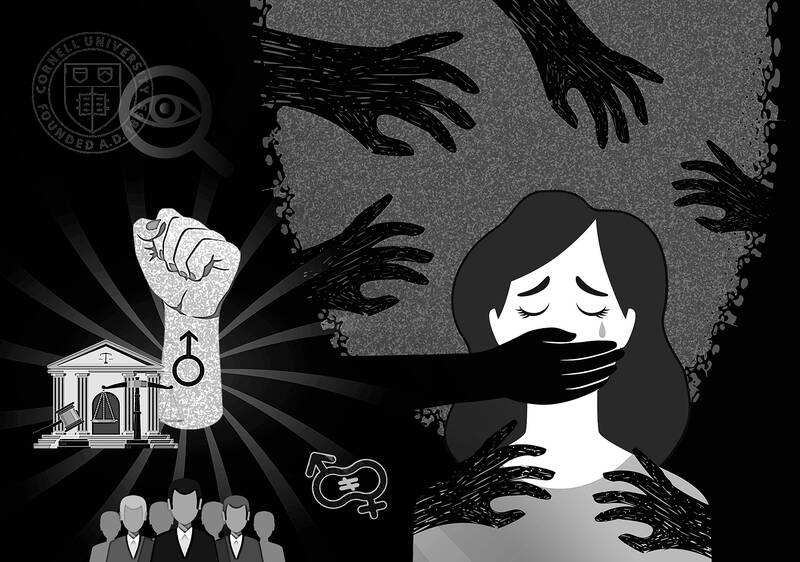
Illustration: Louise Ting
Violence against women is hardly new. Nor is the impunity that some men feel in attacking them.
However, the man now occupying the White House has contributed to a lower and more dangerous standard for what men can do to women with impunity.
US President Donald Trump was found in civil court to have sexually abused the writer E. Jean Carroll. He has repeatedly insulted the physical appearance of female journalists, politicians and public figures. He was caught on a hot microphone boasting about using his fame to forcefully kiss and grope women without consent, stating that being a star allows men to “do anything” and “grab ’em by the pussy.”
When women have spoken out against him, Trump has resorted to smear campaigns, as he did with Carroll, Stormy Daniels and former US secretary of state Hillary Rodham Clinton. When women have stood up to him, he has exploded in anger against them, as he did with Fox News anchor Megyn Kelly, TV talk-show host Rosie O’Donnell, former US vice president Kamala Harris and US Representative Alexandria Ocasio-Cortez.
His administration is the most belligerently misogynistic of any in memory. It has openly equated testosterone levels to strength, conducted a cage match on the White House lawn as part of its celebration of the US’ 250th anniversary, fired senior female officials, and accused the Democratic party of being run by “a bunch of childless cat ladies.”
Nor do I think it irrelevant that Trump, US Vice President J.D. Vance and Trump’s erstwhile pal Elon Musk inhabit what has been termed the “manosphere” — a place where the main events are dominance and submission. The whole point is to humiliate weak men and to subjugate women.
An implicit promise of the 2024 Trump campaign was to restore patriarchy to the US. Fifty-four percent of men supported Trump in that year’s election.
After Trump’s re-election, sexist and abusive attacks on women — such as “your body, my choice” and “get back in the kitchen” — surged across social media, according to an analysis from the Institute for Strategic Dialogue.
A remarkable number of Trump’s cronies are sexual harassers and predators. Trump was introduced at the Republican national convention by Ultimate Fighting Championship chief executive Dana White, who was once caught on tape slapping his wife in a nightclub.
Vance has claimed men in the US are “suppressed” in their masculinity.
Before becoming Trump’s defense secretary, Pete Hegseth paid off a woman who accused him of sexual assault. (Hegseth’s own mother accused him of abusing women, though she later disavowed her words. He has denied the claims.) And as secretary, Hegseth has championed “high-T” men and blocked promotions of female officers.
One of Musk’s companies, SpaceX, reportedly paid US$250,000 to a flight attendant who said Musk had exposed himself to her, though he denies the allegation. In a lawsuit filed last year, former employees accused him of “treating women as sexual objects to be evaluated on their bra size.”
After kissing Trump’s derriere, Mark Zuckerberg, the third-richest person in the US, called for more “masculine energy” because the corporate world was becoming “culturally neutered”. He told podcaster Joe Rogan: “Having a culture that celebrates the aggression a bit more has its own merits that are really positive.”
The Trump regime celebrated toxic masculinity by smoothing the way for Andrew and Tristan Tate to be released from Romania to the US. The Tate brothers had been accused of luring women to Romania and then forcing them to work as pornographic webcam performers. Britain is also investigating the Tate brothers for rape and human trafficking. US marshals arrested the Tate brothers in Miami on 18 July, following an extradition request from the UK. They have denied all charges.)
“I’m a Trump fan because I’m a man,” Tate has said. “You have to support Trump if you’re a man.”
Trump’s authoritarian manosphere is organized around a hierarchy topped by heroic male warriors. Winning is all about getting other males to submit to the dominant male. Women are relegated to subservient roles.
Anything that challenges the traditional heroic male roles of protector, provider and controller of the family is considered a threat to the social order. LGBTQ+ people are believed to weaken the heroic male. Hence, Trump’s executive order declaring that the US government will recognize only a person’s sex assigned at birth, limit the definition of a “male” or “female” to their reproductive cells, and potentially withhold federal funding from programs that acknowledge transgender people or “gender ideology”.
I do not want to oversimplify a complex social phenomenon or engage in the same kind of gender stereotypes that the manosphere promotes. Male domination is hardly the only characteristic that unites Trump, Vance, Hegseth, Kennedy, Musk and the tech bros. Misogyny is not unique to authoritarian men.
Nor do I presume to know what happened at the Cornell fraternity house two years ago. But I do not think it unreasonable to see it related to a climate of distrust bordering on hate, fostered by Trump and his administration against people who seem weak or feminine.
Robert Reich, a former US secretary of labor, is a professor of public policy emeritus at the University of California, Berkeley. He is a Guardian US columnist and his newsletter is at robertreich.substack.com. His new book, Coming Up Short: A Memoir of My America, is out now in the US and in the UK.
KioskNews shows a cleaned-up reading view extracted from the publisher’s page — the original always lives on their site, not ours.