International student numbers in Korea top 300,000 as share from China shrinks
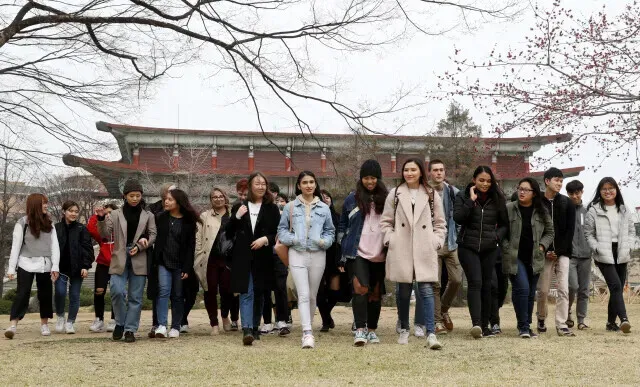
International students at Sejong University walk through the school’s campus in Seoul’s Gunja neighborhood. (Hankyoreh file photo)
The number of international students in South Korea has passed 300,000 this year, with students from Vietnam, Uzbekistan, Mongolia, Nepal and elsewhere filling a growing share of the seats once dominated by students from China. The share of international students dropping out before finishing their studies has also fallen over the past two years.
According to a data brief published Sunday by the Korean Educational Development Institute (KEDI), there are roughly 307,000 international students in the country this year. That figure includes graduate students and those enrolled in nondegree programs such as Korean language courses.
At four-year universities and junior colleges, the number of international students nearly doubled from 96,258 in 2017 to 190,737 in 2025. Enrollment at four-year institutions, which include general and industrial universities, rose 70.4% over that period, from 90,095 to 153,477. At junior colleges, it grew more than sixfold, from 6,163 to 37,260.
The makeup of that student body has changed considerably. Chinese nationals accounted for 59.9% of international students at four-year universities in 2017 (53,943 students), but only 29.2% (44,804) last year. Over the same period, the share of Vietnamese students climbed from 10.9% (9,856) to 28.7% (44,082), nearly drawing level with China.
More students are also arriving from elsewhere in Asia. Students from Uzbekistan, Mongolia, Nepal and Myanmar made up 20.8% of international students at four-year universities last year, up from 6.4% in 2017. Nepali enrollment grew especially quickly, rising nearly fivefold in just two years, from 1,786 in 2023 to 8,879 in 2025.
The shift has been even more dramatic at junior colleges. The number of Vietnamese students there jumped from 2,766 in 2017 to 22,342 last year, raising their share from 44.9% to 60%. The share of Chinese students, meanwhile, plunged from 34.4% (2,121 students) to 2.6% (983).
Fewer international students are leaving school without finishing. At four-year universities, the share of international students who dropped out — whether by withdrawing, failing to register or failing to return from a leave of absence — fell from 6.85% in 2023 to 5.6% last year. At junior colleges, the rate fell from 10.02% to 7.23% over the same period.
KEDI attributed the decline to several factors: government monitoring of illegal overstay and dropout rates through the International Education Quality Assurance System, visa restrictions on underperforming universities, and on-campus support such as Korean language instruction, help with daily life and career counseling.
The picture varied by region, however. At four-year universities in the Seoul metropolitan area, the dropout rate among international students rose from 5.7% in 2024 to 6.2% last year. Among junior colleges, those in the Gangwon region stood out: their dropout rate fell from 25.2% in 2023 to 19.5% last year but remained high compared with the rest of the country.
“Dependence on Chinese students has declined, but with the top three countries still accounting for more than 60% [of international students], reliance on particular countries needs to be eased,” KEDI said. The institute also called for stronger support to keep students enrolled in areas with high dropout rates, tailored to local conditions at four-year universities in the Seoul metropolitan area and junior colleges in Gangwon.
KioskNews shows a cleaned-up reading view extracted from the publisher’s page — the original always lives on their site, not ours.