Xi’s narrative of WWII obscures the ROC’s role
When Chinese President Xi Jinping (習近平) discussed US-China cooperation during World War II (WWII) at a White House state dinner on Thursday last week, he left out a name central to that history: the Republic of China (ROC).
“Over 80 years ago, the Chinese and American people stood shoulder to shoulder in a fight against Japanese militarist aggressors,” Xi said at the dinner hosted by US President Donald Trump.
China did fight alongside the US, but its government at the time was the ROC, now based in Taiwan. The People’s Republic of China (PRC) was founded in 1949, four years after the war ended.
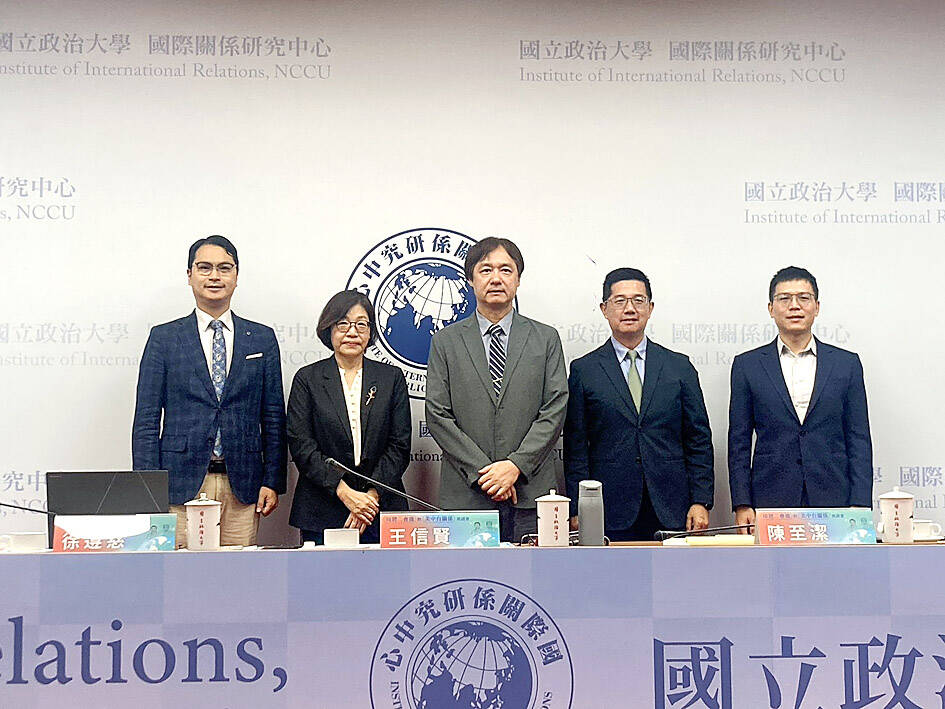
National Chengchi University Institute of International Relations director Wang Hsin-hsien, center, pose for a photograph with other experts attending a seminar in Taipei yesterday.
Photo: Yang Mien-chieh, Taipei Times
Leaving the ROC unnamed was likely aimed at helping Beijing portray the wartime alliance as part of the PRC’s own history, Taiwanese academics said yesterday at a forum in Taipei on the summit.
Wang Hsin-hsien (王信賢), director of National Chengchi University’s Institute of International Relations, said Xi stood to gain if the alliance came to be remembered simply as one between “China” and the US.
Repeated use of such language by Washington could make “the erasure of the Republic of China ... very apparent,” Wang said.
The White House’s own fact sheet, issued on Friday, also referred simply to “China.”
“The two leaders recalled that United States and China were allies in World War II and fought side by side to win the war,” it said, without identifying the ROC.
The US’ de facto embassy in Taiwan was more specific when in a post in September last year commemorating the war’s end, American Institute in Taiwan Director Raymond Greene referenced the First American Volunteer Group, nicknamed the “Flying Tigers,” who fought alongside the ROC Air Force.
The Mainland Affairs Council on Friday protested Xi’s remarks, saying they did not reflect that it was the ROC that fought alongside the US.
Institute for National Policy Research vice president Kuo Yu-jen (郭育仁) on Saturday said that Xi’s comments had two goals.
One of them was to “suggest that the Republic of China has completely disappeared and been replaced by the People’s Republic of China,” he said.
The other was for Xi to highlight Japanese wartime militarism through his reference to fighting “Japanese militarist aggressors” amid strained China-Japan relations.
He linked it to Tokyo’s campaign for a permanent UN Security Council seat and its call to remove the UN Charter’s “enemy state” clauses, which refer to countries that fought against the charter’s signatories during WWII.
Days before Xi’s remarks, Japanese Prime Minister Sanae Takaichi called for those clauses to be remove in a UN General Assembly address that also urged Security Council reform.
Tzeng Wei-feng (曾偉?), an associate research fellow at the National Chengchi University’s Institute of International Relations, said that despite the WWII remarks, he saw no clear sign that the visit had immediately changed Washington’s Taiwan policy.
However, he said he was concerned how language used in prominent diplomatic settings could spread and endure.
He pointed to the 1972 Shanghai Communique, in which the US “acknowledged” that people on both sides of the Taiwan Strait maintained there was one China and that Taiwan was part of China.
Beijing’s later portrayal of that wording as US “recognition” of its position showed how an interpretation of diplomatic language could spread and endure, Tseng said.
“Xi isn’t saying this just for Trump to hear,” he said. “He’s saying it for the whole world to hear.”
KioskNews shows a cleaned-up reading view extracted from the publisher’s page — the original always lives on their site, not ours.