Former NFL star calls out Cowboys for controversial two-point decision in fourth quarter: "Wasn't smart'
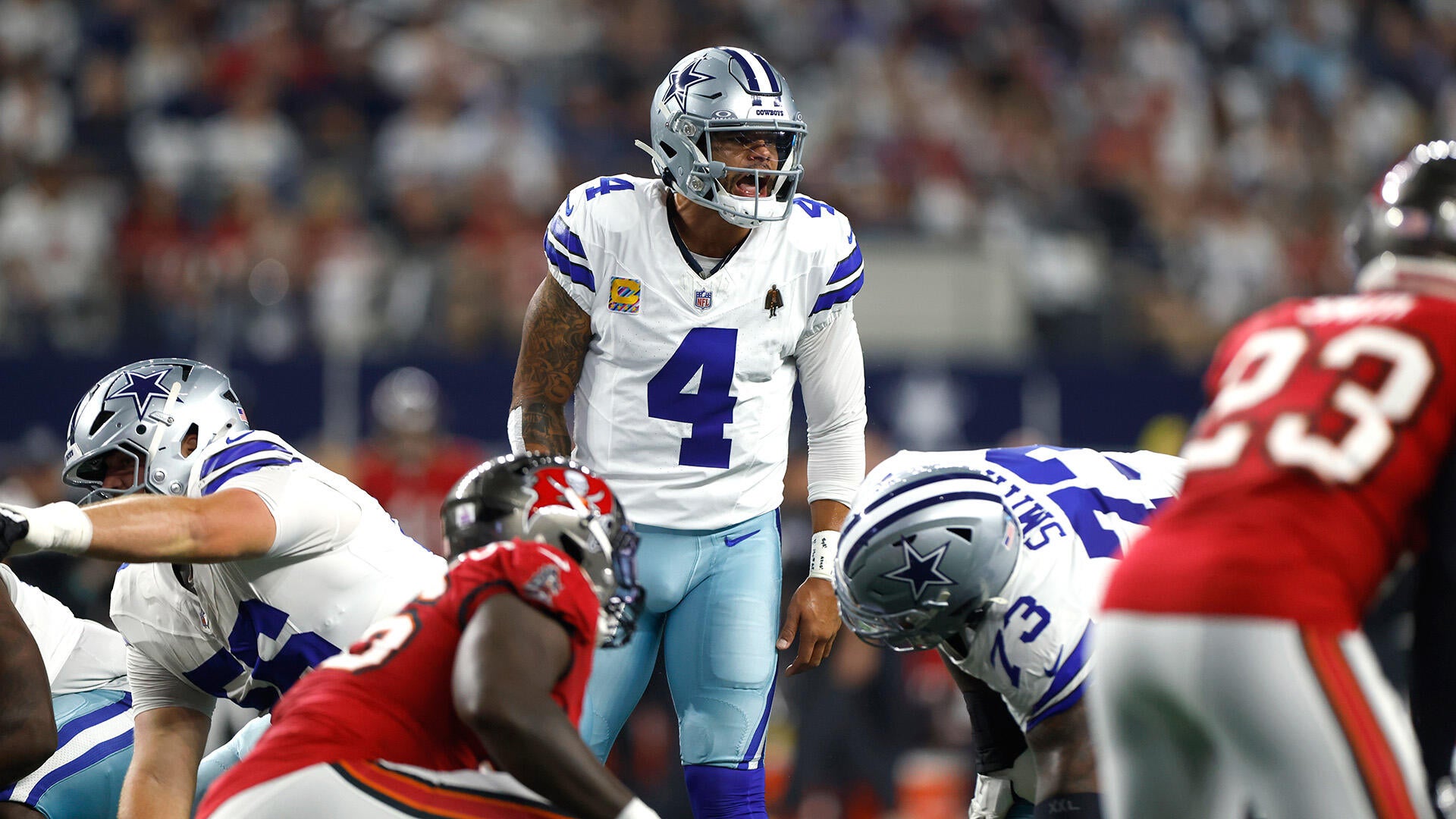
Dez Bryant didn't like Dallas' call to go for two, and he may have been right

• 5 min read
Former Cowboys star Dez Bryant isn't a fan of analytics, at least not when it pertains to one specific scenario, and that exact situation came up during Dallas' stunning 24-16 loss to the Tampa Bay Buccaneers on Thursday night.
With the Cowboys trailing 24-10 in the fourth quarter, Dak Prescott engineered a 99-yard drive that culminated with an 18-yard touchdown pass to George Pickens. After the score, Cowboys coach Brian Schottenheimer decided to go for two, but the Cowboys came up short.
Bryant shared his thoughts about the decision on social media, and he definitely didn't agree with Schottenheimer's choice to bypass an easy extra point.
Dez better get used to the idea of the Cowboys doing this, because if this same situation comes up in the future, Dallas will definitely be going for two, and Schottenheimer made that clear after the game.
"That's our philosophy," Schottenheimer said via Patrik Walker of the team's official website. "When you're down 14, especially with our offense, because when you get it, you have a chance to go and win the game, and you make it a six-point game."
Bryant was clearly frustrated with the call, but Schottenheimer's decision came down to numbers, so let's break down both sides of the coin.
Why the Cowboys went for two
This all comes down to analytics. The math says it makes more sense to go for two when you score a touchdown while trailing by 14. The main reason teams do this is so they know what they need to get sooner rather than later.
A two-point conversion has about a 50% chance of success if you look at the historical rate, while an extra point has about a 97% success rate. Since the Cowboys needed two scores to tie or take the lead, Schottenheimer had to plan ahead and decide what the team would do after each touchdown.
With that in mind, he essentially had two options (this all assumes the game played out similarly to Thursday, with the Cowboys defense not giving up any more points):
1. Kick the extra point after each touchdown
2. Go for two after the first touchdown, and the result of that attempt would determine what the team would do on the second touchdown. If you convert the two-pointer, you kick the extra point on the second attempt. If you fail on the two-pointer, then you have to attempt a two-point conversion on your second attempt.
If you go with option 1, that guarantees overtime. If you go with option 2, you have a chance to win in regulation. For the Cowboys specifically, option 2 likely had some appeal because the Bucs had been steamrolling their defense all night. If the Cowboys had converted the two-pointer, then Dallas' defense would have only had to make one more stop to give the Cowboys a chance to win the game.
Now, let's run through all the numbers on the two-point decision:
- Two-pointer is successful on first TD plus a kicked extra point on second TD = 48.5% (In this scenario, you win in regulation)
- Two-pointer fails on first TD, second two-pointer is successful = 25% (In this scenario, the game goes to overtime)
- Two-pointer fails on first TD AND second TD = 25% (In this scenario, you lose)
- Successful extra point on both touchdowns = 94.1% (In this scenario, the game goes to overtime)
If you kick two extra points, there's no scenario where you win in regulation, and that's part of the allure of the two-pointer. If you make the first one, you put your team in an advantageous situation, and that's what Schottenheimer was trying to do.
Why Dez didn't like the decision, and why he might be right
After the game was over, Bryant offered a longer explanation for why he didn't like the two-point decision, and considering this take is coming from a former player, it's certainly worth listening to.
"I don't care if we got the 2, I still think that wasn't a smart decision," Bryant wrote. "Knowing you're down 7 vs. down 8 makes a difference."
Basically, there's a psychological aspect of the decision that the math doesn't account for. A player's mentality changes based on the score, especially late in the game. If you watch a highlight of the Cowboys' two-point attempt, Dak Prescott and several other players walked off the field with a dejected look after the conversion failed. This team just drove 99 yards for a huge touchdown, but it felt like they lost momentum after the failed two-point conversion.
Not only is there a psychological aspect to consider, but there's also the overtime aspect. In general, teams want to win in regulation because, in the past, overtime would essentially come down to a coin flip. If you won the coin toss, you got the ball, and you could go down and win the game with a touchdown. However, with the new overtime rules, both teams are guaranteed a possession, so if you force overtime, you know your best unit — in Dallas' case, that would be the offense — will get to see the field at least once.
The time left in the game should also play into a coach's consideration. If the Cowboys had scored with 2:30 left, it probably wouldn't make sense to go for two, because if you fail, you're now in a situation where you might need TWO more possessions to win, which is what would happen if you also failed on the second two-pointer. In that situation, your opponent would get two possessions, and they would be able to burn off a minimum of two minutes without getting a single first down.
Also, if you miss the first two-point conversion, you're down eight, which means you have to score quickly, because you have to leave yourself some time in case you miss the second two-point conversion. And if you do miss, then your defense has to make ANOTHER stop.
I get the math of going for two in the Cowboys' situation, but this shouldn't be an automatic play. As Bryant pointed out, there are other factors at play besides the raw numbers, so teams should probably make case-by-case decisions rather than make it their "philosophy."
KioskNews shows a cleaned-up reading view extracted from the publisher’s page — the original always lives on their site, not ours.