US, Myanmar hold more talks: sources
TOKYO: The US outreach to the military-backed regime is a sharp reversal from its stance since the 2021 coup, with the talks focused on scam hubs and rare earths
Reuters, WASHINGTON and TOKYO


The US and Myanmar’s military-backed government held talks in Tokyo last week, people familiar with the matter said, their second meeting in a month as Washington steps up re-engagement with the generals it shunned after their 2021 coup.
Earlier talks in Myanmar’s capital, Naypyidaw, in the middle of last month focused on securing the release of a US businessman and shutting down scam centers that target Americans, but could pave the way for broader discussions, including on Myanmar’s rare earth mineral deposits, Reuters previously reported.
It was not immediately clear exactly what the two sides discussed at last week’s talks, disclosed to Reuters by three people with knowledge of the engagement. The people, including one US official, all requested anonymity because of the sensitivity of the meeting.
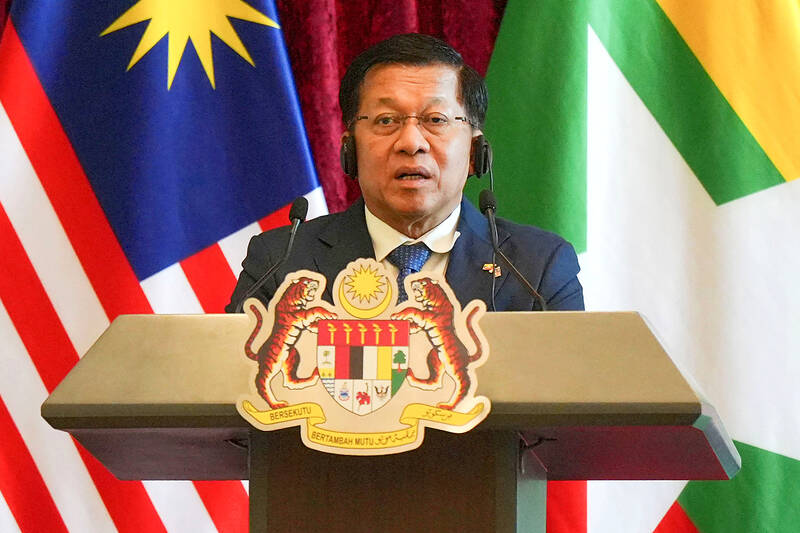
Burmese President Min Aung Hlaing speaks during a joint press conference with Malaysian Prime Minister Anwar Ibrahim, not pictured, following their meeting in Putrajaya, Malaysia, on Thursday last week.
Photo: AFP
US Assistant Secretary of State for Intelligence and Research Michael Vance again led the Tokyo talks, which involved more than a dozen US officials, one of the people said. Reuters could not establish who represented Myanmar.
The US Department of State did not respond to a request for comment on the latest talks, but says it engages with all groups in Myanmar on issues affecting US interests. A spokesperson for the junta did not respond to a request for comment.
Asked about its role in hosting the talks, the Japanese Ministry of Foreign Affairs said in an e-mailed statement it had been “communicating as necessary” with both sides, but declined to comment on specific diplomatic exchanges.
Last month’s meeting in Naypyidaw between Vance and Myanmar’s coup leader-turned-president, Min Aung Hlaing, provided an opening for broader discussions, people familiar with those talks previously said. The quick return to the negotiating table in Tokyo suggests both sides are keen to keep the dialogue going.
A major focus of the US push is securing Myanmar’s help in shutting down scam hubs that run romance and other frauds and have swindled Americans out of billions of dollars, the people said.
Researchers say many scam operations are based in areas controlled by army-backed militia, with some proceeds flowing to the military, raising doubts about whether the Burmese leaders are serious about enforcement. The junta has said it is participating in a multinational effort to curb scam centers.
US officials have also discussed access to Myanmar’s large deposits of heavy rare earths, which are used in products ranging from electric vehicles to wind turbines. US officials acknowledge significant obstacles: The deposits are largely located in territory controlled by ethnic armed groups fighting the military, while China, the main buyer of Myanmar rare earths, could balk at any US role.
The US last week lifted sanctions on the daughter of a Burmese businessman accused of supporting the country’s military, saying the move was part of a new approach to the country.
“This approach highlights the importance of pursuing dialogue with all groups involved in Burma’s civil war and commits to re-examining the range of tools the United States has historically leveraged to promote core interests in the country,” the State Department said of the sanctions move.
Min Aung Hlaing remains under US sanctions for human rights abuses.
It is unclear whether Japan has any stake in the US-Myanmar talks beyond playing host, including for earlier talks in the Japanese capital in June, but there are signs that Tokyo is also moving to re-engage with Myanmar.
Japan’s acting envoy to Myanmar met with the foreign minister of the junta earlier this month in their first known public engagement. Tokyo does not formally recognize the administration.
That meeting followed a visit last month by Japanese ruling party lawmaker Hiromichi Watanabe to Naypyidaw, which he said was aimed at restarting bilateral cooperation and resuming development aid to Myanmar, the state-run Global New Light of Myanmar newspaper said.
The Japanese foreign ministry said the acting envoy raised issues such as protection for Japanese nationals and support for Japanese companies, while Watanabe’s trip was in his capacity as an individual member of parliament and “does not in any way prejudge” the position of the government.
Watanabe said his trip was aimed at preparing the environment to normalize relations, though he acknowledged that barriers remained.
KioskNews shows a cleaned-up reading view extracted from the publisher’s page — the original always lives on their site, not ours.