Poll of 10,000 Canadians finds half consider U.S. to be an adversary and 45% feel worse off today than a year ago
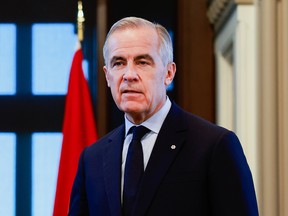
Canadians are feeling relatively “jaunty” in the face of a trade war with a country they now view as an adversary and no friend, even while saying they feel worse off than they did a year ago, according to a new poll of more than 10,000 Canadian adults.
Sign In or Create an Account
Most believe Prime Minister Mark Carney and his Liberal government are best suited to handle trade negotiations and American designs on Canada, and most voters overall feel the Liberals are making headway and “doing some good things” — or they’re at least giving them the benefit of the doubt that they will.
But while Carney is polling stronger than his party, which isn’t the case for Pierre Poilievre, the high cost of living and other bread-and-butter issues were ranked as more personally pressing than the trade war.

Get a dash of perspective along with the trending news of the day in a very readable format.
By signing up you consent to receive the above newsletter from Postmedia Network Inc.
A welcome email is on its way. If you don't see it, please check your junk folder.
The next issue of NP Posted will soon be in your inbox.
We encountered an issue signing you up. Please try again
According to the poll, Carney leads on attributes like “understands the lives of people like me,” though only 32 per cent thought this was true of him, according to U.K.-based pollster, Lord Ashcroft Polls.
“If living standards continue to stagnate, it’s easy to see how an air of calm authority could, over time, turn into aloof technocracy,” Lord Michael Ashcroft, a British businessman, philanthropist and former deputy chair of the British Conservative party, wrote in a commentary for National Post.
While found 47 per cent of Canadians think the country is heading in the wrong direction compared to 40 per cent who believe Canada is on the proper path, the numbers are notably less pessimistic than in other western nations, Ashcroft wrote.
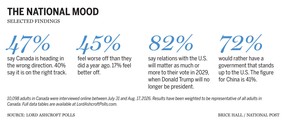
“Overall, Canadians say the country is on the wrong track by a margin of just seven points — positively jaunty numbers compared to their equivalents in Europe and the U.S.”
Recent U.S. polls put the “wrong direction” camp ahead by 20 to 30 points, with a similar picture in Britain.
U.S. President Donald Trump’s tariffs and bombastic rhetoric “didn’t just help to swing the 2025 election; they continue to shape Canadian politics” Ashcroft wrote. “Many see Carney almost as a wartime leader, his economic credentials making him the man for the times.”
In all, 10,098 adults in Canada were surveyed online between July 31 and Aug. 17. A poll sample of this size has a margin of error or plus or minus one percentage point.
In addition, 16 focus groups involving 128 participants — equal numbers of men and women drawn from a range of backgrounds — were held in four locations in B.C, Alberta, Quebec and Ontario.
While the poll found support for the way Carney is handling Trump, people were more likely to worry the country is off track, a finding that surprised Carleton University’s Richard Nimijean, given more recent polls have reported more upbeat results, with the “right direction” overtaking the wrong. It could come down to timing, said Nimijean, an associate professor of Canadian studies.
The Ashcroft poll was conducted at a time “when people were feeling pretty tired of and stressed by” the trade conflict, Nimijean said.
Days after the Ashcroft polling stopped, Carney pulled his negotiating team out of the trade talks, telling reporters: “You’re at war when you get attacked. We got attacked.”
The prime minister’s rallying call might have marked an important mood shift that could explain why more recent polls found higher optimism, and why the jaunty sentiment has continued, Nimijean said.
Still, when asked whether they feel better or worse off than they did a year ago, 45 per cent of Ashcroft poll respondents said they felt worse off, rather than better (17 per cent); 37 per cent said they felt about the same.
Those aged 45-54, the most hard-pressed group, felt worse, rather than better off, by a 37-point margin: only 15 per cent said they felt better off, versus 52 per cent who said they feel worse off.
Despite the “we won’t be bullied sentiment,” issues around affordability, housing and cost of living still deeply matter, Nimijean said. “Getting affordable housing hasn’t gone away. Accessible health care as an issue hasn’t gone away,” and people in vulnerable sectors are legitimately worried about their jobs, he said. This week, steelmaker Stelco Holdings announced plans to lay off up to 500 workers at its Hamilton and Lake Erie facilities.
When looking at political party affiliation, one third of Liberal voters (32 per cent) said they feel worse off than they did a year ago. More than half (57 per cent) of Conservative voters shared that sentiment.

On the economic outlook, while people were more likely to say they expect the economy will do poorly over the next year for Canada as a whole, they were more optimistic about how things will fare for themselves personally.
It’s a phenomenon seen globally, according to the pollster. People feel they have no control over issues like tariffs, the Iran war and international uncertainty. “But closer to home, when people think about their own lives and careers and prospects, things feel somewhat less gloomy and more within their power to determine,” the Ashcroft team said in an email.
Men tend to be more bullish about the economy, and women more guarded, according to the poll.
Canadians across all age groups and parties named the cost of living as the top concern facing Canada today. Housing was the second most important issue for voters up to age 44. Health care took second spot for the 45 and older.
Conservatives were more likely to name immigration and border control, followed by the economy and jobs.
Trade and tariffs came in fifth spot for Canadians as a whole.
When asked which party, regardless of how they intend to vote, does the best job handling issues they consider most important, “the economy was the most tightly contested issue among those who named it as a priority,” according to the poll. The Conservatives had a slight lead (43 per cent) over the Liberals (42 per cent).
On energy and natural resources, 71 per cent of those polled said they’d rather have a government that lets Canada use its own natural resources to reduce energy costs over a government that preserves its natural resources “even at a time of higher energy prices.”
Even a majority of NDP voters (57 per cent) preferred using natural resources to keep energy bills down.
In focus groups, a new oil pipeline to the West Coast drew mixed reviews. “Some saw it as a welcome and overdue investment that would promote energy independence and economic resilience, while others — particularly those who had switched from the NDP (in the last federal election) — worried about the environmental impact and the effect on First Nations,” according to the poll.
“I know sometimes it doesn’t seem like the woke options, but I feel like a lot of people don’t think about the alternative being to buy from countries like Saudi Arabia where they have terrible human rights,” remarked one Liberal participant from the B.C. focus group.
“I also think there are ways to get oil here where Indigenous people are partners and there is responsible stewardship of the land. And with gas being like $1.80, it’s really important to have our own supply.”
Overall, 51 per cent of respondents said they see the U.S. as an “adversary or threat,” and just 25 per cent viewed their southern neighbour as a friend or ally.

Four years ago, in 2022, the opposite was true: 73 per cent of Canadians saw the U.S. as an ally; 23 per cent saw the Americans as a threat.
“Those who voted Conservative in 2025 were the only group more likely to call the U.S. an ally than an adversary” by a four-point margin, according to the poll.
Focus groups supported the push to make the country more economically self-sufficient “though many felt this was long overdue and regretted that it had taken the Trump presidency to force action on this front,” according to the poll.
A closer relationship with China, however, was slightly more worrisome.
For Canadians as a whole, including for Liberal, Bloc and NDP voters, a trade war with the U.S. was the most serious threat to Canada. For Conservatives, it was immigration, followed second by trade tensions.
More than eight in 10 people polled (82 per cent) said managing relations with the U.S., even after Trump is no longer in office, would be at least as important as it is now in deciding their vote in Canada’s next federal election, “partly because they see Trump as a symptom as much as a cause of the movements in American politics over the last decade or more,” the Ashcroft team said in an email. Among the Republican Party, whoever succeeds Trump could have a similar agenda.

Overall, Canadians have a generally positive view of Carney and the Liberal government: 42 per cent, including one in five Conservative voters, said the Liberals are “making progress and doing some good things.”
Only just over a quarter, including just over half (52 per cent) of Conservative voters, said the Carney Liberals “won’t achieve anything good” and want them out as soon as possible.
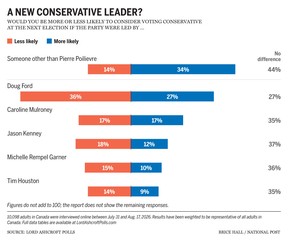
On the leadership question, 34 per cent of Canadians as a whole said they would be more likely to consider voting Conservative in the next election if someone other than Pierre Poilievre led the party.
Among those who said there was some chance they’d vote Conservative in the next election, but probably won’t, 34 per cent said what most put them off was that “I don’t like Pierre Poilievre.”
Roughly another third said the party feels too close to engaging in U.S.-style politics; 23 per cent said they worry about what the Conservatives would do in government.
“The Conservatives have struggled to find a narrative or a story to tell Canadians that speaks to the moment, that speaks to how Canadians are feeling,” Nimijean said. “The challenge for Mr. Poilievre is, how do you reach out more to the centre or to the moderates while also speaking to the base you have? It’s not easy.”
The poll echoes what an annual public survey — the Confederation of Tomorrow survey of 5,600 adults — has found when Canadians are asked if they are satisfied, or not, with the way things are going. “It’s basically 50-50,” said Charles Breton, executive director of the Centre of Excellence on the Canadian Federation in Montreal.
What isn’t clearly captured by the new poll “is that Canadians still feel a relationship with the U.S. is an important relationship — not the way things are going now. We do not want that relationship,” Breton said.
“But it is an important relationship, nonetheless.”
National Post
An ambitious new poll by British-based Ashcroft Polls surveyed 10,098 Canadian adults on a wide range of topics, from their thoughts on who is the country’s No. 1 enemy to their top kitchen table issue. Here are the key findings.
Threats to Canada
After a trade war with the Americans (47 per cent), the most serious threat to Canadians as a whole was the risk of a new economic and financial crisis (38 per cent) followed by immigration (32 per cent). Climate change was fourth overall, followed by loss of jobs to robotics, AI and machine learning.
Allies or adversaries?
The U.K, Australia and France were more likely to be seen as allies of Canada, while Russia, Iran and the U.S. were the most likely to be seen as an adversary or threat.
In 2022, 73 per cent of Canadians saw the U.S. as an ally. Today, only 25 per cent do.
The U.S. vs China: Who should Canada stand up to?
When asked if they had to choose, 72 per cent of Canadians as a whole said they’d prefer a government that stands up to the United States versus 28 per cent who said the government should seek accommodations with the U.S.
By comparison, 59 per cent of Canadians would prefer to seek cooperation with China rather than stand up to Beijing (41 per cent).
Trump will still be a threat even after he’s no longer in the White House
Most Canadians feel the same tensions with the U.S. will exist even after Donald Trump is no longer president by the time of the next federal election in 2029: 40 per cent said managing the Canada-U.S. relationship will be as important as it is now, with a further 42 per cent saying it will be even more important.
The party and their leader’s approval ratings
Canadians are more likely to have a net positive view of Mark Carney than of the Liberal party: 60 per cent had a positive view of Carney, compared to 55 per cent who had a positive view of the Liberals.
The reverse was true for Conservative Leader Pierre Poilievre, who scored a lower positive score (43 per cent) than his party (49 per cent).
Who would you never vote for?
A slightly higher proportion of voters said they would never vote for the Conservatives (27 per cent) than said the same for the Liberals (24 per cent) or NDP (22 per cent).
What are the most important issues facing Canada today?
The cost of living was chosen by 60 per cent of respondents as the most important issue facing Canada today, followed by health care, the economy and jobs, housing and trade and tariffs with the U.S.
Source: Ashcroft Polls interviewed 10,098 Canadian adults online between July 31 and Aug. 17 A poll sample of this size has a margin of error or plus or minus one percentage point.
National Post
Our website is the place for the latest breaking news, exclusive scoops, longreads and provocative commentary. Please bookmark nationalpost.com and sign up for our newsletters here.
Join the Conversation
This website uses cookies to personalize your content (including ads), and allows us to analyze our traffic. Read more about cookies here. By continuing to use our site, you agree to our Terms of Use and Privacy Policy.
KioskNews shows a cleaned-up reading view extracted from the publisher’s page — the original always lives on their site, not ours.