Canadian high diver welcomed fear during historic leap off Newfoundland iceberg
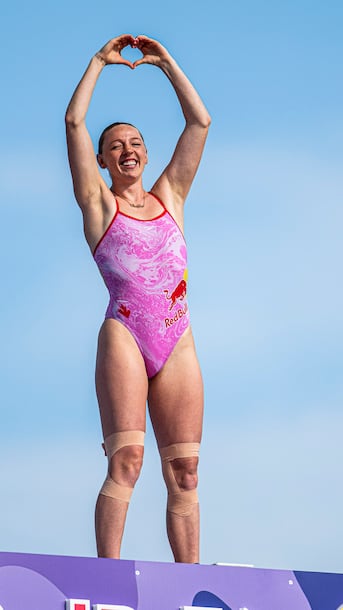
In the last year, Canada's Molly Carlson has jumped from a moving helicopter into a cage surrounded by sharks, completed her highest dive yet from a 27-metre platform, and, in her latest nerve-defying feat, became the first woman to dive off an iceberg.
Battling intrusive thoughts, she leapt from edge, soon feeling bliss in 'dive of my dreams'
The Canadian Press
·

Listen to this article
Estimated 6 minutes
The audio version of this article is generated by AI-based technology. Mispronunciations can occur. We are working with our partners to continually review and improve the results.

In the last year, Molly Carlson has jumped from a moving helicopter into a cage surrounded by sharks, completed her highest dive yet from a 27-metre platform, and, in her latest nerve-defying feat, became the first woman to dive off an iceberg.
Yet, the Canadian high diver will be the first person to tell you she's not, in fact, fearless.
“I don't feel like I've ever conquered fear,” Carlson said. “I've just learned more about it, and I've welcomed it and I have grown with it.”
Carlson lives with fear every day as one of the world’s best in the extreme sport of cliff diving, where she leaps off 21m platforms and performs acrobatics while reaching speeds up to 85 km/h in the air, before landing feet first in the water.
The 28-year-old from Thunder Bay, Ont., is also an influencer with a following of more than eight million across TikTok, Instagram and YouTube, where she built an online community, and company, known as Brave Gang that celebrates all forms of bravery and self-love.
Carlson has shared much of her athletic and personal journey through social media, including her historic iceberg dive, documented in the short film "Red Bull Iceberg Dive," available on YouTube.
The 30-minute documentary details Carlson's preparation for the stunt, including cold-water training and learning to ice climb from fellow Canadian Red Bull athlete Will Gadd, whose accomplishments include ascending a frozen wall on the American side of Niagara Falls. Six months of training led to the moment in June, when Carlson climbed and dove off an estimated 14m iceberg off the coast of Newfoundland into 1 C water.
Carlson said she was keen to take on a challenge that highlighted natural Canada and was partly inspired from watching fellow high diver Orlando Duque, who dove off an iceberg in Antarctica in 2018. From conception to execution, Carlson said the project was about four years in the making.
Dealing with unknown stressful
And while Carlson is accustomed to competing in a high-risk sport, this endeavour presented unique danger.
Unlike a stationary platform or cliff, icebergs move and can roll over, which meant experts had to find what Carlson deemed the "unicorn" iceberg that was stable to scale and had a shelf to safely dive from. Dealing with the unknown of when, or if, the dive would happen was stressful on Carlson, who at one point becomes emotional about the toll it's taking in the documentary. Talking about the experience months later, Carlson said she was prepared to abort the plan if it couldn't be performed safely.
"If we get there, it's too dangerous, it's not the vibe, something feels off, we both have to be comfortable in our expertise to say no," she said of her discussion that included Gadd. "The whole time we were in Newfoundland, we didn't know until like 30 minutes before if it was even possible."
Canadian diver reflects on terrifying cliff fall, overcoming near-death experience
How Molly Carlson used empowering messages to help overcome mental health struggle
Even with the ideal iceberg, there were challenges. Carlson typically knows the exact height of the platform she dives from which is important in a calculated sport like diving. But the iceberg's height, measured by drones, wasn't precise, meaning she had to rely on her athletic instincts.
"I really had to use my eyes in the air to be able to adjust how fast or slow I go," she said. "It was really going to be, fix yourself in the air to land safely," she said.
Scaling the iceberg unnerved Carlson, too. Gadd set up a rope and guided her to the top, but still Carlson said, "This is not my expertise."
At the top, conditions were windy, and Carlson had to battle intrusive thoughts. But when she leapt from the iceberg's edge into her backflip, she felt "bliss."
"I felt like I was in the air for like 10 minutes," said Carlson, who landed without a splash, calling it "the dive of my dreams."
WATCH | Molly Carlson shares struggles with anxiety, and overcoming:
Cliff diver Molly Carlson talks about the importance of staying authentic
May 1, 2025|
Duration
0:46
The Canadian social media star shares how being authentic helps her connect with the online community.Relationship with fear has changed
Carlson, who has been open about living with anxiety and overcoming an eating disorder as a competitive teenage diver, said her relationship to fear has changed over the years. When she was in high school, she said, she thought she wasn't allowed to have anxious or negative feelings. But as an adult, she said, "I realized fear keeps you safe."
"If you can find the right balance of fear and welcome it into your life, you can actually find calm with it, versus putting so much energy and pressure to push it away, it's just going to distract you," she said. "As soon as I realized that, so much of my anxiety calmed down."
In the end, Carlson executed the iceberg dive exactly how she wanted, but she would have been happy with any outcome, she said.
"Before I welcomed fear, I bet I would have gone to that iceberg and been like, 'If you mess up this time, if you make a splash, I'm going to be so embarrassed.' And that's just so not the priority anymore," she said. "The priority is to go, to make a difference, to show people that you're allowed to be scared and do it anyways.
"That's the biggest message, and I think bravery comes from accepting that fear is allowed to be there," she said.
Most people cannot identify with Carlson's athletic or adventurous exploits, but she said she thinks being open about her anxiety makes her relatable.
"And to show that I'm still human up on these crazy heights," she said.
KioskNews shows a cleaned-up reading view extracted from the publisher’s page — the original always lives on their site, not ours.