Marcos to gov’t agencies: Use AI to improve services
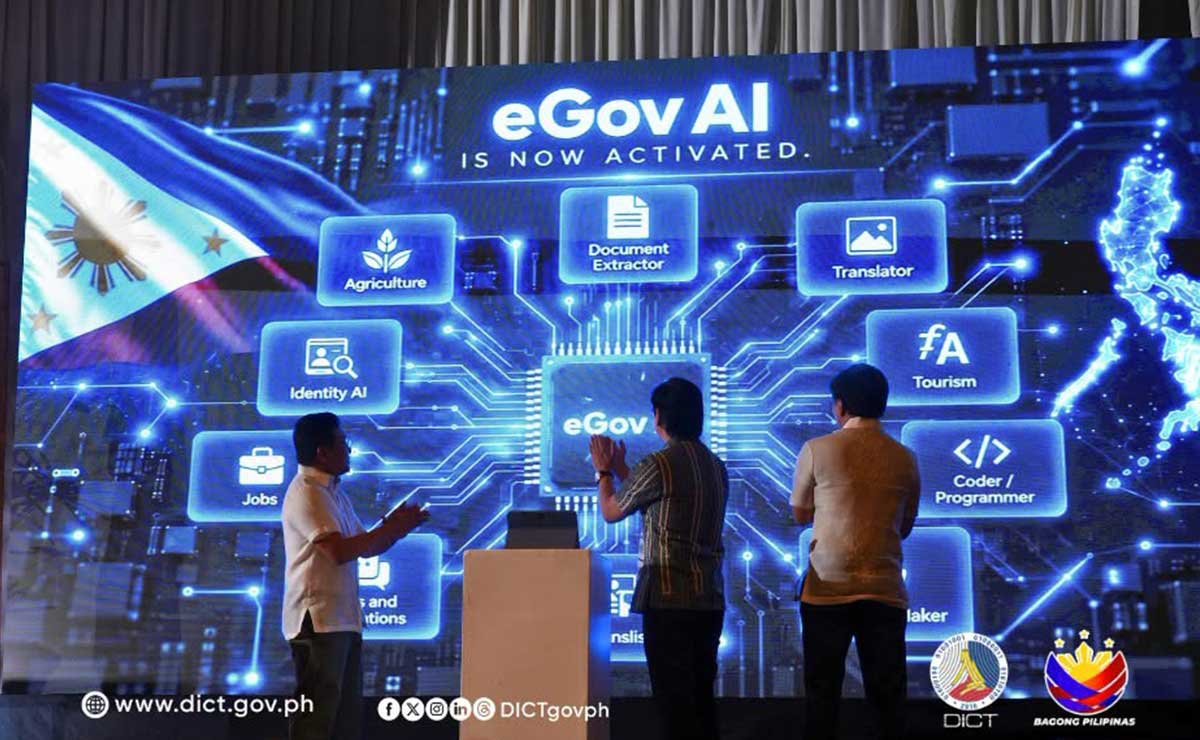
MANILA, Philippines — President Marcos has ordered the government to use artificial intelligence (AI) to provide better services to the Filipino public.
In a message delivered by Cabinet Secretary Benhur Abalos during the ceremonial launch of the all-in-one government AI platform eGov AI in Manila on Monday, the President said the technology should be made to work for more Filipinos, as it could help improve public services and make everyday tasks more efficient.
“We live in a time when technology is transforming how we learn, work, and do business. AI offers new ways of solving problems and making everyday tasks more efficient,” Marcos said.
Article continues after this advertisement
“Hence, the government must be ready to make these technologies work for the Filipino people,” he added.
FEATURED STORIES
NEWSINFO
NEWSINFO
NEWSINFO
The President cited a 2024 study by the Philippine Institute for Development Studies showing that only 14.9 percent of firms in the country used AI tools, with adoption concentrated among larger companies and those in urban areas, despite the near-universal access of Filipinos to computers and the internet.
The study identified weak digital infrastructure, limited awareness of emerging technologies, significant skills gaps, and scarce funding opportunities among the barriers to AI adoption.
Ethical, responsible use
“These realities tell us where our work must continue,” Marcos said. “We must make innovation more accessible and equip our people with the skills to use it.”
He also called for responsible use of AI, saying technology must advance alongside “accountability, security, and public service.”
Article continues after this advertisement
Developed by the Department of Information and Communications Technology (DICT), eGov AI’s services may be accessed through the eGovPH Super App—one-stop shop application for all national and local government services—on smartphones.
The eGov Super App already has 61 million unique users and 65 million downloads, representing about 75 percent of the adult population.
Article continues after this advertisement
According to DICT Undersecretary David Almirol Jr., eGov AI includes several AI-powered services covering employment, tourism, agriculture, health, document processing and chatbots, in partnership with government agencies.
The eTrabaho can use AI to extract information from a user’s resumé, generate templates, and match job seekers with employers.
Meanwhile, the eTourism AI feature can recommend destinations, restaurants, and itineraries based on a user’s preferences. It is designed not only to provide seamless travel experiences but also to boost local tourism by relying only on government-vetted information.
Almirol said he even used it to create a one-day itinerary for his trip, with AI citing only information from published records by the Department of Tourism.
For farmers, eAgri AI, developed with the Department of Agriculture, can provide information on crops, possible plant diseases, and best agricultural practices.
Meanwhile, the Government eHealth AI, developed with the Department of Health, is designed to provide health-related analysis based on information entered by users, including recommendations involving exercise and diet.
An AI analysis module can identify a user’s symptoms and possible illnesses that can be prevented based on the health information provided.
Almirol also demonstrated the Document Extractor AI, which can analyze and summarize uploaded documents, including PDFs, graphs, and images. The platform also includes optical character recognition and identity-verification capabilities linked to the National ID system.
The platform also allows users to build their own AI chatbots by providing information and frequently asked questions they want the system to use.
Almirol said developers can access eGov AI’s application programming interface to build websites, bots, AI agents, and other applications that may address other needs of Filipinos.
Marcos urged government agencies, private-sector partners, developers, and other stakeholders to continue working together to expand access to AI.
“Every technology we introduce must ultimately serve the public interest,” he said.
Your subscription could not be saved. Please try again.
Your subscription has been successful.
“Let us give Filipinos greater access to the tools they need to learn, participate, and prosper. And let us ensure that as technology moves forward, no Filipino is left behind in the opportunities it creates,” he added. /cb
KioskNews shows a cleaned-up reading view extracted from the publisher’s page — the original always lives on their site, not ours.