BOOK EXCERPT: How dolerite turned the Karoo into an ancient canvas and a barrier to fracking
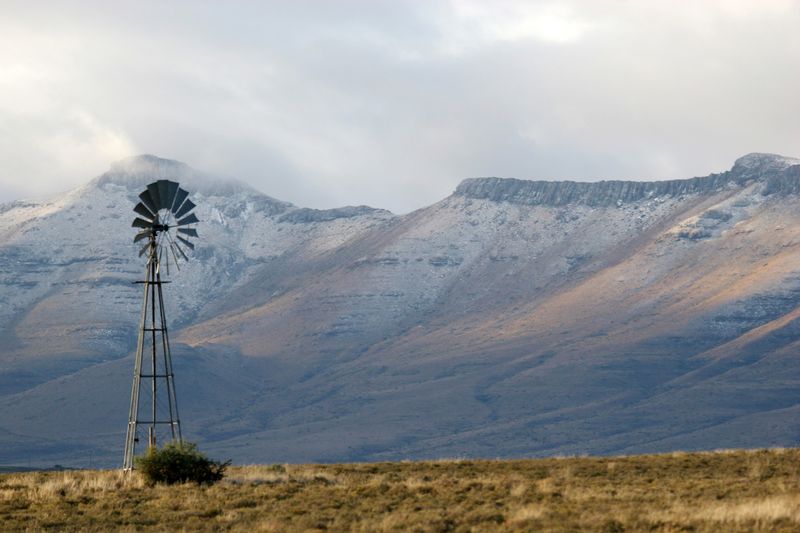
What defines the Karoo, that charismatic semi-desert sprawled across South Africa’s midriff?
First, its clay soils are evenly sprinkled with dwarf bossies and surprisingly high biodiversity. Second, it is huge, sprawling over 400,000 square kilometres – slightly larger than Germany.
Third, there are way more sheep than humans (by a ratio of 7 to 1).
Fourth, many of its hills are flat-topped. Fifth, there are so many windpumps they have become a visual shorthand for this semi-desert. Sixth (which you’d only know if you owned a kettle or a horse in the Karoo), the soils are very high in minerals, especially calcium.
Much of this has its origins in a geological catastrophe that happened 182.5 million years ago, the traces of which are irrevocably embedded in the Karoo’s rock formations.
Goodbye, Gondwana
From 300 million years ago, the Karoo’s rock formations were laid down in sedate sedimentary layers for 120 million years, eroded from high mountains by water and wind, occasionally encapsulating fossilised remains of ancient life.
Back then, Africa was part of a giant supercontinent called Gondwana. It was surrounded by the areas we now know as South America, Antarctica, India, Madagascar and Australia.
Then Gondwana began to tear apart. Maybe because of the geological tension this caused, or maybe because of a rising plume of molten rock, magma began to rise. It oozed steadily upwards from 100km or more below the surface, through all the Karoo’s layered sediments (Dwyka, Ecca, Beaufort, Stormberg).
Like melted chocolate rising through piles of flapjacks, it filled every crevice, fault, pocket and crack, from tiny to large. And for two million years, it kept coming.
Magma and lava
All kinds of hell broke loose in comparative slow motion. On the surface, some parts of South Africa were covered in sheets of lava to a depth of 3km. The jagged basalt peaks of the Drakensberg mountain range are the most visible remnant of that. Lava pressed down and “baked” sand dunes into the striking formations now visible around Clarens in the Eastern Free State.
Lesotho’s high, water-catching mountains were formed then.
As the magma rose closer to the surface, it would have encountered wet sediments or groundwater. The hydrothermal explosions that resulted punched upwards, creating thousands of holes in Earth’s crust – through which hydrocarbon gases poured.
The volumes of magma were staggering – somewhere between 1.5 million and 3 million cubic kilometres. Finally, it slowed and then stopped, leaving an entire country blackened and smoking.
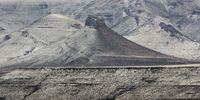
It took millennia to cool. Under the surface of what would become the Karoo, it set in layered sills atop pancaked sediments, in saucer-shaped rings and vertical dykes, an irregularly patterned subterranean jungle gym of iron-hard rock sheets, pillars and random shapes, veined right throughout the Karoo bedrock like the roots of a tree.
This igneous rock is called dolerite. Its common name is ironstone.
Looking for water
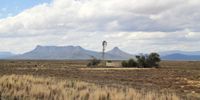
The characteristic flat-topped mountains and hills of the Karoo are the most widespread visible remnant of the dolerite’s tough, level sills. They protected the softer underlying sandstone from erosion.
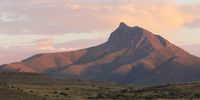
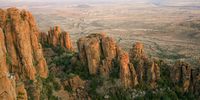
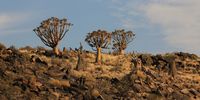
The thrusting dolerite crest of Compassberg near Nieu-Bethesda and the jointed stone pillars at the Valley of Desolation outside Graaff-Reinet are also among the most iconic exposed remains of that magma upwelling today. Near Williston and Loxton and up to Van Wyksvlei, they appear as pop-up koppies made from piled blockish boulders, burnt black by the sun.
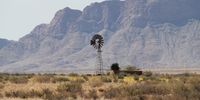
Less visible are the underground cracks left in the adjoining sediment as the superheated dolerite rose. Groundwater collects in the crevices around sills and dykes. Anyone looking to drill for water in the Karoo will do so in the vicinity of dolerite. Windpumps generally mark the spot, the priceless caches of underground water.
The Karoo’s clay soils are full of minerals thanks to the dolerite. Wander around an ironstone koppie and between the stones you will find unique plants thriving in the sheltered, comparatively fertile clay. The western side of the semi-desert, called Namaqualand or the Succulent Karoo, is one of only two arid-area biodiversity hotspots in the world. (The other is the Horn of Africa.)
Human culture and ironstone
Dolerite’s other role has been its importance to human evolution and South Africa’s culture. This takes at least two forms.
First, all across the Karoo you can find Stone Age artefacts and tools. They were made out of hornfels, a hard, fine-grained surface shale that was heated (metamorphosed) by dolerite.
Hornfels is very hard and, like glass or obsidian, it breaks with a “conchoidal” fracture. With it, Stone Age people created tools for cutting, scraping and stabbing.
Professor emeritus of geology at Rhodes University and a Karoo dolerite expert, Julian “Goonie” Marsh, said: “I have found some places along dolerite dykes intruding shales, where the ground is littered with hundreds of worked hornfels fragments. One can imagine such sites to literally have been stone tool ‘factories’. Without dolerite to make hornfels, one can wonder whether this Stone Age culture could have thrived as it did across the Karoo Basin.”
Second, dolerite has qualities that lent themselves to early human creativity.
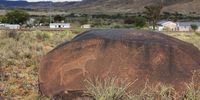
As this rock ages, the exposed area darkens to reddish brown and then pitch black, as if the rock were becoming sunburnt. This is called a rock varnish, patina or oxidation.
But if that is pecked or scraped away, the pale reddish-brown rock underneath is exposed. Some of the planet’s earliest human artistic expression is etched on dolerite, at sites all over the Karoo.
In just one rock etching site near Nelspoort (north of Beaufort West), there are hundreds of etchings and engravings of animals and geometric symbols, many thought to date back thousands of years, made by South Africa’s San and Khoi.
These indigenous communities engraved eland, black rhinoceros, giraffe, hartebeest, zebra, bird-human figures, spirit beings, jackal, blesbok and elephant. Dark patina has reclaimed many of them. The oldest ones can only be seen at certain angles, in certain lights.
Drumming on dolerite
There is also an acoustic quality to ironstone. Many large dolerite boulders balanced near the top of flat-topped hills give off a bell-like sound when struck. Ancient strike-marks show that Bushmen and Khoi people used them for drumming.
John Parkington, emeritus professor of archaeology at the University of Cape Town, writes in his co-authored book San Rock Engravings: “Karoo rock gongs are almost without exception located among clusters of engravings and are recognisable as sets of hammered or pecked patches usually on dolerite boulders, nearly always on the lips of rocky ridges.”
He explains that most sedimentary rocks, like sandstone, produce no ringing sound, but that igneous rocks are “homogenous, dense, ‘metallic’ in structure and will allow the force of a blow to resonate... to ring in effect”.
When or why were they used? No one knows anymore, but Parkington and co-authors David Morris and Neil Rusch mention rain-making rituals as a possibility.
Fracking hell
Like the Marcellus shale fields in the US, the Karoo Basin seemed to have had exactly the right mix of events, depth and pressure to create gassy hydrocarbons – on paper at least. In 2015, the US Energy and Information Administration calculated the technically recoverable shale gas resource at 390 trillion cubic feet (tcf) or more, which would have made it the world’s eighth-richest basin in shale resources.
But it is also among very few such basins in the world that is veined with dolerite.
So what did the “igneous event” do to the methane gas trapped in the shale (Ecca) layers? More and more scientists think the gas that the frackers seek is long gone. Or at least gone in commercially viable quantities.
The late Dr Billy de Klerk, who wrote his doctorate on magmatic processes, said that the doleritic magma was at about 1,200℃ when it intruded.
“It’s entirely likely that the enormous heat of this dolerite, hot-boxed for millennia by the insulated layered sediments, would have driven off most of the volatile hydrocarbon gases like methane.”
In September 2017, the South African Journal of Science published a study by eight geologists (three from the University of Johannesburg), called Deflating the Shale Gas Potential of the Main Karoo Basin.
They write: “Contact metamorphism by dolerite sills has resulted in catastrophic and explosive degassing and alteration of shale,” and conclude that if there is gas, it would be at the bottom end of a range of estimates – perhaps 13 tcf.
“To be economically viable, the resource would be required to be confined to a small, well-delineated ‘sweet spot’ area in the vast southern area of the basin.”
Minister of Mineral and Petroleum Resources Gwede Mantashe has expressed great keenness for shale gas exploitation.
But dolerite may have put paid to that. Even had it not cooked off the gas, the sheer physics of drilling through this extremely hard and faulted rock is enough to daunt the keenest fracker.
So the next time you pass a Karoo ironstone koppie, doff your hat. Those are our fortresses against frackers, our secret water stashes, our ancient art canvases, our singing rocks. DM
Chris Marais and Julienne du Toit are the authors of the five-book Karoo Heritage Collection (R1 300, including courier in SA). For orders, contact julie@karoospace.co.za
Living overseas? The Karoo Heritage eBook Collection (R500) can be bought online: The Karoo Heritage Collection eBook – Karoo Space.
KioskNews shows a cleaned-up reading view extracted from the publisher’s page — the original always lives on their site, not ours.