6 takeaways from our interview with the officer shot down in Iran
In April, five weeks into a costly and unpopular war, an American fighter jet was shot down over Iran, leaving two aviators stranded behind enemy lines.
The officers on board — a pilot and a weapons systems officer, who we are referring to by their mission call signs Alpha and Bravo for security reasons — ejected from their F-15E jet, call sign Dude 44, after it was hit by an Iranian missile.
The crewmates were then stranded miles apart in a mountainous desert region with Iranian bounties on their heads. What unfolded is considered to be one of the largest and most complex rescue operations in U.S. military history.
In his first interview, Bravo provided 60 Minutes correspondent Norah O'Donnell new details about his harrowing story of survival and the rescue operation to save him and his crewmate Alpha.
Bravo thanks Alpha for "saving our lives"
Bravo told 60 Minutes that the impact of the shoulder-mounted missile on their aircraft hit them like a "freight train" and that the catastrophic damage to American fighter jet was "evident." He credits his crewmate Alpha for saving their lives by reacting quickly.
"We do all we can to try to save the aircraft. It was evident that that wasn't possible. And soon thereafter, we ejected and found ourselves floating over the heart of Iran," he told O'Donnell.
"So within seconds, you're ejecting? That's how quick the decision is?" O'Donnell asked.
"It is… I will be thankful, to my dying day, for my pilot and crew mate, Alpha, for saving our lives and ejecting us," the weapons systems specialist said.
Bravo clarified that the F-15E will delay ejections by several seconds, putting some distance between the crewmen after they've landed on the ground to keep them safe.
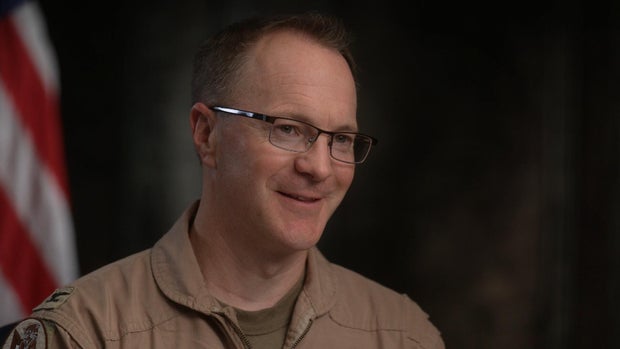
Bravo credits airmen who maintained Dude 44 aircraft, equipment
Bravo acknowledged his fellow officers who maintained their aircraft, his equipment and his survival gear, saying everything performed better than expected despite damage by the missile.
"I want the airmen that worked diligently on the seat and on the equipment for our survival gear there to know… they did an incredible job," Bravo said.
"Despite the damage to the aircraft, to include the damage to my ejection seat, it outperformed the design specifications. And I call that a testament to their professionalism."
Bravo falls to Earth with damaged parachute
As if being shot down and ejecting weren't scary enough, Bravo's parachute was damaged when the jet was struck by the missile.
"At one point when I looked up and saw no parachute, that was the most terrifying thing I've ever seen," he said. "So I paused, right then. And I prayed, 'Lord, your will be done. But if I'm getting through this, I need help.'"
Bravo is unsure exactly how quickly he was falling, but he and military debriefers he spoke to afterward estimated it was "somewhere between 70 and 100 miles an hour."
"Free-falling is a good way to put it. I wasn't focused on the speed at which I was falling," Bravo said. "I was instead focused on trying to correct the problems that were in front of me and doing anything I could to unfurl or pull pieces of the parachute loose.
"We're trained to work through problems, not only through the ejection sequence, but any survival scenario and under considerations for parachute malfunctions."
When asked how he could possibly survive the fall, even though he broke his back, shoulder and arm, he called it "a miracle."
"I believe that it's a testament to God's provision in my life to bring me through that moment in a way that didn't prevent injuries, but prevented any catastrophic injuries that would have affected my ability to survive," Bravo said. "And I'm grateful, eternally, for knowing that he was there with me."
Bravo was on the run for his life as Iran hunted him down
Surviving the ejection and falling to Earth was only the first part of his harrowing journey. Then he was hunted by Iranian forces looking to capture him.
According to U.S. military sources, they got to within a few hundreds meters of Bravo.
"I was focused on things like getting away from the enemy, finding the right place to communicate, finding the way to hide or defeat the ways that the enemy might track me," he said.
Iran is about the size of Alaska, Bravo said. His immediate concern was concealing himself and evading capture.
"I had communication equipment with me, but I did not immediately take the opportunity to communicate," he said. "Where I found myself, I thought the priority should be getting away from that spot before someone else started showing up to look for me."
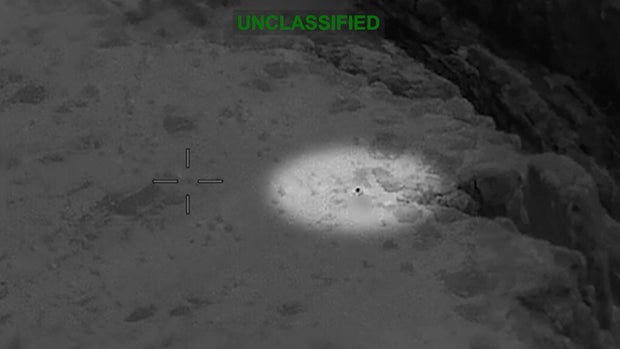
Bravo climbed up a 7,000-foot ridgeline, despite his broken bones and sprained ankle and cuts and scrapes to his face and head.
"Never let a lack of motivation put you on Iranian TV," he said.
He continued, "Given the terrain that I faced, I think you'd find it surprising, what I was able to overcome, given those injuries. But I did it because of a warrior ethos that we talk about."
After about 48 long hours, rescue party comes for Bravo
Bravo said the moment U.S. forces came to rescue him on the ridgeline, with Iranian soldiers massing at the base of the mountain, "was one of the greatest moments of my life."
"I don't know how to say it any more clearly than, thank you for all that they did," he said.
Bravo said he wanted to keep what his rescuers said to him private, but his comments to them were direct: "Let's go."
An aircraft stuck in the sand provides one final hurdle to escape
When they made it back to the makeshift airstrip, the rescue plane's landing gear was stuck in the desert sand.
It took a clandestine unit of the U.S. Air Force to get Bravo and the 90-plus special operators out of Iran.
The U.S. then bombed its own marooned aircraft to prevent it from falling into the hands of Iran.
Bravo said he never had a doubt the U.S. military was coming for him.
"It's what we do," he said. "I have great faith in my creator. And second only to that is my faith in the men and women of the United States military."
KioskNews shows a cleaned-up reading view extracted from the publisher’s page — the original always lives on their site, not ours.