Government quality, capability set successful nations apart in a contested world: Chan Chun Sing
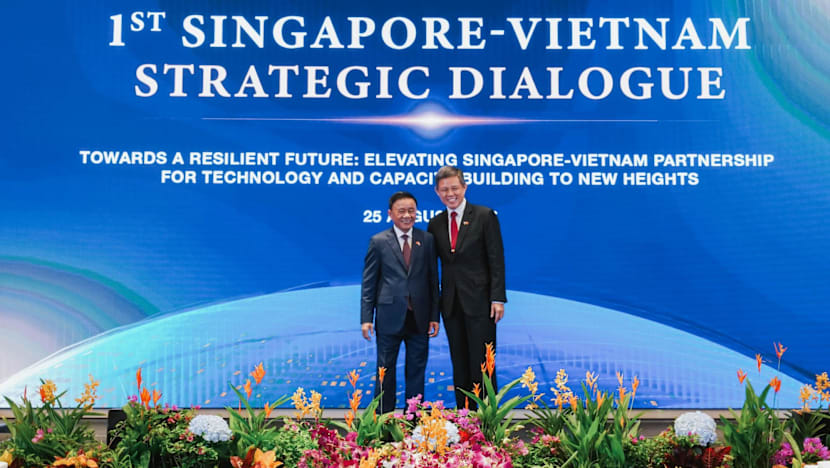
SINGAPORE: The quality and capability of government will increasingly distinguish successful nations from the rest amid a weakening rules-based international order and rising geopolitical competition, Coordinating Minister for Public Services Chan Chun Sing said on Tuesday (Aug 25).
Speaking at the inaugural Singapore-Vietnam Strategic Dialogue held at Conrad Singapore Marina Bay, Mr Chan said that strong institutions help countries anticipate change and adapt when external shocks occur.
“Policy consistency, regulatory effectiveness, and the quality of the public service matter for economic competitiveness. Businesses consider these factors when deciding where to invest and where to build for the long term,” said Mr Chan, who is also Singapore’s defence minister.
“Governments also need the confidence and trust of their people. Public trust enables governments to build consensus, mobilise society, and undertake difficult reforms in which benefits may only be apparent many years later.”
Mr Chan co-chaired Tuesday’s dialogue with Permanent Member of the Communist Party of Vietnam (CPV) Central Committee Secretariat Tran Cam Tu.
Other key figures who attended the dialogue included Vietnam's Minister of Foreign Affairs Le Hoai Trung and Singapore's Foreign Affairs Minister Vivian Balakrishnan. Singapore's Minister for Digital Development and Information Josephine Teo was also present.
At the dialogue, the foreign affairs ministers of both sides signed an agreement on a study visit programme and an executive education programme for senior CPV officials from 2027 to 2029. Both countries also issued a joint statement on the Vietnam-Singapore technology connectivity strategy.
The Singapore-Vietnam Strategic Dialogue was formed under the ambit of the Comprehensive Strategic Partnership between both countries, which was established last year.
“We intend for this to be a forward-looking platform where we can exchange perspectives candidly on emerging challenges, and identify areas where we can work together bilaterally and regionally,” said Mr Chan in his opening speech.
Mr Tu said in his opening remarks that the dialogue reflects the increasingly deep level of political trust and the importance of the relationship between both countries.
Speaking in Vietnamese, he added that the platform will further strengthen political trust, enhance cooperation across all fields, and help develop the Comprehensive Strategic Partnership between both sides in a profound and substantive manner, becoming a model of mutually beneficial cooperation in the region.
Mr Tu also said Vietnam is interested and eager to learn from Singapore's experience in building a modern administration and effective national governance, including identifying and nurturing talent, and building a team of leadership successors with the vision and capacity to meet the country's needs in the new era.
MORE VOLATILE, CONTESTED ENVIRONMENT
In his opening speech, Mr Chan said that Singapore and Vietnam are both operating in a more complex environment today.
“For decades, Singapore and Vietnam have benefited greatly from an open and rules-based international order, deep economic integration, and a stable regional environment. These conditions provided important tailwinds for our economies to grow and for our people to prosper,” he said.
“Today, many of these conditions are weakening.”
Both counties feel the shifts acutely as small, open and trade-dependent economies, said Mr Chan.
With intensifying geopolitical competition, the boundaries between economic policy, technology policy and national security are blurring.
Supply chains and investment decisions are also being shaped by strategic and security considerations, beyond commercial ones, he said.
“Within our societies, aspirations are also becoming much more diverse. Younger generations have grown up in very different circumstances from their parents and grandparents. Their expectations of work, society, and government will naturally be different,” added Mr Chan.
While artificial intelligence (AI) and other emerging technologies offer tremendous opportunities for productivity and growth, they also create new risks and divisions across economies and societies, he said.
Mr Chan noted that Singapore and Vietnam will experience the challenges differently, but with similar underlying questions.
“How do we continue to govern well in a more volatile and contested environment? And how do we prepare the next generation of leaders to do this in a much more complex environment?” he asked.
LEADERSHIP VALUES
Mr Chan said that leadership must be anchored on “the right values and a strong sense of stewardship”.
“The most difficult decisions in government are seldom straightforward choices between right and wrong. More often, they involve competing priorities,” he said.
“We need to balance present needs against the interests of future generations, economic opportunities against risks, and diverse interests of different groups in society.”
He said Singapore places “considerable emphasis on identifying and developing leaders with integrity, judgement, and the instinct to consider the long-term interests of our country”, while at the same time staying grounded and connected to the people they serve.
As citizens become better educated and informed, governments must continually update their engagement methods, said Mr Chan, emphasising Singapore’s efforts in prioritising engagement and partnership in its public service transformation.
“Staying close to the ground also helps us to understand how policies are experienced in practice and where aspirations are changing,” he added.
“It also builds trust. And trust gives governments the legitimacy and space to make difficult decisions and think beyond the immediate.”
Mr Chan said the country seeks to develop leaders with depth and expertise in one or two sectors, and sufficient breadth to understand issues across sectors, work across organisational boundaries, and connect different perspectives.
This is increasingly important as many of the challenges faced today do not fit neatly within a single ministry, he explained.
While not every leader is expected to possess the same depth in every area, the leadership team should collectively have sufficient depth across the issues it has to deal with, and the breadth to integrate perspectives and make decisions in the broader national interest.
“Good outcomes depend not only on having strong individuals with deep expertise, but also having officers who can marshal resources and collaborate across government and with the private sector,” he said.
HARNESSING TECH
Mr Chan also called for leaders to understand and harness the forces reshaping economies and societies, including technology.
They must also create the conditions for innovation and growth, giving businesses the confidence and environment to experiment, adopt new technologies, improve productivity and create new sources of growth, he said.
“Our governance and regulatory frameworks must manage risks without unnecessarily constraining innovation,” he added.
In the digital age, governments must also build trust, said Mr Chan. This includes addressing cybersecurity, scams and misinformation, protecting citizens' data, and ensuring that those who are less digitally able are not left behind, he said.
To unlock the potential of AI, facilitate cross-border data flows and integrate the digital economy, common approaches and greater interoperability is also needed internationally, said Mr Chan.
“This will create opportunities for our businesses, particularly small and medium enterprises, and enable citizens to benefit from more seamless services,” he said.
KioskNews shows a cleaned-up reading view extracted from the publisher’s page — the original always lives on their site, not ours.