Anita Anand, Canadian Foreign Minister: ‘Significant progress in ties… trade, energy, security, technology key areas’
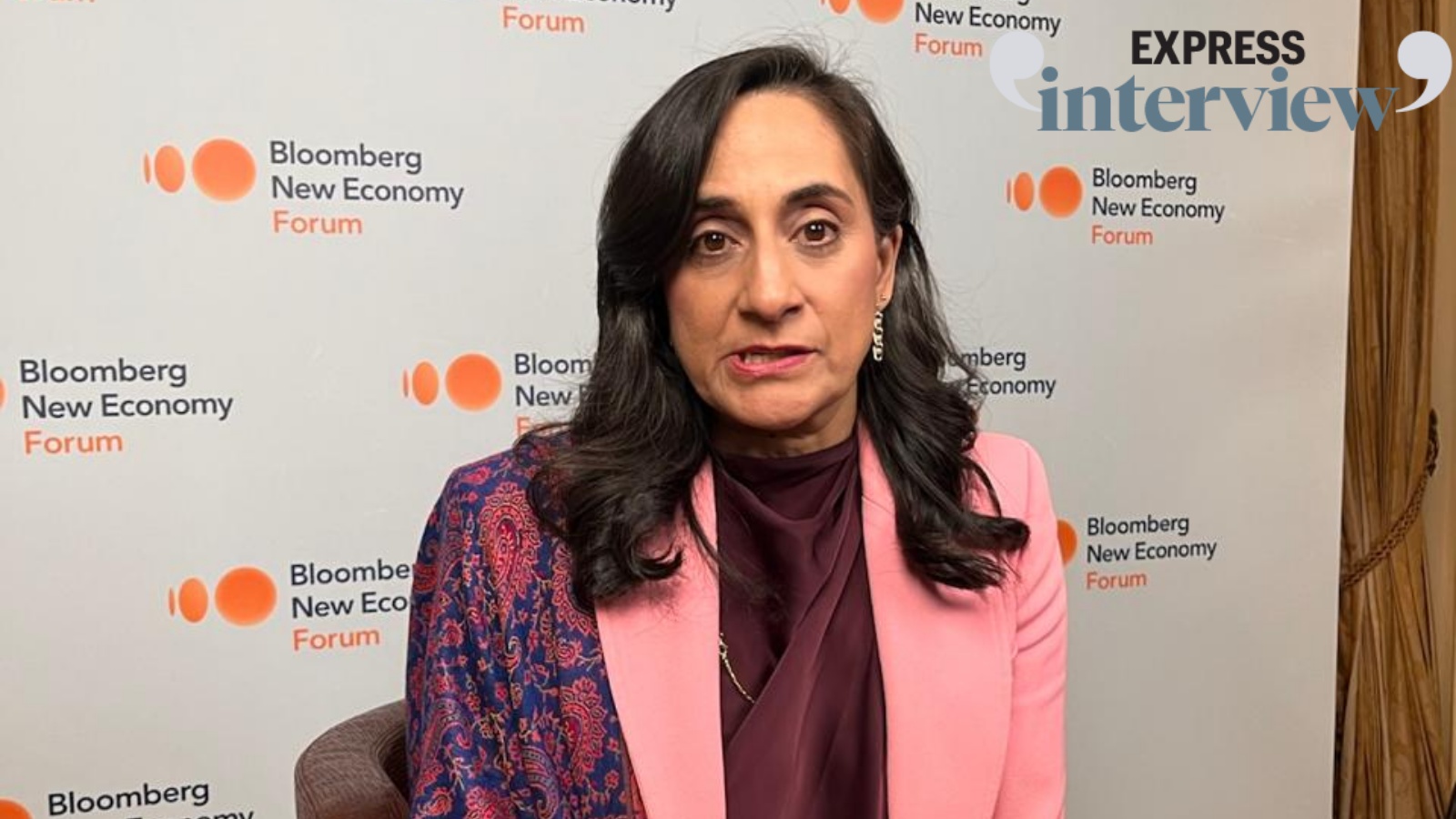
India forms a large part of Canada’s strategy to double non-US trade over the next 10 years and diversify its trading partners, visiting Canadian Foreign Minister Anita Anand said on Wednesday. In an interview to The Indian Express, on the sidelines of the Bloomberg New Economy Forum, Anand spoke on the trajectory of India-Canada bilateral ties and the areas of cooperation.
There has been significant material progress. I came last October to begin the process of reviving a relationship that is so important to both countries. (External Affairs) Minister S Jaishankar and I set down a declaration of the areas in which we intend to grow the relationship — from the security dialogue at the highest levels, to technology and information systems, to food security, to trade and investment, to people-to-people ties. These are areas that have been fundamentally important in the bilateral relationship. Not to mention energy. And we will continue to work together on these items, building on that October 2025 visit, looking forward to the conclusion of a Comprehensive Economic Partnership Agreement (CEPA) this year.
Prime Minister Narendra Modi is expected to visit Canada at the end of this year. He and Canadian PM Mark Carney have said the CEPA talks should be concluded by year-end. How confident are you that the talks will be concluded, and what are the key challenges?
A trade team from India was in Ottawa last week. Our Minister of International Trade, (Maninder) Sidhu, is in India this week with a 150-member delegation of the business community. So the work continues on negotiations at an accelerated pace, and I am sure that both trade ministers have this well in hand.
How are you trying to assuage India’s concerns on pro-Khalistan elements, and how is the approach different from the previous (Justin) Trudeau government?
The security concerns that Canadians have are always top of the mind for our government. It is one of the reasons why we put in place the security dialogue at the highest levels. It is one of the reasons why we listed the Bishnoi gang as a terrorist entity under Canadian law, and why we are relying on the rule of law as being a fundamental principle on which our relationship will continue. Rule of law and domestic security are top of the mind for our government, always.
The two leaders had agreed on the uranium supply deal and pacts on critical minerals. What is the progress?
One of the key signatures of PM Carney’s visit here was the signing of the uranium deal… that was indicative of the potential of the relationship on critical minerals. Certainly, we built critical minerals into the declaration last October when we signed that, Minister Jaishankar and I, and we will continue to have a dialogue about what the competitive advantages are, and how our work can complement each other. Canada led the G7 Buyers Club or Production Alliance after last year’s G7 meeting, and that goal was to stabilise supply chains for critical minerals. We’re very pleased that India was an outreach partner at that meeting, and we look forward to further conversations.
The issue of visas, and access to destinations like Canada for education and job opportunities, is important for India. How does Canada position itself towards Indians who want to live, work or study there?
The people-to-people ties between India and Canada are strong. Students form one facet of that broader relationship, but part of the drivers of this relationship being renewed is the people-to-people ties and students are included in that. Universities across our country are partnering with India, Indian universities and firms… We have Canadian universities that have a presence and are seeking a greater presence in India, and we are fully supportive of that. In terms of the broader visa question, of course that rests with the Minister of Immigration, but I will say that we very much value the educational connection between our two countries.
From your experiences about India, what do you think has changed in the country over the years?
India is an economic powerhouse, a $4 trillion-dollar economy, sixth-largest economy in the world, and as we double non-US trade over the next 10 years, as we diversify our trading partners, India is a large part of that strategy.
Story continues below this ad
In Davos earlier this year, PM Carney talked about rules-based order in the world. Both India and Canada are facing challenges from their neighbours — the US and China. How do India and Canada cooperate in maintaining the rules-based order in the face of these challenges?
Going back to the Davos speech, essentially, what PM Carney was saying is that the traditional set of rules upon which the global economy and the broader international order were founded have dissipated, have disappeared, and as middle powers, we can stand by and watch, or we can take a leading role in forming the new international order, which is being developed as we speak. Canada feels that it has a role to play internationally, bringing other middle powers together on issues that relate to national sovereignty and resilience, whether it is Arctic security, maritime security, Ukraine, information systems and information technology, those are issues that strategically matter for individual countries. There are also issues on which countries can cooperate in order to further their strategic autonomy.
On the war in Ukraine, India has initiated a proposal for a partial ceasefire in the Black Sea area, keeping in mind food security. How do you see this evolution of India from being an advocate for peace to actually taking some steps?
Canada is very keen to play a role as well as in ensuring that we bring parties to the table. I’ve spoken with Minister Jaishankar about the Black Sea ceasefire proposal, have spoken with Ukrainian Foreign Minister Andrii Sybiha, and have been trying to ensure that Canada supports this process as much as possible. The stability of supply chains in agriculture and agri-food is of fundamental importance, including in the Black Sea. When you think about Ukraine’s dominance in agriculture, in wheat farming, the rest of the world needs those exports to continue.
The situation in the Strait of Hormuz has put pressure on energy security. How can India and Canada cooperate to reduce this energy insecurity?
Fundamentally, we need to continue to support the UN Convention on the Law of the Sea and the concept of freely navigable waterways. In addition, we need to call out and condemn the Iranian retaliatory attacks in and around the Strait of Hormuz, and finally, we need to ensure that we’re working with Gulf countries to support them. Their economic welfare and livelihood is deeply connected with a navigable Strait of Hormuz, and so Canada, as an energy superpower, will continue to do whatever we can in that respect. At the beginning of the war, we put forward 23.6 million barrels of oil in order to stabilise energy supplies, and we’ll continue to do this type of work in support of a freely navigable Strait of Hormuz and the supply chains that are negatively affected.
PM Carney is being talked about as a possible chief guest for the Republic Day celebrations next year. How do you see this development, especially from where the relationship was three years ago.
Story continues below this ad
January 26 is a very important date for the Republic of India. I know that PM Carney is looking forward to welcoming PM Modi in Canada in December. In terms of his schedule after that, those decisions are with his office. But I know that the two leaders spoke yesterday. Their relationship is strong, and it is an honour to be able to have this conversation with you on behalf of our country.
KioskNews shows a cleaned-up reading view extracted from the publisher’s page — the original always lives on their site, not ours.