McLaren titanium grades surge higher at WA project
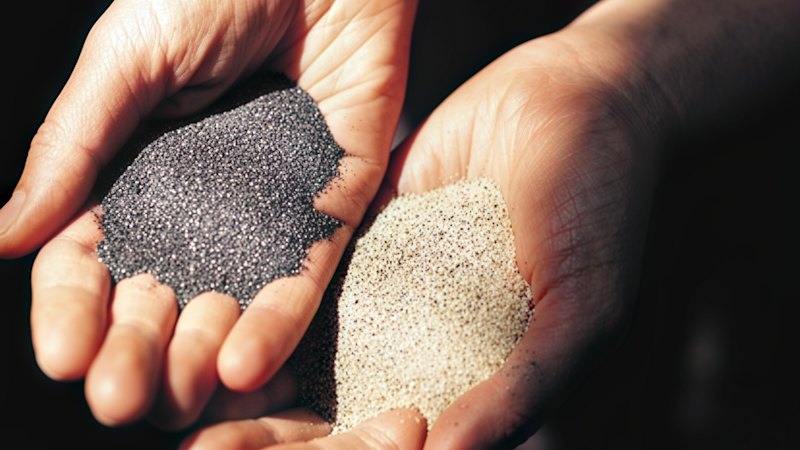
McLaren Minerals has tabled the best batch of high-grade heavy mineral (HM) assays to date from its flagship McLaren titanium project in the Eucla basin, Western Australia, with the latest drilling returning a length-weighted average of 5.44 per cent HM over an average thickness of 16.2m, all from surface.
The impressive results come from a set of 74 holes covering 1199m of sampling and represent a solid step-up from the 4.96 per cent HM average unveiled in the previous crop of results. The drilling is part of a major program designed to increase confidence in the project’s existing 529-million-tonne resource.
The standout intercept was a hefty 21-metre section from surface grading 7.61 per cent HM. Other notable results included 18m at an even stronger 8.06 per cent HM from surface and another 18-metre hit from surface going 7.55 per cent HM.
The company says the latest assay results continue to demonstrate a strong and consistent grade profile across the deposit. Without applying any HM cut-off, 66 of the 74 holes, or 89 per cent, averaged at least four per cent HM.
‘To return a length-weighted average of 5.44% HM over an average thickness of 16.2m is quite remarkable.’
McLaren Minerals managing director Simon Finnis
Delving deeper into the numbers, 62 per cent of the holes averaged at least five per cent HM, and 24 holes, representing 32 per cent of the suite, came in at or above an impressive six per cent HM.
The results also confirmed substantial mineralised thickness from surface, with 54 holes, or 73 per cent, returning at least 15m of completely sampled mineralisation. A further 11 holes hit at least 21m of mineralisation from surface.
Higher-grade zones also appear to be a feature within the broader mineralised profile, with nearly a third of the holes hitting grades of at least 10 per cent HM over one metre. The peak one-metre result was a stellar 16.43 per cent HM from a shallow depth of 8m.
McLaren Minerals managing director Simon Finnis said: “This is the strongest set of results yet from the 2026 drilling program. All from surface and across 1,199m of sampling, to return a length-weighted average of 5.44% HM over an average thickness of 16.2m is quite remarkable. The grade profile appears to be strengthening as we move south through the deposit, and what we’re seeing is consistently mineable grade and widths from surface across the entire dataset. Every batch seems to outdo the last.”
The news lands at a time when the broader mineral sands sector in Western Australia continues to be active, with major players such as Sheffield Resources recently restarting operations at its Thunderbird project, highlighting the industry’s ongoing viability. Titanium is now recognised by governments as a critical mineral essential for aerospace, defence and new energy technologies, making the development of large-scale domestic projects such as McLaren increasingly strategically important.
Adding weight to the project, metal prices also appear supportive, with recent US Geological Survey data showing rutile holding firm at around US$1450 (A$2020) per tonne and ilmenite at US$350 (A$487) per tonne, providing a solid commercial backdrop for McLaren’s development plans.
The McLaren project sits in the western Eucla basin and hosts a significant JORC-compliant resource of 529 million tonnes at 4.5 per cent HM, containing 23.7 million tonnes of in-situ heavy minerals. The inventory currently comprises 249 million tonnes in the indicated category and 280 million tonnes in the inferred category.
The current drilling program is designed to upgrade a larger portion of the resource to the higher-confidence indicated category, which will then underpin a maiden ore reserve estimate and a bankable feasibility study.
To date, McLaren has received 6671 assays from 11,568m drilled, which equates to 58 per cent of the total samples, suggesting plenty more newsflow is on its way.
With assays still rolling in and each batch seemingly outdoing the last, McLaren is systematically de-risking what is already a massive titanium deposit. As the company continues to build a more detailed picture of the grade and consistency across the project, it appears to be steadily marching towards a resource upgrade and the all-important feasibility studies that could transform it from an explorer into a developer.
Is your ASX-listed company doing something interesting? Contact: mattbirney@bullsnbears.com.au
KioskNews shows a cleaned-up reading view extracted from the publisher’s page — the original always lives on their site, not ours.