Finance and tech talent is beginning to return to Venezuela
The hype among young entrepreneurs is not only based on an improving economic outlook. It is also pinned to the prospect of political change. Many argue a new government is vital to sustain Venezuela’s transformation
By Andreina Itriago and Nicolle Yapur / Bloomberg


Francisco Amador left Caracas to build a career in finance. Little did he know that after 13 years at JPMorgan, TD Cowen and a hedge fund, Venezuela’s economic reopening would bring him back home.
The 35-year-old is part of a still small, but growing cohort of young Venezuelan investors and entrepreneurs looking to their homeland after former Venezuelan president Nicolas Maduro’s abduction opened the prospect of a recovery in the struggling, oil-rich nation. A generation once thought lost is being drawn back by a burgeoning start-up and private-equity scene, along with opportunities tied to the revitalized energy sector.
Mostly in their 30s, they are Venezuela’s homegrown version of the finance-and-technology crowd: former bankers, investors, engineers and start-up founders who built careers in places such as New York, Miami, Mexico City and Buenos Aires. Many work in or around fintech and venture capital. They are now launching businesses or scouting investments aimed at filling gaps left by years of economic crisis, underinvestment and an exodus of skilled workers.
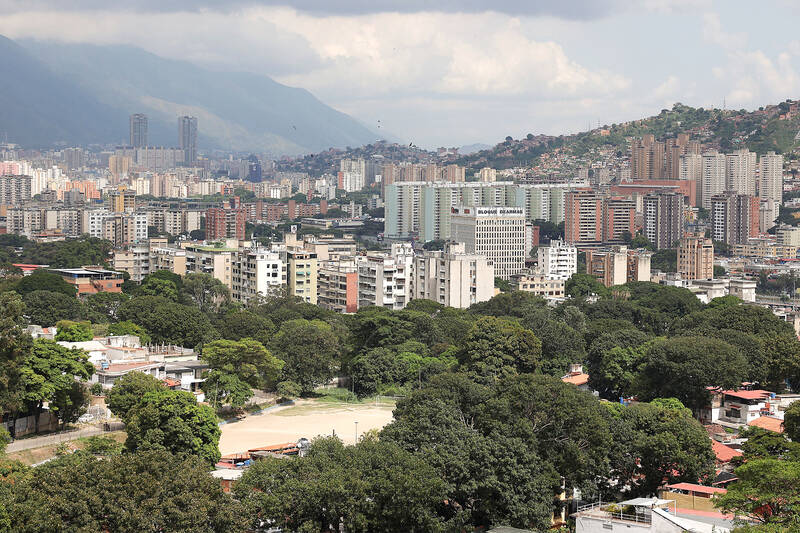
Caracas is pictured on Oct. 26.Photo: Reuters
Photo: Reuters
Like many of his peers, Amador moved to the US to study in 2009, then spent much of the next two decades working in Houston, Texas, and New York. After the COVID-19 pandemic hit, he moved to Miami to be closer to relatives. He admits he does not have much left in the nation that watched him grow and had little desire to return until this year, when Maduro’s capture by US forces triggered hopes of political change and an unprecedented wave of investor interest.
“I started looking for different ways to get involved,” he said.
He found one with Arqos Capital, an investment firm dedicated to Venezuela, where he became managing director. He is now convinced that to make the most of his new role he needs to move to Caracas, where he plans to settle next year.
“Opportunities come when you’re there,” he said. “I didn’t expect to end up coming back.”
Some in this group of young entrepreneurs have already relocated. Others split their time between Venezuela and their adopted homes abroad, or are considering a permanent return. They bring experience from global banks and companies, access to international networks and capital, as well as something foreign investors often lack: an intimate understanding of Venezuela’s economy and the relationships needed to navigate it. Their bet is that getting in early would give them an edge if the recovery gathers pace.
For now, they remain an exception rather than the vanguard of a broader reversal of Venezuela’s years-long exodus. About 4.5 percent of Venezuelan adults — about 890,000 people — still say they want to leave the country, a recent Anova survey showed. Almost 250,000 have concrete plans to do so within the next 12 months and that group has more years of schooling than the national average, suggesting Venezuela remains at risk of a continued brain drain.
Ignacio Carrillo-Batalla, chief technology officer at Venezuela’s pioneering delivery app, Yummy, quit the cozy job at BlackRock he got after graduating from New York University to return to Caracas in 2021 at a time where even fewer Venezuelans were taking the leap. Although there were signs of nascent economic change back then, US sanctions and political uncertainty still pushed most investors away.
“The risk was undoubtedly much greater,” he said. “Things could easily not have worked out the way they did, but now the outlook points in a clearer direction.”
Start-ups like his “broke the myth” of Venezuela being an impossible place to grow a business, Carrillo-Batalla added.
Yummy is now one of the country’s most prominent homegrown start-ups, attracting about US$100 million in investment while building Venezuela’s largest delivery and ride-hailing platform. Diego Salas, the chief financial officer, returned to Caracas in September after more than a decade abroad. He left in 2012 after graduating high school, making his way to New York to work in places such as Scotiabank and IBM, until connecting with the start-up in 2020.
New ventures have expanded in the past few years, many offering technology and financial services. For example, buy-now-pay-later app Cashea recently raised US$100 million in a Series B round after growing rapidly to fill a gap left by Venezuela’s traditional banking system. Thanks in part to its efforts, credit grew about 40 percent in real terms in the third quarter, opposition-led research group Venezuelan Finance Observatory said in a recent report.
“The start-up scene is sexy and attracts a lot of attention, but the most significant activity is actually taking place in private equity,” said Carlos Aguilo, a consultant and founder of Rebbit Group, which specializes in helping tech companies scale up and enter new markets.
Salas, a Harvard Business School graduate who is also founder and managing partner of venture firm Epakon Capital, is planning an investor trip the first week of March in conjunction with Miami-based Persea. The aim is to move beyond the exploration phase by showcasing concrete opportunities in Venezuela’s manufacturing, retail, real-estate, energy and technology sectors.
“People are starting from scratch,” he said. “We make it very easy for them.”
Government and private analysts predict economic activity would pick up by 6 percent this year, with that pace on track to nearly double next year. Oil production hit 1.2 million barrels a day last month, the state driller said, and is expected to keep climbing toward 1.5 million next year.
However, the hype among these young entrepreneurs is not only based on an improving economic outlook. It is also pinned to the prospect of political change. Even as the US works closely with the administration of Maduro deputy Delcy Rodriguez to boost oil investment, many argue a new government is vital to sustain Venezuela’s transformation.
“There is a lot of talk about hundreds of billions of dollars of investment, but still not any tangible, concrete investment,” said Raimundo Diaz, executive vice president for the Americas at Vistra, a corporate services provider.
Those founders “want to have the first-mover advantage,” Diaz added.
The economic strain is being felt by Venezuelans themselves. About 77 percent rate the country’s economic situation as bad, while 57 percent say the same about their family finances, the latest AtlasIntel survey conducted for Bloomberg News showed. Still, respondents are considerably more optimistic about the months ahead: 41 percent expect Venezuela’s economy to improve over the next six months, while 47 percent expect their own family’s financial situation to get better.
Simeon Aldana, a software engineer who left Venezuela for Argentina eight years ago amid shortages and rampant crime, is among those gradually jumping in. After building his career abroad, including work for Banco Santander and US companies, he returned intending to spend just a month or two in Venezuela and ended up staying for almost a year. He now splits his time between the two countries and said he might move back for good in February next year.
His start-up, Hipocrates, uses artificial intelligence to automate tasks for medical providers, from scheduling appointments and handling calls to generating clinical documents and following up with patients.
“There’s a lot to build,” he said. “You leave behind the quiet life you’ve already built in Argentina, Spain or wherever you are, and you start building a new one.”
Still, when you are in Caracas “that’s where you really feel at home,” he added.
KioskNews shows a cleaned-up reading view extracted from the publisher’s page — the original always lives on their site, not ours.