RSAF trials new tools at Exercise Wallaby that significantly speed up mission planning
ROCKHAMPTON, Australia – The Republic of Singapore Air Force (RSAF) is field-testing two digital tools that have drastically sped up its ability to execute air missions, such as heliborne missions and air strikes.
At Exercise Wallaby, a Helicopter Decision Support System (Heli DSS) being trialled has cut the time taken to plan a flight mission from two hours to 20 minutes, freeing up pilots and ground controllers to focus on higher-order decision-making and contingency planning.
Meanwhile, an application called the Digitally-Aided Close Air Support (DACAS) has shortened the time needed to call an air strike by 50% to 80%.
Before the Heli DSS, two to three route planners had to pore over physical maps and scrutinise terrain contour lines – while factoring for weather conditions and troop locations – in order to chart flight paths.
Long planning times meant that pilots sometimes missed the small window of opportunity when it was optimal to carry out air missions and had to fly in less-than-ideal conditions, said system developer Ho Leong Hock from the RSAF Agile Innovation Digital (RAID). RAID is a start-up unit within the air force that deals with artificial intelligence and data analytics.
The new AI-enabled system uses discrete agents to process data from each domain, before an orchestrator layer brings them together and drafts a mission plan.
Heli DSS project lead Cai Weijun said the system suggests routes to the pilots, but the mission plan is ultimately subject to human approval. With feedback from pilots, the system was improved between each of the five flights it had been used for so far.
Similarly, the DACAS application has shortened the time ground forces need to coordinate close air support missions with strike controllers.
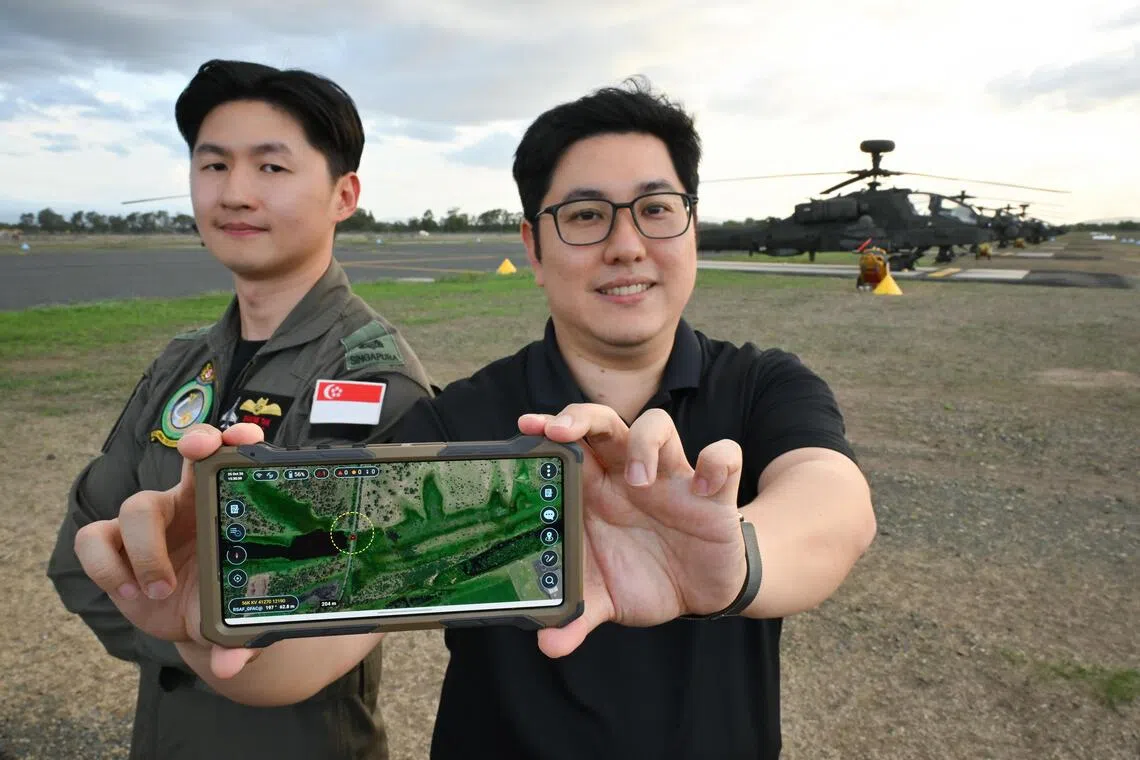
DACAS project lead Shayne Tan (left), 34, and DACAS developer Adriel Chua, 40.
ST PHOTO: LIM YAOHUI
Traditionally, the two sides go through a 12-step checklist before an air strike is greenlit. This checklist includes assessing the strike’s effectiveness, the safety of flying in and out, reading back coordinates and real-time situation updates.
The app has transformed a formerly voice-operated process into a digital one, saving time while addressing the challenges of voice communication, said project lead Shayne Tan.
For example, verbal communication may be cut off when an aircraft is behind terrain.
The tool also allows for a continuous information flow between ground and air units, which improves the tracking of enemy forces and target areas, said Tan. It uses the SAF’s Battlefield Management System to relay critical information, such as friendly and enemy positions, to pilots.
Voice communication had been a pain point for AH-64 pilot Tan Yao Bin, who said coordinates might get jumbled.
“With the string of latitude and longitude numbers and poor communication, pilots might read back the wrong information to the guys on the ground. Then they will go back and forth trying to clarify what is the correct information,” the pilot said.
He said the DACAS has been a huge improvement in how he carries out air strikes, compared with his experience in the previous two Exercise Wallaby outings.
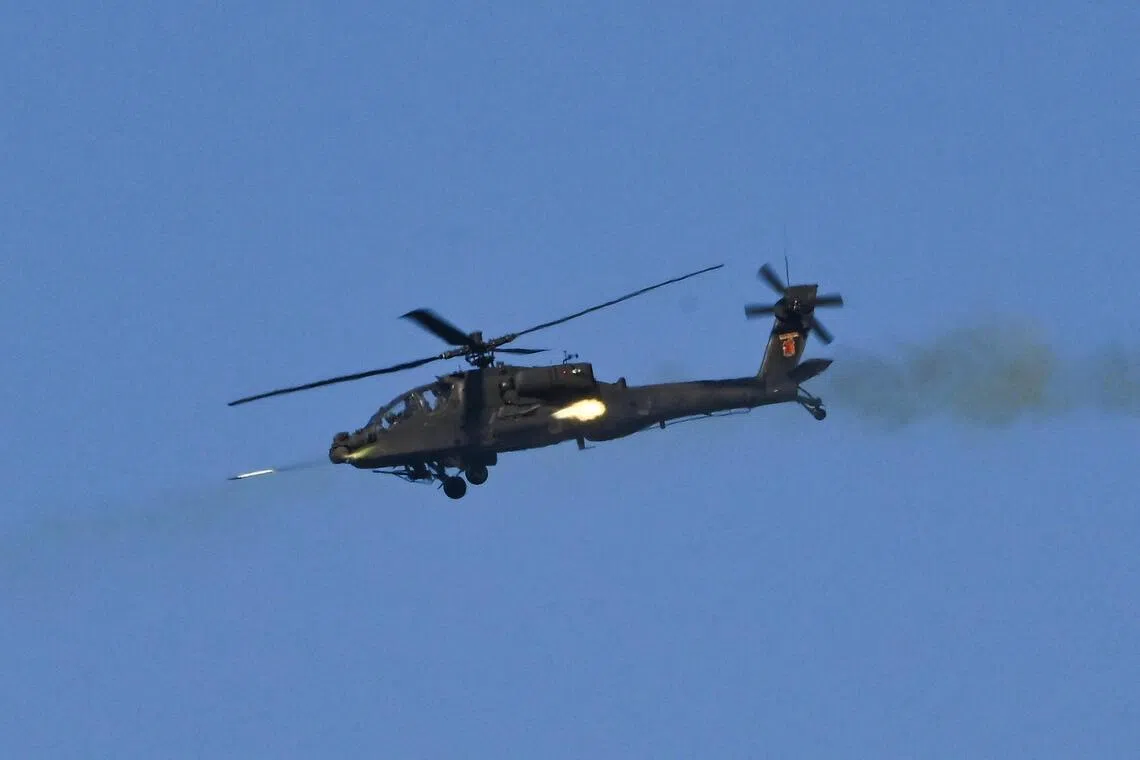
The Digitally-Aided Close Air Support (DACAS) has shortened the time needed to call an air strike by 50% to 80%.
ST PHOTO: LIM YAOHUI
Exercise Wallaby frame 3 air director Ng Kehang said the deployment of both systems is crucial as the SAF adapts to congested operating environments, including airspace that is crowded with unmanned aerial vehicles.
Going forward, the project teams are focusing on several key enhancements.
The Heli DSS has been developed as a “white-box” AI system, where decision pathways are transparent to human operators. Cai said the immediate priority is integrating machine learning, where the system learns directly from commander and pilot feedback, refining future flight proposals based on which routes aircrews accept, tweak or reject.
For DACAS, developers from the RSAF and the Defence Science and Technology Agency (DSTA) said they intend to refine the app’s visual interface and readability, to ensure strike pilots can absorb critical targeting data even more seamlessly in high-tempo combat environments.
KioskNews shows a cleaned-up reading view extracted from the publisher’s page — the original always lives on their site, not ours.