Analysis: Mamata Banerjee Has A Delhi Mission After Her Bengal Defeat
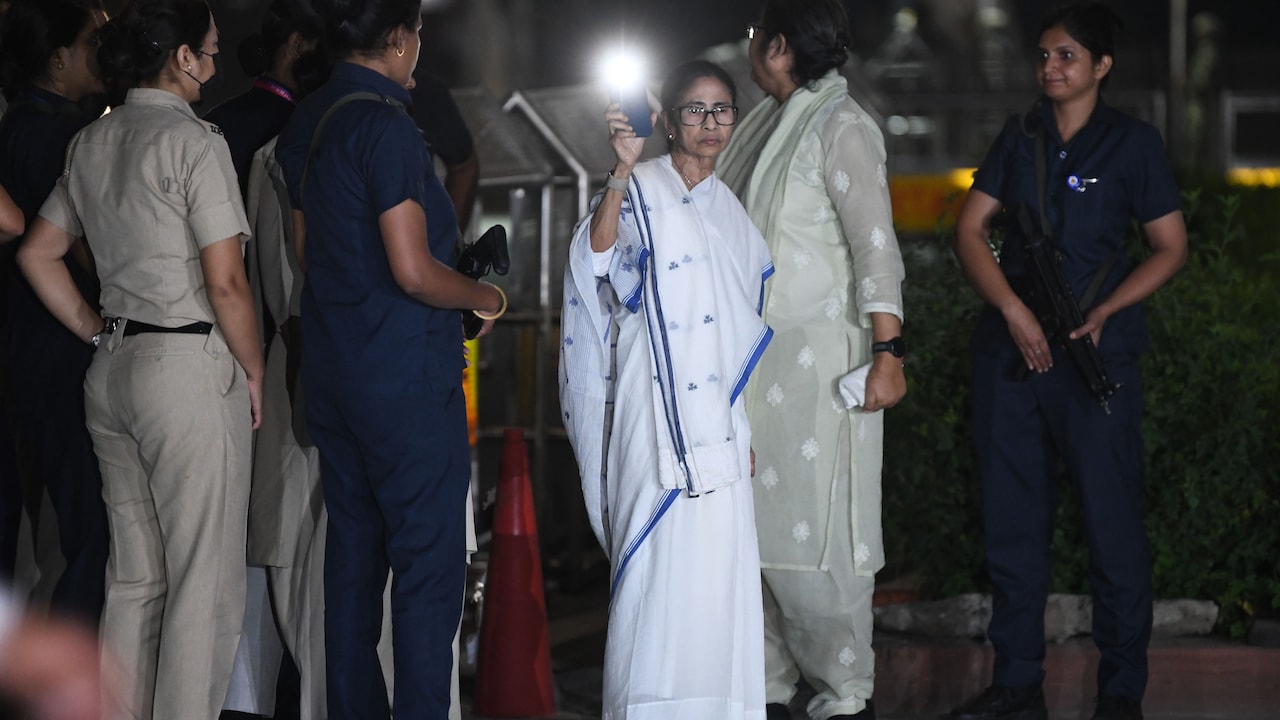
When the INDIA bloc met President Droupadi Murmu on Friday night to raise the issue of alleged electoral fraud, the delegation of 10 led by Rahul Gandhi included Mamata Banerjee. A former chief minister of 15 years, a seven-time MP and three-time union minister, Banerjee carries her own weight in the Opposition camp, and is also a leading woman face among them. But as she spends more and more time in Delhi, there is a growing sense that her political focus is gradually shifting from Kolkata to the national capital.
After the debacle in the 2026 West Bengal Assembly elections, Mamata Banerjee's political gaze is no longer confined to the state. Delhi has now become an important part of her political strategy.
So, what exactly is Mamata Banerjee's Delhi mission?
Most political analysts are saying that the future of the Trinamool Congress is uncertain. The TMC was created and built by Mamata Banerjee, and now stands divided. If Mamata herself has no political future, what happens to the original party? There is also another reality. Mamata's political strength and glory are not what they once were, and even age is no longer entirely on her side at 71.
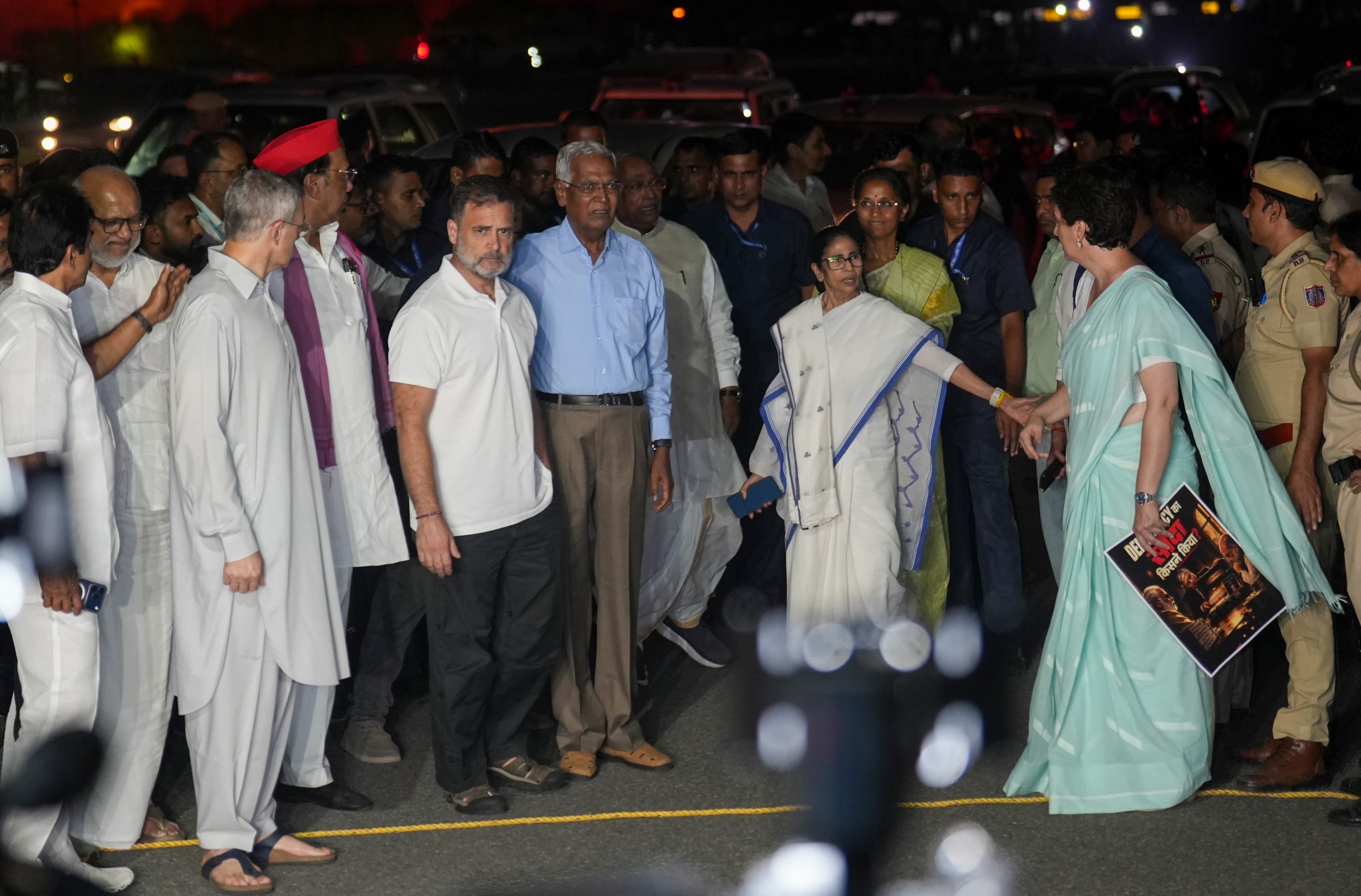
A delegation of INDIA bloc consisting of Congress President Mallikarjun Kharge, LOP Rahul Gandhi, TMC founder Mamata Banerjee and others after meeting President Droupadi Murmu.
Photo: PTI
She is apparently trying to build a new bonhomie with the Congress leadership, particularly Rahul Gandhi. And as the 2029 Lok Sabha elections gradually come closer, the larger all-India political situation is also changing.
There is a familiar political pattern at the Centre: after a government has been in power for a long period, anti-incumbency eventually begins to emerge. It is almost a law of politics, if not a law of nature.
Therefore, as 2029 approaches, the Opposition is trying to identify issues that can be turned into a national political movement against the BJP-led government at the Centre.
One such issue is the Election Commission and the Special Intensive Revision, or SIR, of electoral rolls. After The Indian Express reported on internal differences within the Election Commission over the SIR, Opposition parties have attempted to mobilise politically around the issue.
Rahul Gandhi has pointedly been trying to mobilise people around what he describes as the issue of "vote chori", and the campaign has continued to expand beyond Parliament into public demonstrations.
In recent days, the Opposition's protests have intensified, with Rahul Gandhi and other leaders taking part in demonstrations in Delhi.
At the same time, a new generation of political activists is becoming important. The Gen Z constituency is increasingly critical in contemporary politics, and the youth-led Cockroach Janta Party movement has also become active around this issue.
What strategy the BJP will adopt in response is a separate part of the story. But Mamata Banerjee is now trying to argue that the SIR contributed to her electoral defeat against the BJP. She is attempting to transform what she sees as a political disadvantage into a political asset in Delhi. She has received support from Rahul Gandhi, Akhilesh Yadav, Sharad Pawar and other Opposition leaders. The significance of this is that Mamata is no longer standing alone on the SIR issue. She is becoming part of a larger national Opposition campaign.
Mamata and CPI(M) general secretary MA Baby have also opened communication channels over the issue, despite the bitter political rivalry between the TMC and the Left in West Bengal.
There is another major change in Mamata Banerjee's political position. She has accepted the leadership of Congress at the national level. Mamata has said that if Rahul Gandhi becomes the Prime Ministerial candidate of a united Opposition, she is prepared to accept that. This was not her earlier position.
For years, Mamata Banerjee remained highly critical of Congress. In West Bengal, there was no seat adjustment between the TMC and Congress in recent elections. Congress went into electoral battles as a partner of the Left.
Mamata's earlier position was very clear: first Congress had to leave the Left, and only then could she consider an alliance with Congress. Now the political situation has changed dramatically.
Mamata is also trying to reposition herself not merely as the leader of a defeated regional party, but as a national Opposition leader.
Sonia Gandhi and Rahul Gandhi, meanwhile, are publicly supporting Mamata and trying to bring her closer to the Congress-led Opposition.
This is not simply a photo opportunity. There is a political calculation behind it.
In Delhi, Mamata Banerjee is not being viewed only as a defeated TMC leader from West Bengal. She remains one of the country's traditionally aggressive political faces.
She has been a Member of Parliament seven times. She has also served as a Union Cabinet minister three times in Delhi. Therefore, in the national capital, Mamata Banerjee is not an unknown political face. She has a history. She has a national political identity. And she has demonstrated her ability to fight the BJP and other major political forces.
One senior Congress leader recently recalled that around six years ago, Congress had proposed an alliance with Mamata Banerjee to combat Narendra Modi and the BJP. The same proposition was also put before Sharad Pawar. At that time, Mamata Banerjee was not prepared to accept the proposal. Sharad Pawar was also not prepared to accept it, and according to this assessment, Pawar remains unwilling even today. But after Mamata's defeat in West Bengal, she has realised that she may not have many other political options.
That is where Bengal Congress leader Adhir Ranjan Chowdhury's recent proposal becomes important. He has said Mamata Banerjee could merge the TMC with Congress and could even become the Congress leader in West Bengal.
But that would be extremely difficult for Mamata Banerjee to accept. Because if the TMC disappears into Congress, the party that Mamata created would effectively cease to exist as an independent political organisation. For the TMC, that would be an existential crisis.
Mamata may have accepted Rahul Gandhi's leadership at the national level, but that does not automatically mean that she is ready to surrender the identity of her own party in Bengal.
And another question remains unanswered: would the Congress leadership in West Bengal be prepared to accept Mamata Banerjee as its leader? That does not have an easy answer. Because, in West Bengal, Congress cannot grow independently without criticising both the BJP and the TMC.
If Congress wants to become the principal opposition force in Bengal, it has to fight the BJP. But it also has to fight the TMC. The independent growth of Congress is therefore dependent not only on opposing the BJP but also on challenging Mamata Banerjee's political legacy.
There is still an anti-incumbency sentiment against the TMC after its 15 years in power. That remains a political issue that Congress would have to address.
This is the fundamental contradiction in Mamata's new strategy with Delhi at its centre.
In effect, she is attempting to convert her weakness in Bengal into a strength in Delhi. The SIR issue has given her one political opportunity. The Gyanesh Kumar issue has given the Opposition another. And the larger electoral controversy has brought the Opposition parties together.
The Opposition knows that it cannot win an impeachment motion in Parliament. That is not necessarily the immediate objective. The objective is to take the issue to the public. They want to build a political campaign around it. They want to turn it into an electoral issue. And in this entire scenario, Mamata Banerjee is trying to preserve her relevance in Delhi. Not from Kolkata. That is the central point of Mamata Banerjee's new Delhi mission.
KioskNews shows a cleaned-up reading view extracted from the publisher’s page — the original always lives on their site, not ours.