‘It’s an architect’s dream’: five beautiful eco buildings around the world
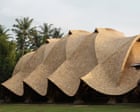
With construction accounting for more than a third of global emissions, sustainable architecture is central to the world meeting its climate targets. The following five creations from around the world exemplify how “green” buildings can also be beautiful.
Children’s Village, Tocantins, Brazil
In Tocantins, central Brazil, the Canuanã school is a boarding school whose pupils come from remote farming communities across the region. In 2017, architects gave the school’s 540 boarders two new “villages” of dormitories, one for girls and one for boys.
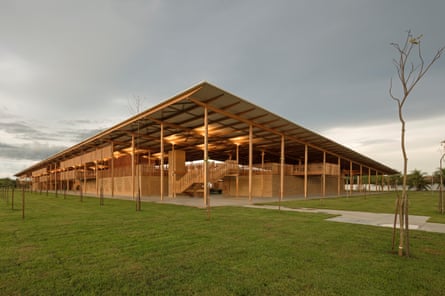
The buildings are made from locally sourced timber and earth bricks. A vast canopy shades the complex, and perforated brick walls let air pass through, so the bedrooms stay comfortable without air conditioning even when temperatures reach 45C. Under the roof, rooms open on to shady, landscaped courtyards and airy verandas.
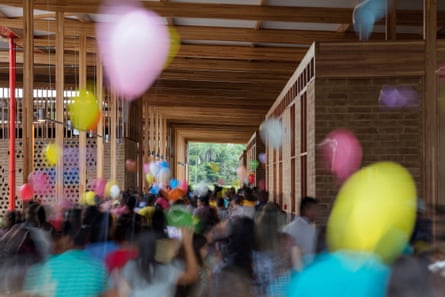
David Mikhail, the co-founder of Mikhail Riches, a UK practice specialising in sustainable design, says: “It is absolutely fantastic. So beautiful. It does a lot with little resource, which is the essence of a sustainable approach.” He adds: “I love the economy of it, and the huge sense of place they managed to evoke through such elegant and limited means.”
The architects have said their biggest challenge was convincing pupils and teachers that earth, brick and timber could feel modern rather than old-fashioned. They managed to do so by listening to students through 10 days of workshops to understand what they wanted from the design.
The Arc, Bali, Indonesia
The Green school in Bali is surrounded by jungle and promotes sustainability through learning in a natural environment. Since it opened in 2008, it has been built almost entirely in bamboo. Its gymnasium, the Arc, was completed in 2021.
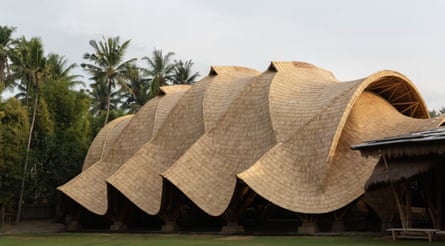
Inspired by a mammal’s ribcage, the Arc’s bamboo arches span a 760 sq metre sports court without a single column interrupting the floor space. The arches support an undulating canopy, and natural ventilation comes from breezes that flow in at the base, while warm air escapes through vents at the top.
Bamboo is a highly sustainable building material because of how quickly it can regrow; large varieties reach building strength in just three to six years. “It is so fast-growing and sequesters a lot of carbon dioxide very quickly, so using it for building is a bit of a no-brainer if you can make it work,” says Mikhail. “And not only have they made it work, they’ve done it absolutely beautifully.”
Sara Kulturhus, Skellefteå, Sweden
Skellefteå, a small city just south of the Arctic Circle, is surrounded by 480,000 hectares (1.2m acres) of forest, and features wooden schools, a wooden road bridge, even a wooden multistorey car park. In 2021 it added Sara Kulturhus, a 20-storey cultural centre and hotel that is one of the tallest timber buildings in the world. It houses two theatres, a museum, an art gallery, the city library and a hotel.
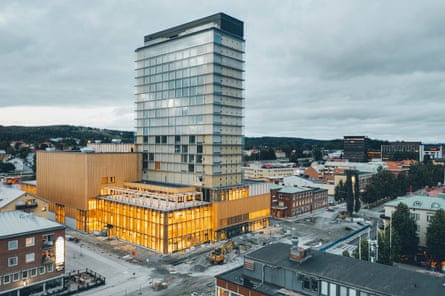
The building is made of glulam – layers of timber glued together – and cross-laminated timber, a kind of super-sized plywood. The hotel rooms arrived as prefabricated wooden pods and were stacked into place. Building in wood saved a year in construction time compared with steel and concrete, while the timber came from trees harvested within 40 miles of the site, and replacement trees have since been planted.
“It promotes a love affair with wood and timber, and the localism of that in an area like Sweden is fabulous,” Mikhail says. “The lovely thing about cross-laminated timber is that the trees you use to make the panels don’t have to be elderly specimen trees. They can be relatively fast-grown and sustainably farmed.”
The Forest, Hobart, Australia
When the University of Tasmania was planning the redevelopment of its main campus in central Hobart, the architects chose to adapt what was already there rather than demolish it and start again. Two early 20th-century brick warehouses and a heritage-listed glass dome were stitched together into a single campus of classrooms and study spaces, which opened in February 2026.
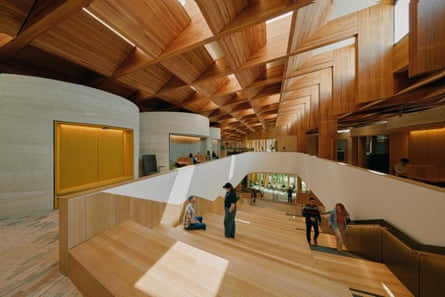
At its heart is the glass dome, built in 1997. It is filled with about 3,200 native plants, including various species of ferns, and has an integrated watering, misting and fogging system that recreates rainforest-like growing conditions.
“You could argue the most sustainable building is actually no building, and the second most sustainable building is a refurbished old building,” says Mikhail. “That’s what this is: they’re taking existing structures and breathing new life into them, reimagining what they could be.”
Rammed Earth House, Cranborne Chase, UK
On the site of a former brickworks in the Wiltshire countryside, this house has been built from the ground beneath it. Rammed earth, which has been used since the Neolithic period, is a building material made of soil that has been compacted layer by layer into thick walls. Here, clay-rich soil was dug up and mixed with rubble from demolished outbuildings and local limestone.
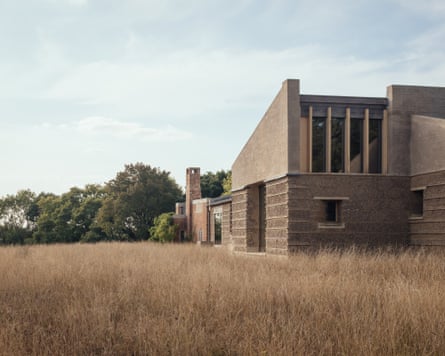
The earth is “unstabilised”, meaning no cement has been added, which makes this one of only a few UK buildings made that way. Unstabilised earth could, in principle, simply go back into the ground if the house were ever demolished.
Rammed earth’s thermal mass also evens out temperature and moisture indoors, which the architects say will matter more as the climate warms. “As a piece of architecture, I think it’s phenomenal,” says Mikhail. “It’s an architect’s dream, and I’m slightly envious of it, I’ll be honest.”
“It’s like a beautiful piece of jewellery, and it riffs on lots of really lovely sustainable ideas.”
KioskNews shows a cleaned-up reading view extracted from the publisher’s page — the original always lives on their site, not ours.