Singapore, Germany to collaborate on AI use in industries, step up research on new tech
SINGAPORE - Singapore and Germany will deepen cooperation in the digital realm, particularly in the development and deployment of artificial intelligence for the industrial sector.
This comes as both countries announced a refreshed roadmap to further bilateral ties and collaboration on Oct 27, after a meeting between Prime Minister Lawrence Wong and German Chancellor Friedrich Merz.
At a joint press conference at Parliament House, PM Wong said both leaders had a fruitful discussion and agreed there was much more to be accomplished together under the strategic partnership between Singapore and Germany.
The updated joint work plan covers collaboration in areas such as AI, digital economy, research and innovation, and ASEAN, among others, and builds on an earlier roadmap from 2024.
“Singapore and Germany may be geographically far apart, but we share many common interests and convictions, and this was very clear from our discussions this morning,” said PM Wong.
“These shared convictions have underpinned our friendship over the past six decades. And in a world that is becoming more uncertain and fragmented, our ties will be even more important in bringing our two countries and our two regions closer together.”
The German leader agreed, adding that Singapore and Germany are “firmly convinced to further develop our strategic partnership, and we are in for the long haul”.
On AI, PM Wong said both leaders recognise the enormous potential of the technology to transform their countries’ economies and create new opportunities for businesses and workers.
That is why both sides want to move beyond digital technologies to work together on industrial AI, he said.
Industrial AI involves the application of the technology in physical operations, robotics and machinery, such as in manufacturing systems and logistics systems.
PM Wong said Singapore and Germany bring complementary strengths to the table to this end.
“At the same time, we recognise that AI brings new risks and challenges,” he added.
“And so, even as we cooperate on AI deployment, we will ensure that this is done in a way that remains safe, trusted, and human-centred.”
In response to a question from the media on whether middle powers can work together on AI to overtake bigger powers like the United States and China, PM Wong noted that a lot of the frontier developments are taking place in America and to some extent China.
Singapore is focused on the application of AI where it has some advantages to offer, said PM Wong.
As a small, compact, and highly connected society where there is rule of law and clear protections for intellectual property, Singapore can push the frontiers of actual AI deployment in healthcare, logistics, finance, and advanced manufacturing.
Chancellor Merz said both countries’ will also work together on AI security, through their newly set up AI safety and security institutions.
Singapore and Germany will also further cooperation in research and innovation, said PM Wong.
In conjunction with the Singapore-Germany Year of Innovation, both countries intend to pursue more joint research and innovation projects in emerging technologies, covering areas such as AI, advanced manufacturing, green technologies, semiconductors, quantum, and space technologies, he added.
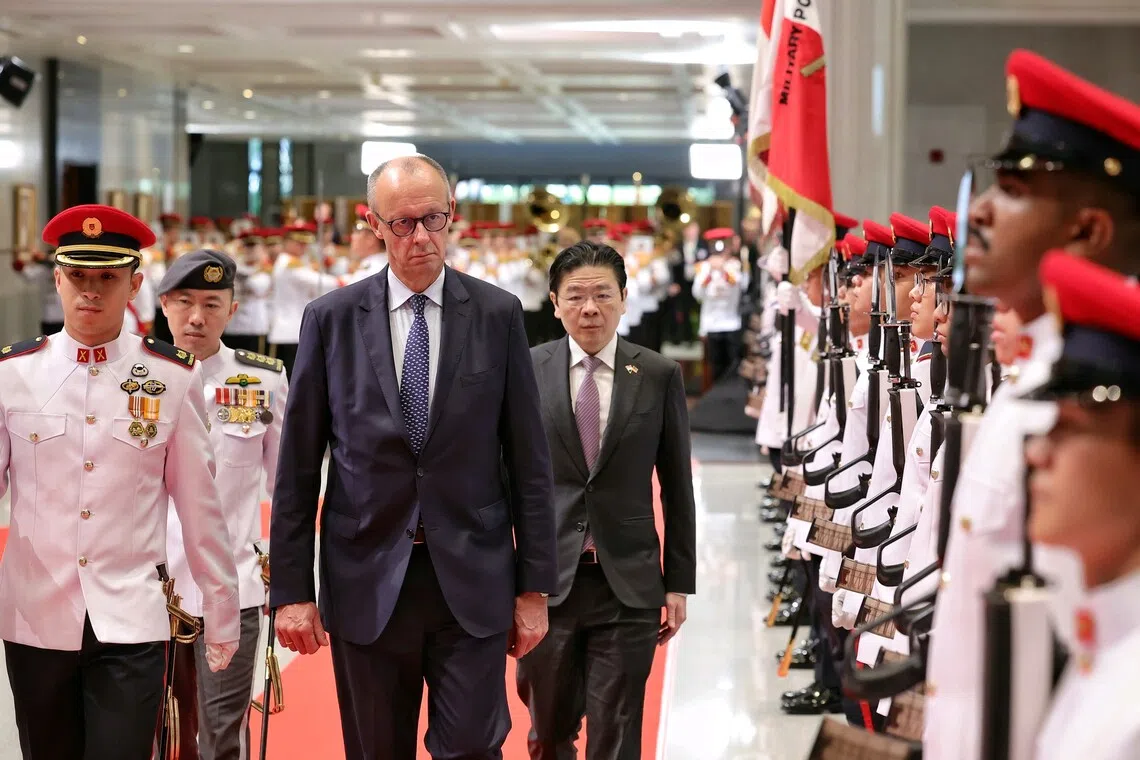
Chancellor of Germany Friedrich Merz (left), accompanied by Prime Minister and Minister for Finance Lawrence Wong, inspecting the guard of honour during a ceremonial welcome at the Parliament House on Oct 27.
ST PHOTO: KEVIN LIM
He noted that the strong German academic and research presence here – the Technical University of Munich campus opened in Singapore 2002, and the Max-Planck Centres for Data Driven Chemistry and Biocultural Worlding in April – has created valuable opportunities for collaboration over the years.
Amid a more fragmented world, both sides will also work to strengthen cooperation between ASEAN and the European Union, which marks 50 years of relations in 2026.
“The zeitgeist is turning against openness and trade, our response is not to turn inwards. Instead, it is to work with like-minded partners to build new connections,” said PM Wong.
He said as ASEAN chair in 2027, Singapore will work with Germany to deepen the 11-member grouping’s partnership with the EU, including by making progress towards an ASEAN-EU free trade agreement.
Asked about concrete steps towards this pact, PM Wong said it will be “challenging” and “complex” but there is reason for some optimism.
The EU has started to establish bilateral trade pacts with individual ASEAN countries such as Singapore and Vietnam, and is negotiating more such pacts with Indonesia, Malaysia and Thailand.
“That gives us more confidence that ASEAN as a bloc can also make progress in our trade discussions for a free trade agreement with the EU,” he said.
Besides trade, both sides are also looking at how to bring the digital systems of the two regions together, he said, citing ASEAN’s Digital Economy Framework Agreement, the first region-wide agreement on digital economy governance covering areas such as digital trade, cross-border e-commerce, cyber security, digital identity, digital payments and cross-border data flows.
He noted that Germany was made an ASEAN sectoral dialogue partner in July, an important step in bringing Germany and South-east Asia closer together.
Many of the 2,900 German companies based here use Singapore as a gateway to access opportunities across ASEAN and the wider Pacific region, he said.
Chancellor Merz, speaking at the press conference, said amid geopolitical instability in the world, there is “a very good chance of achieving an even deeper cooperation with the countries of the region”.
Speaking in German, he said he was in favour of working to integrate the existing free trade structures with Germany’s different regional partners like Singapore, Malaysia, India, and Indonesia.
“This will open up better opportunities in the region to us and our companies,” he said.
He said Germany was also ready to support the ASEAN power grid initiative, that aims to connect electricity networks across the region to enable cross-border energy trading and enhance energy security.
PM Wong said Singapore and Germany are also natural partners in upholding the international rules-based order, with both countries committed to international law and multilateral cooperation.
He welcomed Germany’s endorsement of the the Guiding Principles for Underwater Infrastructure Defence Exchanges, or GUIDE, a voluntary initiative focused on protecting critical underwater infrastructure like subsea cables and pipelines
Singapore is among the 17 founding members of the initiative launched earlier this year.
PM Wong said it has strengthened cooperation across regions to protect critical underwater infrastructure, which is essential to security and connectivity.
“We believe that countries large and small benefit from a world where the rules are respected, commitments are honored, and disputes resolved peacefully,” he added.
KioskNews shows a cleaned-up reading view extracted from the publisher’s page — the original always lives on their site, not ours.