[Guest essay] This Chuseok, think of the seasonal workers who plant and pick your food
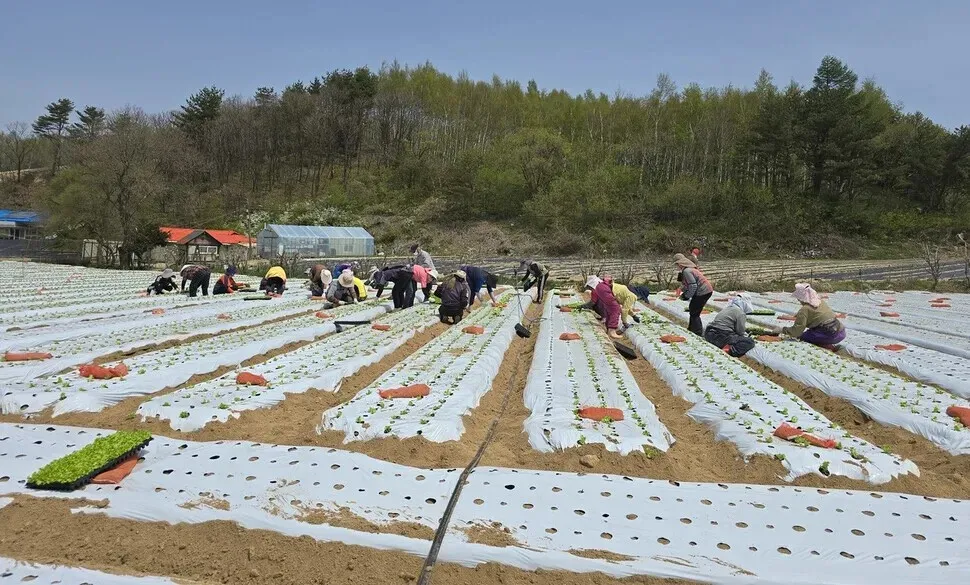
Seasonal workers plant caipira lettuce at a farm in Pyeongchang, Gangwon Province. (courtesy of the author)

By Lochana (alias), seasonal worker in Korea
I am a seasonal worker from Laos. Many of the Korean farmers I’ve worked with have affectionately referred to me as a “son” because of my knack for the work, my dedication to timeliness and my diligent and positive attitude.
I was born in a poor rural village in Laos’s Sainyabuli Province. My parents were rice farmers and raised a little livestock but struggled to put food on the table for all six of us. Now, my older sister and I are working along the slopes of Pyeongchang, Korea, where we grow caipira lettuce, potatoes and carrots to support our family.
I first came to Korea on July 13, 2023. People who come to Korea on seasonal worker visas (E-8), as I did, are eligible to stay for up to eight months, working in rural areas that face labor shortages. For four years now, I come to Korea in the busy season, am placed through official work placement agencies, all above board, and return to Laos when my contract period ends.
It wasn’t easy to get to Korea in the first place. First, I needed to scrape together US$2,500 — a massive sum in Laos. Then there were the additional expenses that I needed to cover, from visa fees and health check costs to my plane ticket, and the costs involved in the paperwork, including a residence registration confirmation, an ID, a passport, land registration and more.
When I arrived in Korea, the workplace I was sent to was not the one specified in my contract. In the five months that I spent working in Andong in 2023, I had to switch workplaces no fewer than three times.
The first farm I had been sent to didn’t even have a bathroom in the accommodation for the five of us workers, who were forced to live in a cramped shipping container. It goes without saying that there was no Wi-Fi to get in touch with my family back home. We were barely able to wash ourselves and weren’t even afforded the dignity of using a proper toilet.
Unable to bear the degrading conditions there, I asked to be moved to another farm.
At the second farm I was sent to, I was assaulted by four of my coworkers. I had been sleeping, and they had been drunk. The attack left me severely injured. I reported the incident to a representative of Lao workers and the company in charge, and even asked the police for help, but no one took any responsibility. Fearing for my safety, I had no choice but to ask to once again be moved to another workplace.
The third farm I worked at was a horror show. I worked harvesting industrial hemp — yes, the drug — and the smell of it gave me splitting headaches. The work was hard — 12 hours a day without breaks, working myself to the bone, all for a mere 50,000 won a day.
Then there was my employer’s demeaning verbal abuse and his repeated kicking of me. I couldn’t take it anymore, so I once again asked to be placed elsewhere.
But the manpower agency said that there weren’t any records and said it wasn’t their responsibility to deal with. The Labor Ministry’s response for short-term workers took too long.
In the end, 16 seasonal workers left the farm in the span of a month. I myself was forced to return to Laos.
Korea needs to improve its current policies for migrant workers changing workplaces. Seasonal workers need to be able to switch jobs with no questions asked if they aren’t given long-term work, are physically assaulted, or have their wages withheld. Something must change so that innocent workers aren’t sent back to their home countries against their will because of the Kafkaesque procedure for changing workplaces.
I was very saddened to hear that a seasonal worker from Laos recently died after working during Korea’s oppressive heat wave. There’s no knowing how much break time their supervisor gave them, but I do know that if they had adjusted their work schedule to avoid working during the hottest hours of the day, there’s a good chance that the worker would still be with us today. Many supervisors force those working under them to keep going, thinking only of what they stand to gain in profit instead of the lives of those working.
Seasonal workers play an important role in getting through the busy farming seasons in rural Korea. I love agriculture, and I am very proud of the life I’ve built in Korea — learning advanced farming technologies, getting to know my coworkers, and growing through our work.
I want to see seasonal workers in Korea enjoy a better quality of life and make the world around them a better place. Seasonal workers aren’t tools to be used when there is a labor shortage and later discarded. I hope that Koreans will see us as neighbors working alongside them, sharing the sweat of hard work, and sharing in the fruits of our efforts.
KioskNews shows a cleaned-up reading view extracted from the publisher’s page — the original always lives on their site, not ours.