'Attacked Thrice After Talks': Iran President Says US Dialogue 'Pointless'
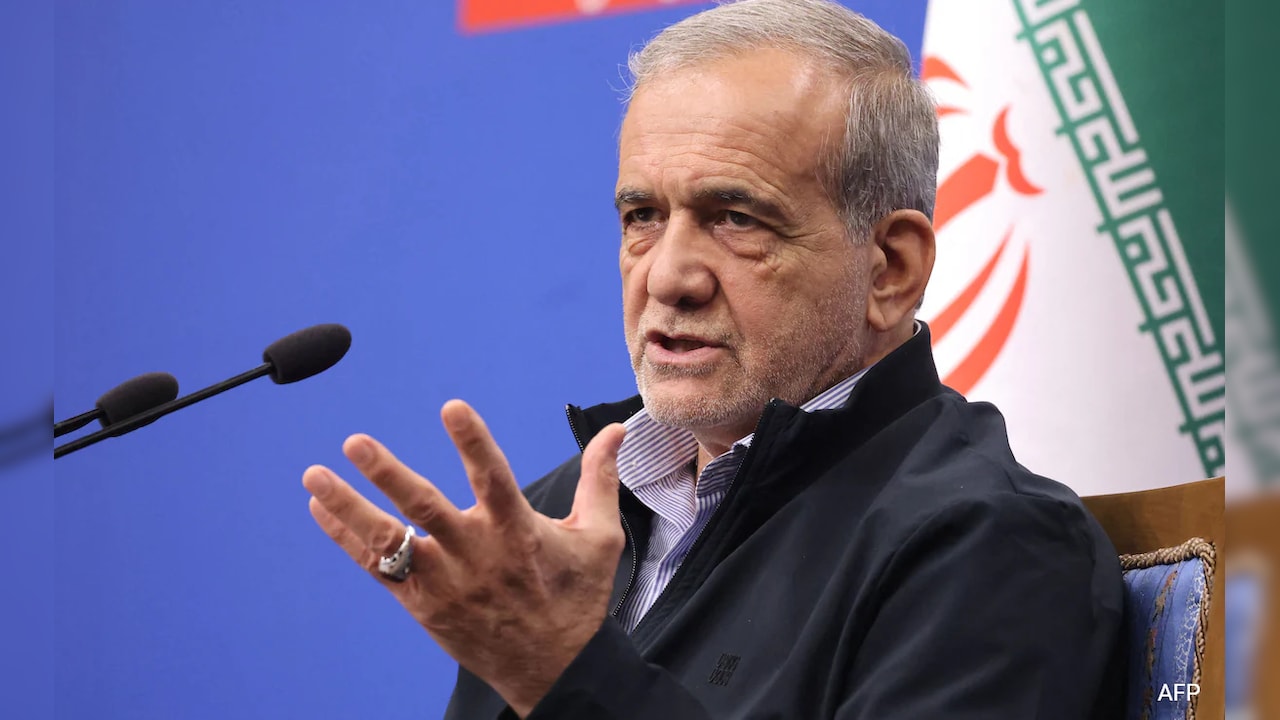
Iranian President Masoud Pezeshkian said Monday that negotiations with the United States were "meaningless" and only resulted in renewed attacks, state media reported, with progress on ending the Middle East war stalled for months.
"So far, they have attacked us three times after talks, and this shows that they are not seeking dialogue; rather, their goal is to overthrow the Islamic Republic of Iran," Pezeshkian was quoted as saying by the state news agency IRNA.
"With an enemy that every day resorts to assassination, sanctions, pressure and threats, and that breaks its commitments, negotiations are meaningless."
The Middle East war was started in late February by the US and Israel when they launched a wave of surprise attacks on Iran, even as Washington and Tehran were in the midst of negotiations on Iran's nuclear programme.
The warring parties agreed a memorandum of understanding in June that spelled out a framework for a permanent resolution to the conflict, but Iranian attacks on vessels in the Strait of Hormuz prompted a return to US military operations.
Negotiations have effectively been at an impasse since then, and recent indirect talks between the US and Iran on the sidelines of the UN General Assembly failed to produce a breakthrough.
Washington in recent weeks has dialled back military operations in favour of economic pressure, and has not struck Iran since September 1.
On Sunday, Iran's top diplomat insisted the United States' war against the Islamic republic would not be resolved by military means.
Vowing a stronger defence if any attacks resumed, Foreign Minister Abbas Araghchi said: "There is no military solution, nor any solution based on new sanctions."
"Only negotiations based on justice and fairness" could end the conflict, he added.
The United States and Israel have said the war is necessary to prevent Iran from acquiring nuclear weapons -- a goal it has long denied pursuing -- though the focus soon shifted to reopening the Strait of Hormuz after its closure sent shockwaves through world energy markets.
Iran has sought to impose its control over the vital shipping lane since the start of the war, striking vessels that attempt to transit without its authorisation.
The US has imposed its own counterblockade of Iranian ports, and has also struck vessels it accuses of violating it.
A tanker was struck while attempting to transit the waterway on Sunday, while another turned back on Monday after being threatened with attack by Iranian forces, according to the British maritime agency UKMTO.
(Except for the headline, this story has not been edited by NDTV staff and is published from a syndicated feed.)
KioskNews shows a cleaned-up reading view extracted from the publisher’s page — the original always lives on their site, not ours.