Market discipline first, taxpayer support last for AirAsia’s woes — Jane Yu
SEPTEMBER 15 — For weeks, a government-appointed review of AirAsia’s finances has raised one question: will the government eventually be asked to bail it out? AirAsia CEO Tony Fernandes has pushed back, saying AirAsia does not need a bailout and can sort out its financing privately.
As a taxpayer, that is reassuring. But it does not settle the issue.
If everything is under control, why is the government preparing for the possibility that it is not?
The stress is real
AirAsia may insist that it does not need rescuing, but there are clear signs that the airline is under financial pressure.
AirAsia’s current problems did not appear overnight. Fuel prices have certainly hurt. The airline said average jet fuel prices reached US$183 per barrel in the second quarter, contributing to a RM830.5 million quarterly loss.
But the group was already restructuring hundreds of millions of dollars in debt at the start of the year, before the latest fuel shock. In January, it was targeting US$500 million to US$600 million in debt restructuring. It then raised about US$300 million in March to extend debt tenures and reduce principal obligations.
Now, it is seeking up to US$1 billion from international debt markets and RM700 million locally. As of June 30, it had RM18.4 billion in current liabilities and RM954 million in cash.
Analysts quoted by The Star suggested the airline’s debt-to-equity ratio was 4.7 times, compared with 1.0 times for most top Asian carriers – meaning it carries significantly more debt relative to equity. It has less room to absorb losses, and another shock could hurt more because its balance sheet has less cushion.
Most strikingly, AirAsia has sold six newly delivered A321neo aircraft since last year without putting them into service. That matters, because aircraft are not easy to come by.
Thanks to a supply chain crisis, the International Air Transport Association says airlines may wait up to seven years for a new plane. According to analysts, selling scarce new aircraft suggests that the airline is in urgent need of cash.
That does not mean AirAsia will collapse tomorrow. But it does make it harder to dismiss the government’s concern as mere overreaction.
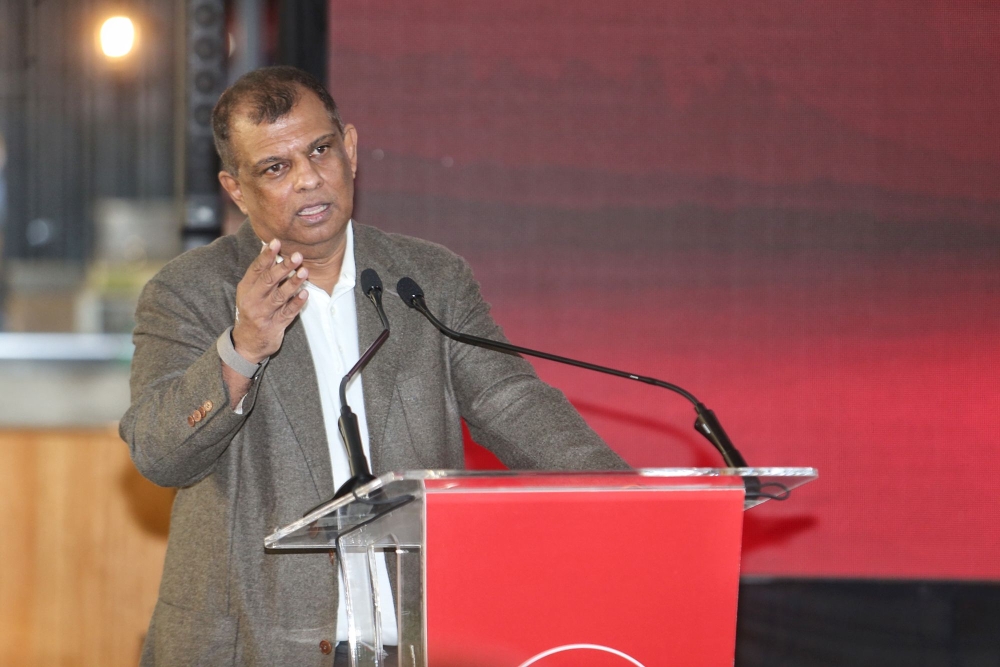
AirAsia co-founder and Capital A chief executive officer Tan Sri Tony Fernandes speaks during the AirAsia Insights Briefing at AirAsia RedQ in Sepang on April 6, 2026. — Picture by Choo Choy May
Too big to fail?
While concern is warranted, it should not be overblown. The problem is that public debate keeps circling back to whether AirAsia is too big to fail. That is jumping the gun: a full collapse is the extreme case, and that is rarely how a struggling company’s story actually plays out.
Fernandes is right that no single airline can replace AirAsia overnight. The Civil Aviation Authority of Malaysia estimates that AirAsia accounted for 33.7 per cent of total passenger traffic in the first quarter of 2026, with Malaysia Airlines second at 17.1 per cent. Any major disruption would affect fares, tourism, jobs and connectivity.
But that does not mean the entire 33.7 per cent is suddenly at risk, unless AirAsia’s finances are far worse than they currently appear.
So if AirAsia has taken on too much, let it scale down. If it has assets that others can use more profitably, let them be sold. Slots and traffic rights can be reassigned to other airlines according to the relevant rules. Lessors can redeploy aircraft. Workers can move to other operators.
The immediate practical question is how much capacity the market can absorb as AirAsia adjusts, and how the government can best facilitate that without disruption. If AirAsia sheds some capacity over time, Batik Air, Malaysia Airlines and other carriers may be able to pick up parts of it where it makes commercial sense.
That is a very different problem from trying to replace the entire airline at once, and this distinction matters. It is a reminder not to treat “too big to fail” as a conclusion before we know what is actually at stake.
Public financing should be the last step
AirAsia is big enough that the government cannot ignore it. That is different from saying every problem AirAsia faces becomes a national problem.
The government’s job is not to “save the company”, but to “protect what the company does” – the routes, the jobs and the competition that has kept flights cheap. Those are not automatically the same thing.
If the airline trims capacity, sells assets or becomes smaller, that may be painful without being catastrophic. The case for government intervention becomes stronger only where the fallout cannot be reasonably commercially absorbed.
Right now, there is no bailout on the cards. But if taxpayers are eventually asked to help, the support cannot simply preserve the status quo. Any rescue should ensure that shareholders and creditors bear an appropriate share of the losses, rather than shifting those losses onto taxpayers. Governance and management changes should be considered. There should also be clear restructuring milestones and a credible path back to sustainable profitability.
Malaysia Airlines itself is the obvious precedent. It went through years of painful restructuring before returning to profitability.
Until AirAsia’s problems are shown to be genuinely catastrophic, we should be careful about treating every reduction in capacity as a systemic “too big to fail” crisis. A smaller AirAsia is not the same as no AirAsia, and gradual retrenchment is something markets are built to absorb.
Let the market work.
* This is the personal opinion of the writer or publication and does not necessarily represent the views of Malay Mail.
KioskNews shows a cleaned-up reading view extracted from the publisher’s page — the original always lives on their site, not ours.