Military draft regulations to be changed
OVERHAUL: Defense officials are planning to change 160 out of the 176 rules governing exemptions and medical discharges from active military service
By Fang Wei-li and Jonathan Chin / Staff reporter, with staff writer and CNA


Defense officials yesterday announced new physical eligibility standards for conscription and a military exercise next month that would include new tanks, drones and command-and-control systems.
Tsai Shih-hung (蔡適鴻), director of the Ministry of National Defense Medical Affairs Bureau’s Department of Health Service and Medical Care, told a news conference at the ministry in Taipei that the height and weight requirements for military draft would be adjusted.
The changes were finalized following the end of the policy’s public comment period on Monday last week, he said.
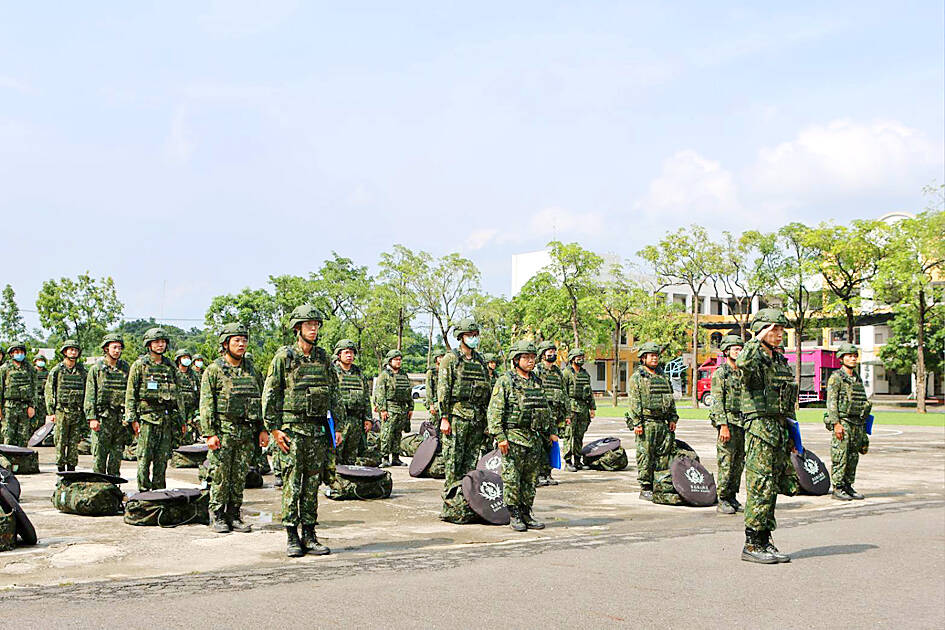
Soldiers take part in a military exercise in Tainan on Aug. 11 last year.
Photo: Fan Wei-li, Taipei Times
The new rules stipulate that people shorter than 1.44m or those with a body mass index (BMI) higher than 45 would be exempted from mandatory military service, as part of extensive changes to the regulations governing physical requirements of active service troops, he said.
The amendments would result in fewer exemptions, as current regulations grant the status to people who are shorter than 1.45m, taller than 1.96m, or whose BMI is under 15 or over 35.
The preview of the regulations for the public comment period showed that officials plan to change 160 out of the 176 rules governing exemptions and medical discharges from active military service.
The rules would simplify the standards for exempting or discharging troops with cancer and gout.
Malignant tumors would lead to a blanket exemption or discharge after the diagnosis has been confirmed with no additional conditions, and people who experience gout-related joint inflammation, joint damage or tophus would be discharged.
Blood pressure standards would remain, but the verification and documentation process is adjusted to prevent draft dodging.
The new rules stipulate that blood pressure must be measured multiple times during one to three uninterrupted days of hospital stay, instead of over 24 hours.
People who have had pulmonary tuberculosis would be medically discharged only if they also showed moderate or severe impairments to lung function,
Separately, Major General Lin Shih-wei (林士偉) told a news conference that the second edition of the national brigade-level drills would pit the 269th Combined Arms Brigade against the 564th Combined Arms Brigade from Oct. 14 to 23.
The event, named “Lu Sheng 2” (陸勝2號), would serve as a certification test for the army’s recently acquired M1A2T Abrams main battle tanks, Taiwan Tactical Network, Eutelsat OneWeb satellite telecommunications and uncrewed aerial vehicles, he said.
The units would engage in simulated combat from the first day of the exercise through its conclusion with no scripted maneuvers or predetermined outcomes, Lin said.
The drills are centered on brigade and battalion-level command and control, fire support coordination, delaying actions, joint air-land operations, and the use of drones and special operations forces, he said.
The army increased Lu Sheng 2’s duration to 10 days from seven days to exercise the troops’ ability to conduct sustained operations without pause, Tsai said.
The exercise area is relocated to Taiwan proper’s strategically important northern region to familiarize units with key terrain features for defensive and offensive operations, he added.
The Army Corps-level headquarters would form commands tasked with coordinating and conducting joint operations, and the reserve commands would liaise between the military and local governments, Lin said.
The exercise should function as an end-of-the-year test for combat preparedness and tactical proficiency for army brigades, he said.
KioskNews shows a cleaned-up reading view extracted from the publisher’s page — the original always lives on their site, not ours.