Chinese robotic dog in hi-tech fire suit withstands blaze at 1,000 degrees Celsius

A robotic dog withstood heat of up to 1,000 degrees Celsius (1,832 Fahrenheit) after it was sent into a blaze in eastern China to test out a new fire-resistant suit, according to state media.
The hi-tech suit – made from a special composite fireproof material – enabled the robotic dog to operate for 10 minutes in the extreme temperatures without damage, the official Science and Technology Daily reported on Thursday.
The technology could potentially be used by firefighters and also the military, according to the team behind it, from the Harbin Institute of Technology Suzhou Research Institute and Sichuan Longjia Aerospace Materials Technology.
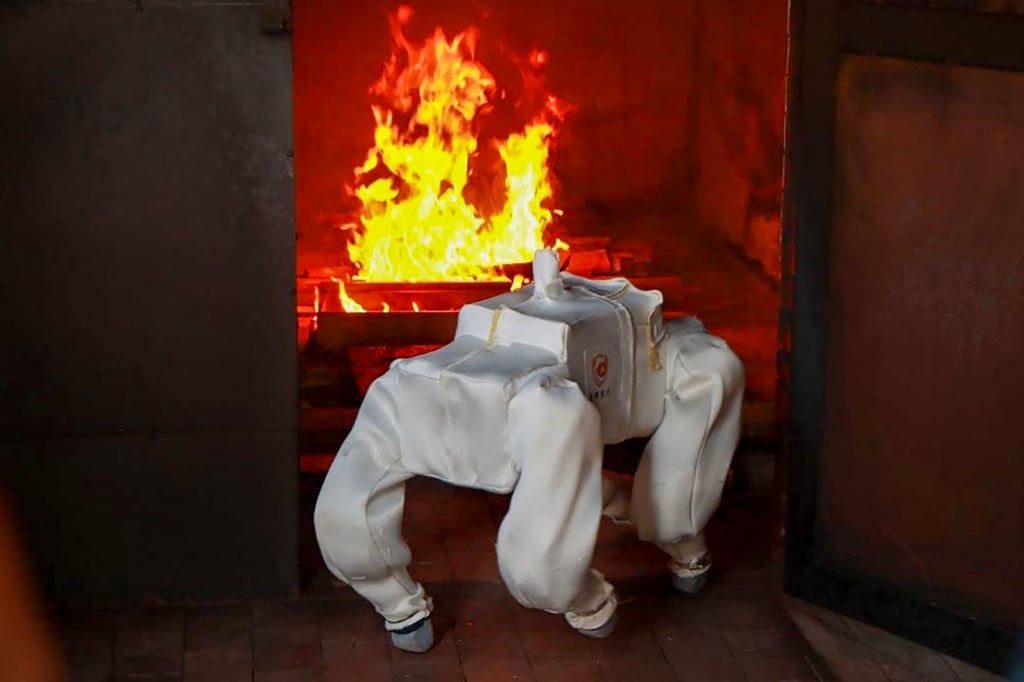
During the test on Wednesday – conducted at a fire station in Suzhou, Jiangsu province – the robotic dog was sent into a blaze fuelled by burning straw and charcoal soaked in petrol.
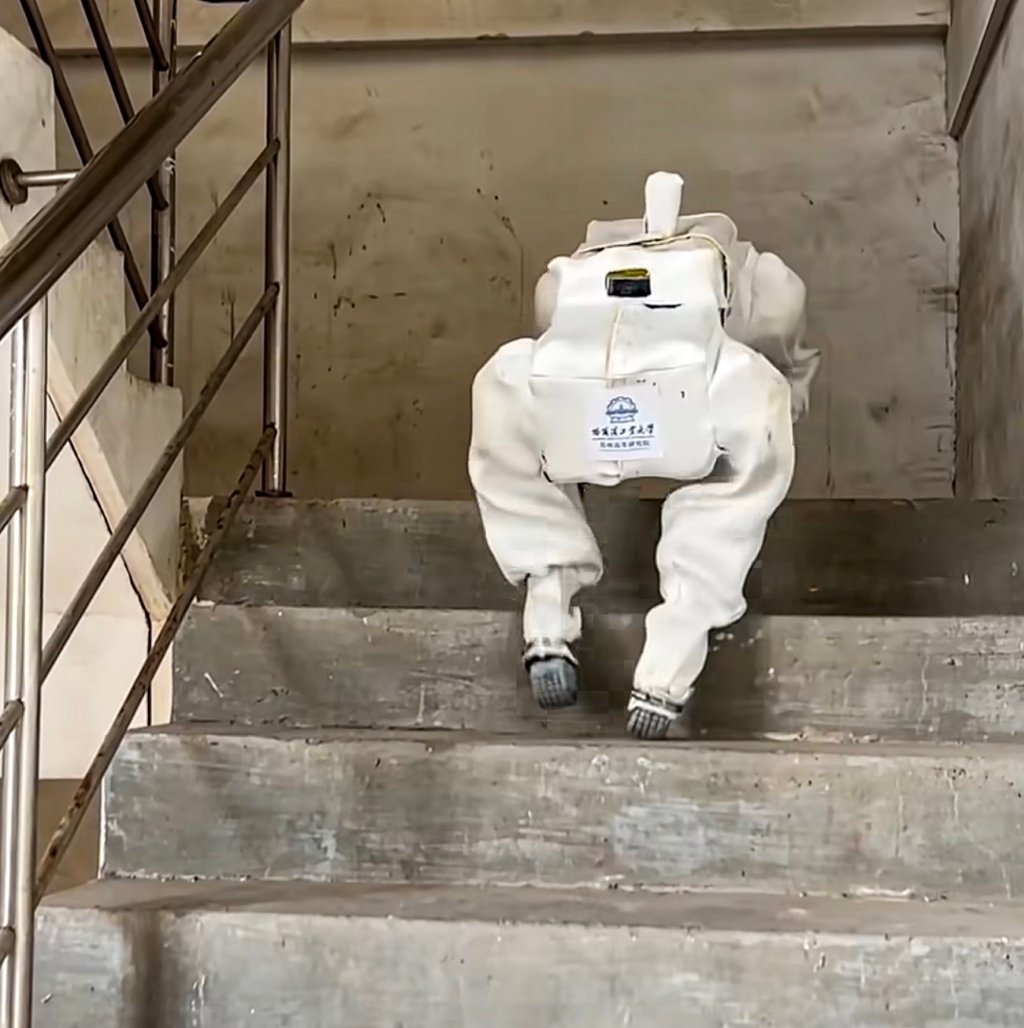
Clad in the protective suit, the robot was able to navigate freely, change direction, climb stairs and remain stationary in the flames.
After it exited the fire 10 minutes later, the outer layer of the suit appeared charred but the robotic dog’s movement remained steady, the report said.
The suit is 5-6mm thick and uses technology adapted from the aerospace thermal protection used by China’s Long March 5 rockets, according to the researchers.
It has a wear-resistant outer layer and inner layers that are engineered for thermal insulation, carbonisation and heat reflection.
The technology addresses a critical vulnerability in drones, quadruped robots and other uncrewed systems – that conventional lithium-ion batteries could be at risk of exploding at temperatures of around 200 degrees, potentially compromising their safety and reliability.
During the test, data from the monitoring system indicated that the internal temperature of the robotic dog’s core battery compartment remained at a cool 45 degrees, while its joint motors reached only 70 degrees, according to the report.
The robotic dog – which was jointly developed with the Jiangsu Provincial Intelligent Robot Technology Innovation Centre – is equipped with laser-gated imaging technology so it can see through dense smoke, as well as 5G and video transmission systems.
These allow operators to control the robot and receive high-definition images reliably, even inside buildings more than 30 storeys tall.
The researchers said that with the protective suit, the robotic dog could handle 95 per cent of fire-scene scenarios to conduct search and rescue missions.
They said the fireproof fabric would soon enter mass production and would hopefully be used in future protective suits for firefighters.
The thermal protection technology could also have military applications. With the ability to operate in extreme heat while maintaining stable communications and real-time imaging, these four-legged robots could potentially be deployed in high-intensity combat zones.
That could be anything from an urban warfare environment or a fuel depot engulfed in flames after an air strike.
The robotic dogs could conduct reconnaissance, enter burning structures, transport supplies across scorched terrain or carry out search-and-rescue operations for wounded personnel without risking human lives.

The People’s Liberation Army is increasingly using robotic dogs in exercises, including for battlefield reconnaissance, logistics, obstacle clearance and armed operations. But the battlefield survivability of the robots remains a concern, and fire protection would address one vulnerability.
The thermal protection technology also has the potential to be applied across a wide range of uncrewed systems, including aerial drones, unmanned ground vehicles and robotic platforms.
According to the researchers, the lightweight, flexible composite material could be customised as an external protective layer, shielding these systems when deployed in hazardous and extreme environments.
KioskNews shows a cleaned-up reading view extracted from the publisher’s page — the original always lives on their site, not ours.