What will Taiwan local elections reveal about 2028 race and cross-strait shifts?

The local elections in Taiwan on Saturday will offer Beijing a window into shifting public sentiment and the island’s political trajectory ahead of its 2028 general poll, with the results potentially affecting city-level cross-strait exchanges, according to analysts.
The “nine-in-one” elections – to decide the island’s mayors, county magistrates and thousands of grass-roots officials – are widely viewed as a midterm test for Taiwan’s leader William Lai Ching-te, who took office in May 2024.
But while Lai’s ruling Democratic Progressive Party (DPP) suffered heavy losses in the previous two local election cycles, a focal point for Beijing will be the renewed cooperation between Taiwan’s two main opposition parties, analysts add.
The question is whether the Kuomintang (KMT) and the smaller Taiwan People’s Party (TPP) – known as the blue and white camps, respectively – can forge a joint ticket two years from now, at what will be a sensitive point in cross-strait relations, they say.
02:53
US midterm elections: What the results mean for mainland China, Taiwan and foreign policy
“Beijing is watching not just the ebb and flow of seats between the blue and green camps but whether public sentiment in Taiwan is shifting,” said Wang Kun-yi, head of the Taiwan International Strategic Study Society.
“Unlike in previous cycles, this election is no longer just a contest over local governance – it is a bellwether for the 2028 leadership race.”
Key figures
Beijing has long framed Taiwan’s local elections as purely municipal affairs, keeping a careful public distance so as not to inflame voter sentiment or hand ammunition to the DPP and its green-clad supporters. Mainland academics have also largely avoided commenting directly.
Yet ahead of Saturday’s vote, Beijing’s Taiwan Affairs Office (TAO) aimed sharp rhetoric at the most closely watched contest, suggesting there would be no prospect of engaging with the mayoral challenger for Taipei, the DPP’s Puma Shen Pao-yang.
The DPP lawmaker – already on Beijing’s sanctions blacklist – has mounted a stronger-than-expected bid against incumbent KMT mayor Wayne Chiang Wan-an, fuelled by a social media-driven campaign phenomenon dubbed the “ocean current”.
Wang Jianmin, a Taiwan affairs expert at Minnan Normal University in Zhangzhou, Fujian province, said the decision to nominate Shen was “in itself an act of confrontation and provocation against the mainland”.
“This electoral strategy is an overt ploy aimed at Beijing – an open defiance,” he added.
Beijing regards Taiwan as part of China to be reunited by force if necessary. Most countries, including the United States, do not recognise Taiwan as an independent state, but Washington is opposed to any attempt to take the self-ruled island by force and is committed to supplying it with weapons.
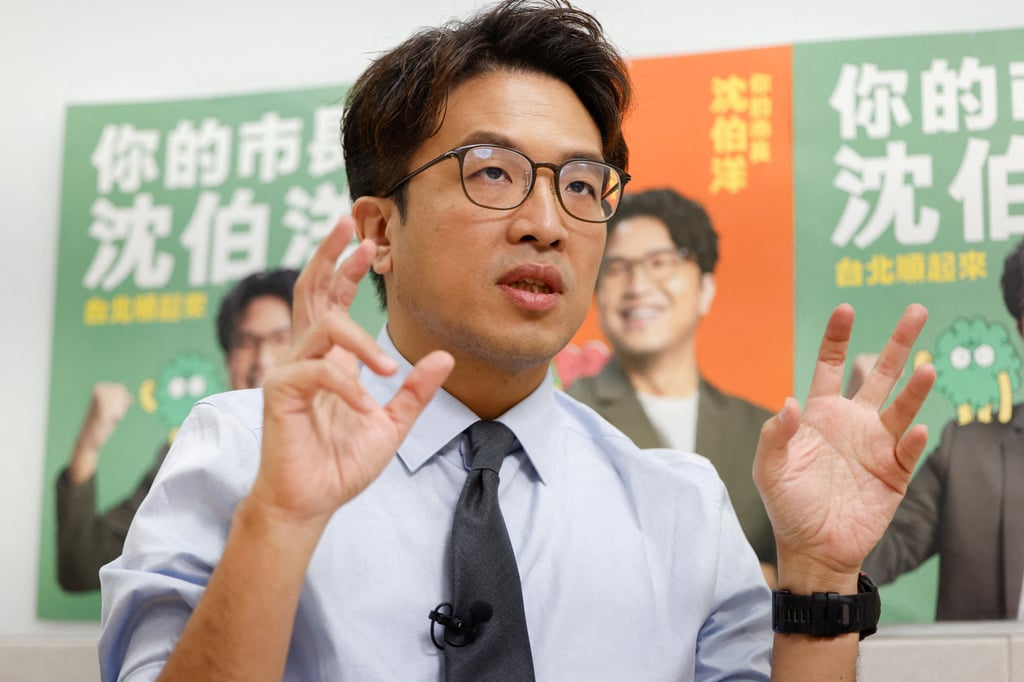
Chen Xiaoxiao, a Taiwan affairs analyst with Jimei University in Xiamen, also in Fujian province, pointed to the DPP’s largely online campaign which has centred the Taipei mayoral candidate.
“The DPP has crafted a new-style campaigning model powered by technology and online mobilisation that has generated notable spillover effects,” she said, while raising doubts over whether digital momentum could translate into actual ballots.
According to Wang Jianmin, other major battlegrounds that will be closely watched include neighbouring New Taipei City, Taiwan’s most populous municipality, and the southern DPP strongholds of Tainan and Kaohsiung.
These are the only two of Taiwan’s six special municipalities held by the ruling party, while the KMT is defending 15 of the 22 city and county leadership posts, including New Taipei City.
The broader picture
Wang Kun-yi, from the Taiwan International Strategic Study Society, said Beijing’s deeper focus would be on whether Taiwanese public opinion was shifting away from the blue-green polarisation of recent years towards economic livelihoods, local governance and managing cross-strait risk.
Whether voters placed renewed emphasis on these issues would be “an important indicator for Beijing”, he said, pointing to Taiwan’s mass recall campaigns and fierce partisan confrontations, as well as international turbulence.
02:41
All 24 opposition Kuomintang lawmakers in Taiwan survive mass recall campaign
A bellwether for 2028
Beyond the municipal results, analysts view Saturday’s vote as an early test for the 2028 island-wide leadership election, both as a midterm verdict on Lai’s administration and as a proving ground for potential contenders.
In 2022, heavy local election losses for the DPP prompted then-leader Tsai Ing-wen to step down as party chair – a precedent that underscores the stakes for Lai.
Negative results for the DPP on Saturday – particularly in southern cities such as Kaohsiung – would undercut Lai’s re-election narrative, while if the party holds its ground, it could consolidate his position, according to observers.
“This election is an important midterm test for Lai Ching-te’s governance and a key test of integration for the KMT and the TPP,” Wang Kun-yi said.
Equally critical will be whether the renewed opposition alliance between the two parties can hold this time, after the first attempt to work together collapsed in the 2024 major elections race.
Analysts said that if the institutionalised cooperation of “Blue-White 2.0” proved effective at the local level, it could provide a template and a foundation of mutual trust for opposition integration in 2028.
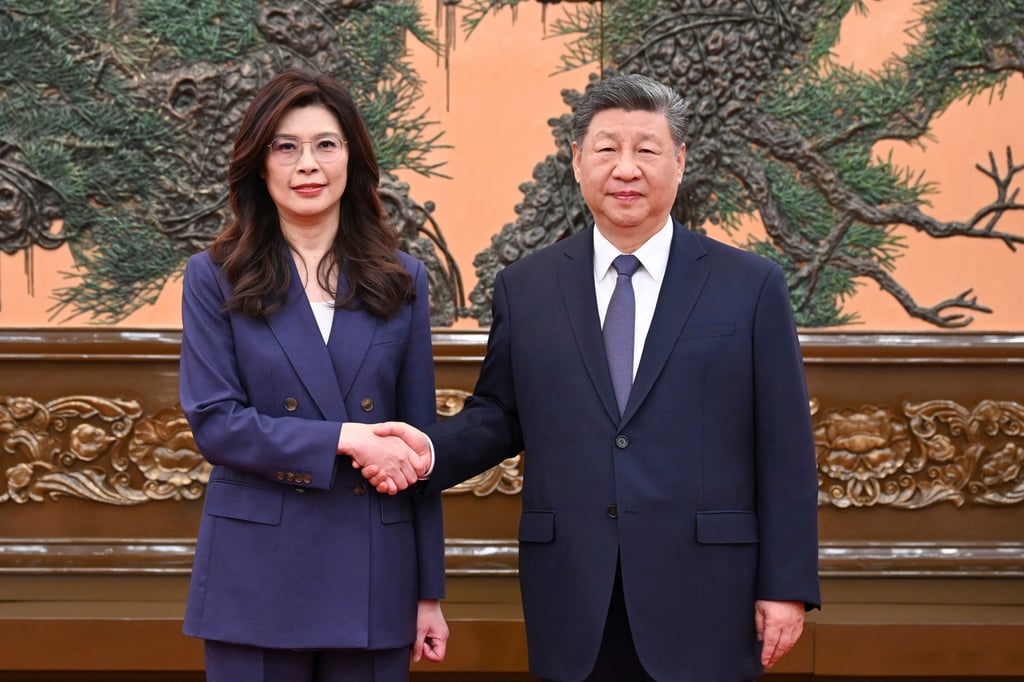
KMT chairwoman Cheng Li-wun and TPP chairman Huang Kuo-chang signed a five-point cooperation agreement in March covering joint nominations and coalition governance for the local elections.
“This is the most significant structural shift in the election,” Jimei University’s Chen said, adding that blue-white cooperation had moved from a post-2024 alliance debate into actual local election battlegrounds – “the deepest integration of opposition forces to date”.
However, while the KMT and TPP fielded unified candidates in four cities and counties, including New Taipei and the city of Chiayi, their cooperation fell apart in Hsinchu county over the Zhubei mayoral race, she noted.
This had “exposed local fault lines and uncertainty remains over whether agreements between the two parties will translate into actual votes”, Chen said.
Saturday’s races will also serve as an audition for 2028 hopefuls, with the performances of several heavyweights on the KMT side expected to determine the party’s pecking order, alongside rising DPP figures.
Those to watch include Chiang, the KMT’s mayoral incumbent in Taipei, and the chairman of his re-election campaign, Taichung mayor Lu Shiow-yen – widely viewed as a leading contender for 2028, alongside Legislative Yuan Speaker Han Kuo-yu and Cheng, the party’s chairwoman.
Cross-strait exchanges
Any shifts in municipal leadership could also affect city-city exchanges across the Taiwan Strait, most notably the Taipei-Shanghai Twin-City Forum – held 16 times over the past 17 years but unusually postponed until December.
After earlier dismissing the forum as unnecessary, the DPP’s Shen softened his stance during the campaign, saying he would support keeping the event – and even pursue exchanges with Beijing – provided there were proper security assessments and “no political preconditions.
Xi’s National Day speech warns against Taiwan independence
In October, TAO spokesman Chen Binhua dismissed any prospect of engaging with Shen, declaring that “diehard Taiwan independence separatists … have no qualification whatsoever to talk lightly about cross-strait exchange and cooperation”.
Also in October, Beijing announced sanctions against VWAY, a company linked to Shen’s father.
“Shifts in local power might affect cross-strait interactions,” Wang Jianmin said, adding that exchanges between the mainland and some cities in Taiwan had been adversely affected under the Lai administration.
“If the number of [KMT] seats won declines, it might hurt future interactions between Kuomintang-governed cities and counties and the mainland,” he observed.
However, Chen noted that while “city-level exchanges face short-term constraints from the political environment, grass-roots interactions remain resilient”.
In April, the TAO unveiled a package of 10 policies and measures to boost cross-strait exchanges and cooperation following the KMT chairwoman’s visit to the mainland and meeting with President Xi Jinping.
“Beijing’s core strategy – opposing ‘Taiwan independence’, resisting external interference and advancing cross-strait integration – will not shift over a single local election,” Chen said.
According to Wang Kun-yi, whether the blue and white camps can coordinate, as well as how the mayors of the six special municipalities approach cross-strait exchanges, “will shape Beijing’s assessment of Taiwan’s political trajectory”.
“Cross-strait relations should not remain permanently locked in political confrontation and electoral mobilisation. Preserving channels of dialogue and expanding people-to-people exchanges are the keys to preventing cross-strait ties from deteriorating further.”
KioskNews shows a cleaned-up reading view extracted from the publisher’s page — the original always lives on their site, not ours.