2026 Chemistry Nobel: Mirror-image molecules and the chemistry of life
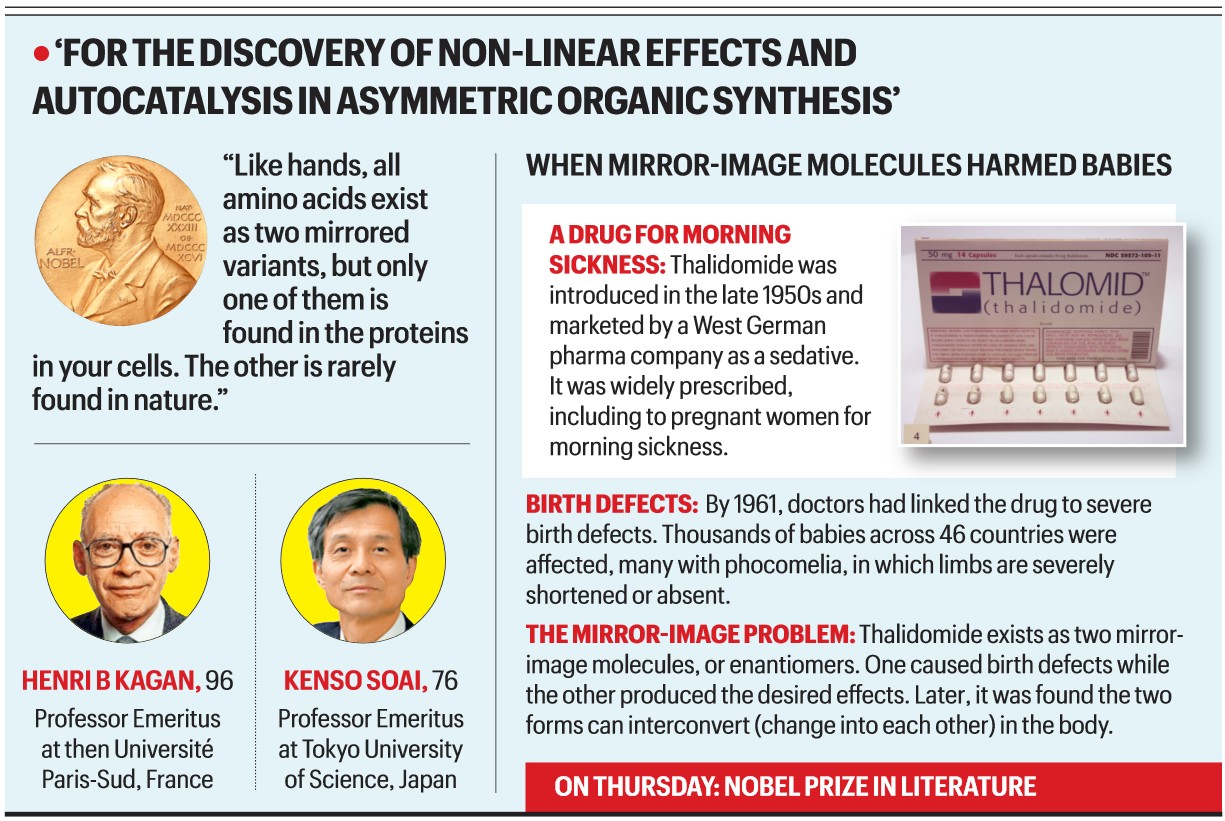
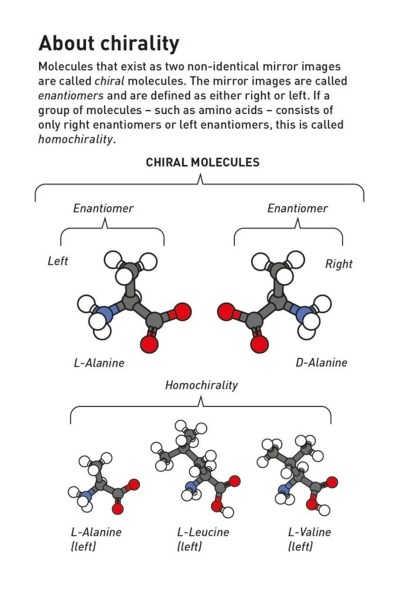
Certain molecules exist in two forms, each a non-superimposable mirror image of the other — like the left and right hands of human beings. Chemically, the two forms are the same in the sense that they are composed of the same set of atoms, connected in the same order. The difference is only in the relative three-dimensional arrangement of those atoms, such that one happens to be the mirror image of the other.
This structural asymmetry, called chirality, becomes particularly interesting in biology. Many of the fundamental molecules in biology, like the amino acids that make up proteins or the sugars in DNA, appear in only one form. The mirror image versions of these amino acids or the sugars do exist, but they are rarely used in these biological settings. This preference for homochirality in life forms has intrigued scientists for long.
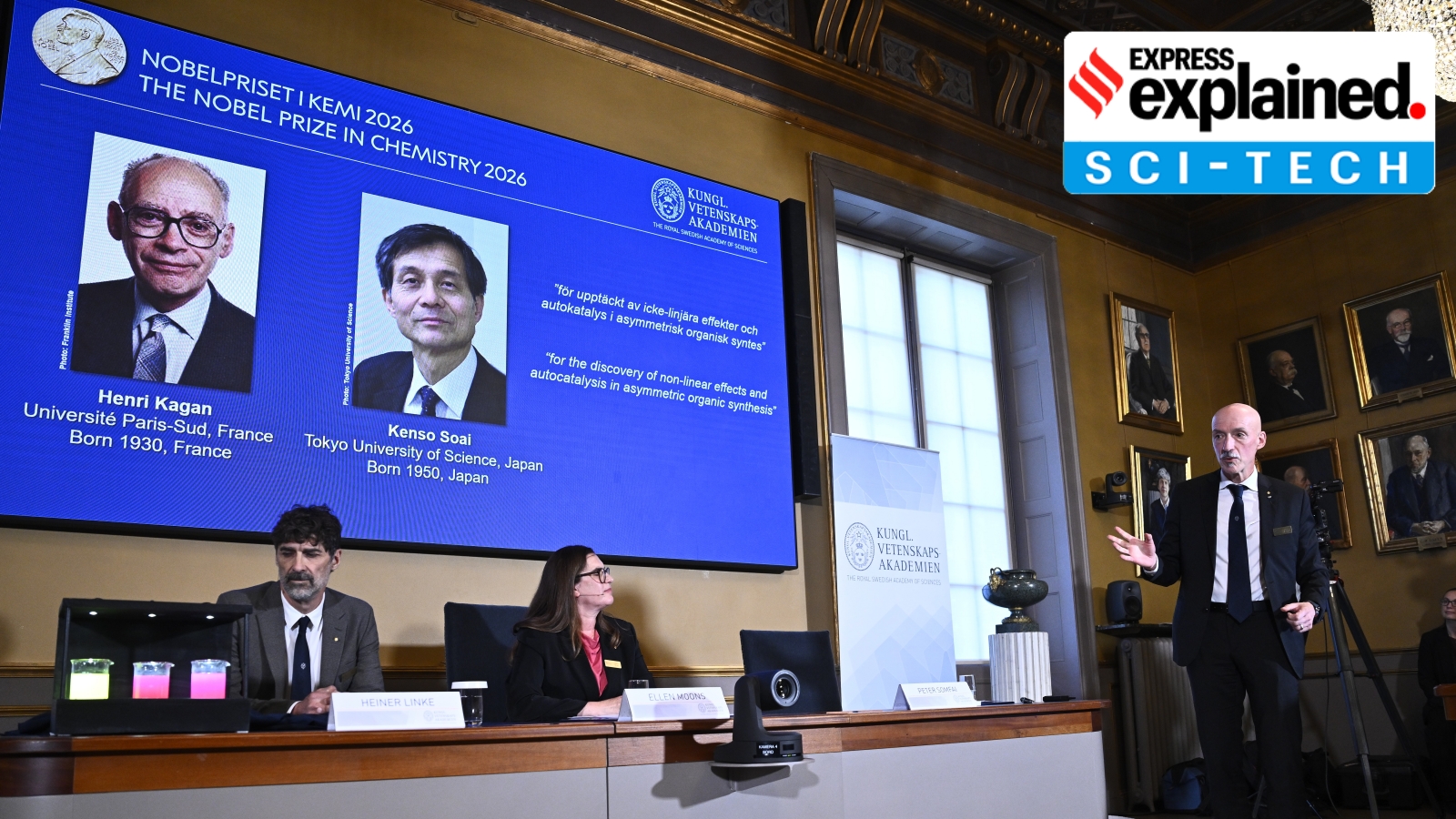
This year’s Nobel Prize in Chemistry has been awarded to two scientists, Henry Kagan and Kenso Soai, for demonstrating how this homochirality can emerge.
The normal chemical processes used to produce a chiral molecule results in the production of both forms, called enantiomers. Kagan developed a way of manipulating these processes in such a manner that one form was produced in much greater proportion than the other. Soai took a step further and designed the first chemical reaction in which only one of the enantiomers was produced. Outside of biological processes, such a result had never been achieved.
The first breakthrough
The propensity of biochemistry to prefer one particular enantiomer over the other was initially thought to be something unique for life forms. After all, when chiral molecules were produced in laboratories, a mixture of both enantiomers was obtained in almost even proportions. However, way back in the early 1900s, German chemist Willy Marckwald had been successful in carrying out a chemical reaction in which the proportion of the yields of the two enantiomers was slightly asymmetric.
Marckwald had used a catalyst — a chemical that speeds up the reaction without itself getting consumed into it — which itself was chiral. And this had led to one mirror-image form being produced more than the other.
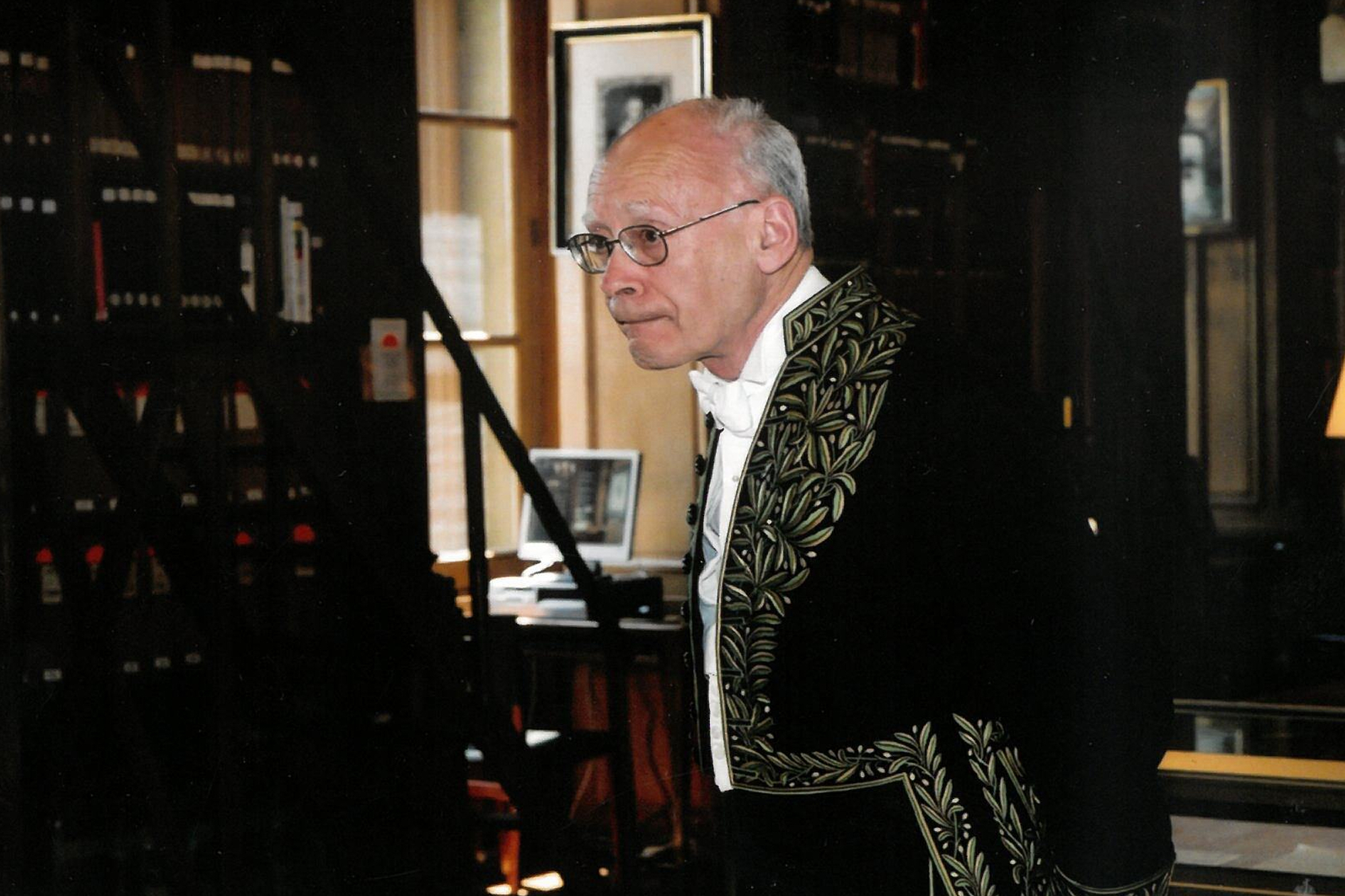 Henri B. Kagan, (AP)
However, subsequent attempts to increase the asymmetry in the yields of the two enantiomers remained unsuccessful. Besides, scientists still did not understand how the use of a chiral catalyst was affecting the reaction in a manner that one enantiomer was produced in greater quantity.
Story continues below this ad
It was Kagan, working in the 1980s, who eventually answered these questions. Before him, it was believed that there was a linear relationship between the catalyst’s chirality and the proportion in which the two forms of the product were produced. In other words, if the catalyst itself contained a disproportionate amount of one form, this would get reflected in the proportions of the final product as well.
Kagan was able to show that this was not true, and that much greater asymmetry in production could be achieved even if the catalyst was only mildly chiral. In the process he was also able to demonstrate the internal dynamics of how this was happening.
 © Johan Jarnestad/The Royal Swedish Academy of Sciences
The next step
This breakthrough created a new excitement in the field. While studying one of the chemical reactions that had produced one particular enantiomer in large quantities, Soai realised that there were significant similarities in the catalyst used and the final product. That prompted him to explore autocatalytic reactions — chemical reactions in which the final products themselves act as catalysts.
None of the autocatalytic reactions known at the time Soai started experimenting with them in the 1990s were known to produce asymmetric formation of enantiomers. After about a decade of trying, he finally succeeded in carrying out an autocatalytic reaction that resulted in the production of one particular enantiomer, which then formed copies of itself in a self-replicating process. The final product contained 99.5% of one enantiomer, a result comparable to the kind of preference seen in biological processes for a particular version of a chiral molecule.
Story continues below this ad
Mysteries of life
The work of Kagan and Soai has demonstrated that homochirality can be obtained in the laboratory as well. It was not exclusive to nature. Their work does not solve the origin of the puzzle of life — how biological processes themselves preferred homochirality. But it did open up fresh avenues for scientists to try and understand the chemistry of life.
 Japanese chemist Kenso Soai (AP)
Possibly the biggest practical implication of their work has been in the pharmaceutical industry. Many drug molecules are chiral, and it matters immensely which particular enantiomer has to be used.
This is because the human bodies prefer only those enantiomers. The other variety of molecule might not just be ineffective, they can even be harmful.
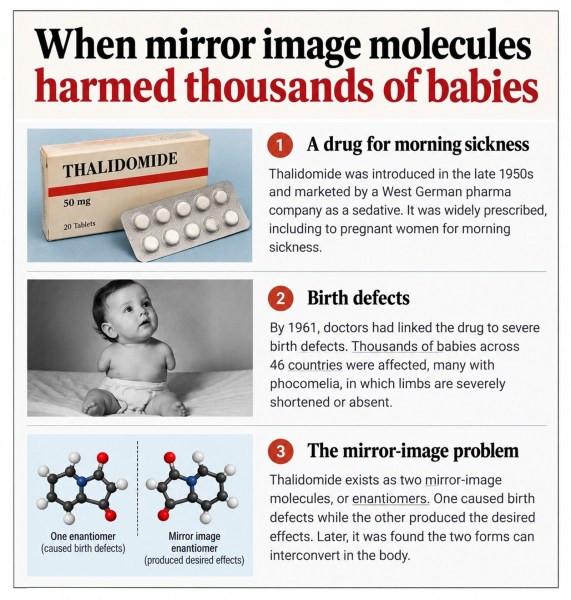
Before this Nobel Prize-winning work showed how one single enantiomer could be produced, pharma companies had been manufacturing the drug molecules as a mixture of both enantiomers, and then the desirable enantiomer was separated through a separate process. This was an expensive, wasteful and often technically difficult way of achieving the final result.
Story continues below this ad
The asymmetric synthesis of a particular enantiomer, as shown by Kagan and Soai, is already being used widely by the pharmaceutical industry. This is relevant for the manufacturing of all other substances that are meant to interact with living organisms, including flavours, fragrances and agricultural chemicals like pesticides.
KioskNews shows a cleaned-up reading view extracted from the publisher’s page — the original always lives on their site, not ours.