Can international campaign get Cristina Fernández de Kirchner back on the ballot?
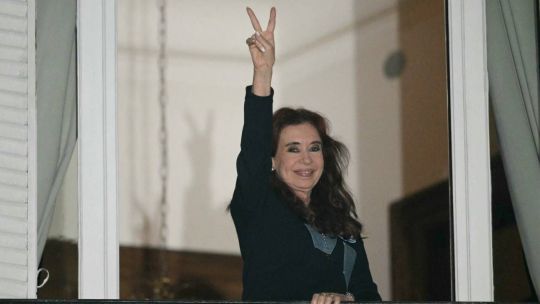
Former president Cristina Fernández de Kirchner continues to work on an international strategy aimed at overturning her corruption conviction in the so-called ‘Vialidad’ case, with the intention of running as a candidate in 2027.
Operating to that end is the ‘Cristina Libre’ (“Free Cristina”) committee, a platform run by the hardline wing of her Kirchnerism movement. It has already undertaken political missions in Brazil, Mexico, Colombia, Paraguay, Uruguay, Italy, France and Belgium to denounce what it says is an attempt to bar their leader from standing for election.
Oscar Parrilli, one of the group's members, a former national senator and president of the movement’s Instituto Patria think tank, offered a blunt assessment in an exclusive interview with Perfil. "Mauricio Macri and Javier Milei are afraid of Cristina because they know she can beat them both," he claimed.
Cristina Libre’s executive committee includes Buenos Aires Province Justice Minister Juan Martín Mena; former national human rights secretary Horacio Pietragalla Corti; former Treasury attorney general Carlos Zannini; National deputy Jorge Taiana; political leader Sol Magno; Delfina Rossi, Banco Ciudad (the City of Buenos Aires' public bank) director; and Mercosur Parliament member Franco Metaza, among others.
Its central goal is to replicate the ‘Lula Libre’ (“Free Lula”) model that succeeded in Brazil, shifting the fight from the Comodoro Py federal courthouse to international tribunals, in order to roll-back the lifetime ban weighing on the Partido Justicialista (PJ) leader ahead of the 2027 elections.
To assist overseas defence efforts, the Peronist movement has enlisted Brazilian lawyer Rafael Valim and the former judge of the European Court, Javier Borrego, to bring the case before the UN Human Rights Committee in Geneva.
Kirchnerism's strategy in Geneva
The Cristina Libre committee’s legal plan it wants to advance in Switzerland does not immediately target the substance of the ‘Vialidad’ conviction; it aims to freeze the political impact of it. The proposed case before the UN Committee of Experts runs on a separate track from filings made with Argentina's Supreme Court of Justice. Operators within the movement are seeking a ruling classifying the process as a violation of the guarantees under the Pact of San José, Costa Rica (the American Convention on Human Rights).
The timeline for this legal manoeuvring was laid out by Parrilli, who revealed to Perfil that the key moment will take place in the coming months, prior to the start of the electoral year. "If the [UN] committee of experts decides to take up the issue, takes it on and refers it to the government, the substantive matter could take a year and a half or two years," he explained.
"At the same time, Cristina's lawyers have requested an injunction to lift the suspension preventing her from running as a candidate. That will be resolved between October and March of next year," the Instituto Patria chief said.
Kirchnerism is seeking international cover before the deadline to register candidate lists.
The mirror and the dilemma
The use of the Brazilian blueprint serves as the political mirror through which Kirchnerism sees itself.
In the case of ex-president Luiz Inacio Lula da Silva, a 2018 recommendation from the United Nations Human Rights Committee was the main tool the Workers' Party (PT) used to keep their leader centre-stage while he remained in prison.
Translating that model to the local scenario, the aim is for a ruling from Geneva to act as a form of institutional pressure on Argentina's federal Judiciary.
International backing would revive Fernández de Kirchner electoral plans. A Geneva ruling could open up a legal window for the former president to run again. Asked by Perfil whether the ex-president might stand in the 2027 PASO primaries, following the approach put forward by Spanish lawyer Javier Borrego, Parrilli did not rule out the scenario.
"Yes, it's being analysed, it's one of the possibilities. But no decision has been made," said the former official
Polls, the Milei factor and PJ tensions
The Cristina Libre committee's work runs parallel to the former president's tenure at the helm of the national PJ.
The party's headquarters on Matheu Street combines resistance to the economic model of La Libertad Avanza (LLA), President Milei's ruling party, with its leader's judicial agenda. The strategy rests on a hypothesis of absolute polarisation, in which, from the Kirchnerite point of view, the libertarian leader's administration functions as the main fuel for opposition regrouping.
Parrilli spelled out the electorate the committee is targeting, which centres on middle-income groups facing economic hardship. "We're going to work on the national-popular sector, on our own sector, on those who are in the middle and whom Milei is going to end up pushing toward us, because of the poor job his government is doing."
He was blunt about the relationship with the opposition: "There's 25 or 30 percent who would vote for a broom before they'd vote for Peronism. That doesn't interest us. Let them do what they want, let them keep existing. We don't want to eliminate them. They want to eliminate us; we just want to beat them.”
Under that theory of political accumulation, the movement's leadership assumes the lifetime ban stems from their historic rivals' political calculations ahead of a potential election. In the view of the president of the Instituto Patria, Fernández de Kirchner's centrality rules out any alternative leadership within the opposition. "You know why Macri and Milei fight with each other over who gets to say they banned Cristina? Because they're afraid of her. Because they know Cristina can beat them both,” he said.
The former senator also took a swipe at Axel Kicillof, the Buenos Aires Province governor and potential Peronist presidential candidate: "Cristina generates expectations, generates hope, generates items on the agenda. Cristina has answers, she didn't back down. And on top of that, she sets the agenda for the future. She's the only leader who has that quality."
Accusations against La Libertad Avanza
The rhetorical tension surrounding the former president's defence reached its most combative point when drawing parallels with the most violent episodes of 20th-century Argentina. From the Cristina Libre’ perspective, the judicial process and the September 2022 assassination attempt represent the historical continuity of an anti-Peronist persecution pattern that they link directly to the political lineages that today make up La Libertad Avanza.
The rhetoric from the Instituto Patria's inner circle links the ‘Vialidad’ case ruling to the failed attack against Fernández de Kirchner. "The assassination attempt is part of this. Make no mistake. It's the bullet that didn't go off. That's why they handed down the ruling, because they failed in the attempt," says the head of Kirchnerism's ideological hub.
According to Parrilli: "The people behind this are the ones who ordered the bombing of Plaza de Mayo in [1955], the ones who were part of [ex-junta leader] Jorge Videla's government, who tortured, killed, stole a baby. They're murderers, their hand doesn't shake if they have to kill Cristina. They tried and they failed. I'm telling you literally."
The former Neuquén senator's accusation takes on a specific name when he targets the Benegas Lynch family, whose members hold seats in La Libertad Avanza's Chamber of Deputies and Senate blocs. "Look at the Benegas Lynch family... who are they? One of them is a deputy now, the other is a senator. Do you know who their father or grandfather was? The one who organised the bombing of Plaza de Mayo in '55."
The former lawmaker clarified: "I'm not saying that everyone who supports Milei, or everyone in La Libertad Avanza, or everyone in the PRO party is like that, but everyone who was involved back then, their heirs, and the grandchildren of the murderers from '55 and '76, are in La Libertad Avanza today. That's just how it is. And they're the ones who tried to kill Cristina Kirchner," the leader declared.
International backing versus infighting
The Cristina Libre committee's reach goes beyond the international signatures gathered in its founding manifesto, which include those of Brazil's Mónica Valente, Mexico's Yeidckol Polevnsky and several Colombian lawmakers aligned with former left-wing president Gustavo Petro.
The platform's roll-out functions as a quiet wedge in the debate over renewing domestic Peronism, fixing the movement's priorities around the figure of the former vice-president.
The installation of the "Cristina, candidate 2027" slogan acts as a check on the ambitions of those pushing for generational change within the PJ — namely, Kicillof. The former president's centrality, driven from nothing less than the party's national leadership, constrains the assembly of Buenos Aires Province Peronism and freezes the renewal plans being tested by the Movimiento Derecho al Futuro leader in Buenos Aires Province.
Kirchnerism, a defining force in Argentine politics over the past 25 years, is resisting disappearance or the retirement its internal rivals are demanding. With a historic electoral floor that polls put at 25 percent of the national electorate, this Peronist faction still wields enough firepower to lead the national PJ, shape the Conurbano (Greater Buenos Aires) and reignite tensions with the government.
KioskNews shows a cleaned-up reading view extracted from the publisher’s page — the original always lives on their site, not ours.