Rams coach McVay says he almost left Rams because of insecurities
The next Super Bowl will be held in Los Angeles. And while it's still early days this season, the odds aren't half-bad that, for one team, the big game will be a home game. The rams are a, maybe the — premier NFL franchise: blue chip; gold standard. This preseason, we were invited inside their huddle, so to speak. We found an organization that wins with contradictions: prudence and gunslinging. Change and continuity. Brawn, yes, but also brain. And the rams are wound tightly on the team's tightly wound leader, Sean McVay. In the decade since the Rams made McVay the youngest head coach in NFL history, he's become a generational talent, pacing toward the best ever - Lombardi, Shula, Belichick – but that push comes at a price.
Sean McVay: Oh, I'm a lot tormented.
Jon Wertheim: You're a lot tor-- what-- what's-- what's tormenting you-- right now?
Sean McVay: The practice that we just had. That's why I'm in such a great mood.
That practice, a month before the NFL season, seemed typical to us, but Rams coach Sean McVay was dissatisfied in the extreme.
Sean McVay: It's why, honestly, I'm not really here right now.
Jon Wertheim: You say you're not really here right now.
Sean McVay: That's right.
Jon Wertheim: Your mind is still on that practice.
Sean McVay: Totally. Yeah. I feel rude right now with you, you deserve more attention than what I'm capable of giving right now and I feel bad about that.
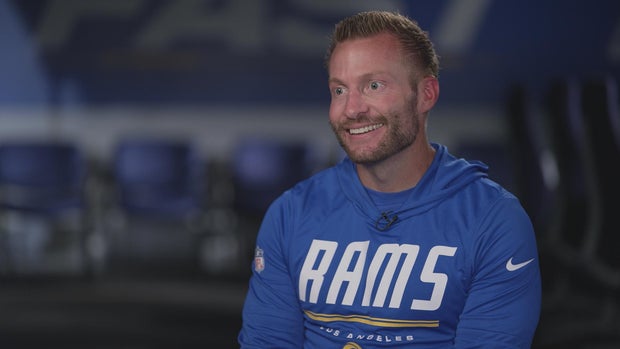
No apologies necessary. This was an unvarnished look into a team — bad practices happen — and into the mind of a football genius, tortured as he is, especially when confronting lofty expectations. The Rams built a super-team studded with talent: quarterback Matthew Stafford — the NFL's reigning MVP — leads the offense. The Rams traded for Myles Garrett, the league's best defender, to anchor the other side. And Aaron Donald, perhaps the best defensive lineman ever, just came out of retirement to rejoin the team.
Sean McVay: We are wired to achieve. And-- and let's make no mistake about it. When we take the field, the expectations are to win.
Jon Wertheim: let's be honest, it's super-- we're-- super-- team wins Super Bowl or, "Oh, this roster couldn't get it done." You're okay with the range of outcome here?
Sean McVay: Oh yeah, because I don't buy into those external narratives. I'm more interested in who we become in the midst of the journey than what the final destination is.
This was not the talk a decade ago when the lowly Rams were leaving St. Louis and returning to their ancestral home of LA.
Les Snead: I'm taking on water as a GM. We hadn't had a winning season.
It was 2016, Les Snead, Rams general manager, needed a win. Snead's job was on the line, but backed by ownership, the Rams gambled big on an unproven commodity.
They made McVay the youngest head coach in NFL history.
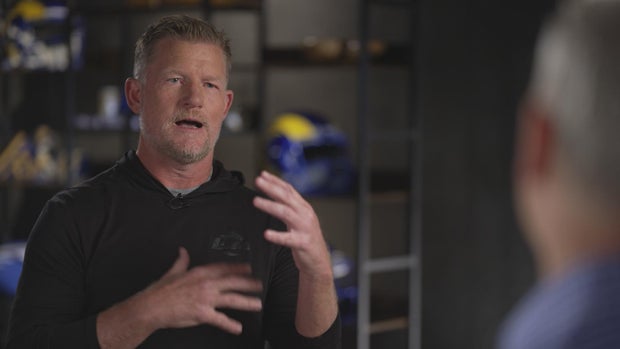
Les Snead: This guy changes the math.
Jon Wertheim: What do you mean?
Les Snead: Tactically, when he's in flow. It's like you're tryin' to defend 12 instead of 11.
Jon Wertheim: Wait. You're-- you're saying the coach gives you an extra guy on the field.
Les Snead: Right.
Soon, the math that was changing was on the Rams side of the scoreboard.
In his first season, McVay took the Rams to the playoffs and won Coach of the Year. Rams offensive coordinator Nate Scheelhaase says McVay's play-calling prowess stems from his power of recall.
Nate Scheelhaase: Yeah, I think his memory-- yeah, at some point they'll probably end up studying it.
Examples abound.
It's not just a neat party trick.
Nate Scheelhaase: I always feel like if you're remembering you're moving faster than somebody that's learning.
Jon Wertheim: He's remembering it practic-- like, pragmatically.
Nate Scheelhaase: That's right, you know not only remember-- but to be able to fix problems in that way.
Mcvay grew up in Atlanta - a star high school quarterback.
When injuries derailed his college career at Miami of Ohio, he made like his grandfather, John McVay, a Super Bowl-winning exec with the 49ers — and turned to NFL administration.
Sean McVay: I wouldn't be where I wa-- where I am today if it wasn't for the influence that he had on this league and the people that he came across that gave me chances that I didn't deserve.
A foot in the door only gets you so far. In Washington, McVay rose quickly. At age 27, he was promoted to run the offense, which broke team records.
Under McVay, the Rams don't just try to beat opponents; they try to hack them, looking to exploit the defense's patterns.
Football might be a game of inches, but note here how the Rams receivers are wide open.
Quarterback Matthew Stafford explained it to us.
Matthew Stafford: Well, on every single play a defender-- is part of an 11-man team that is a responsibility to a gap or an area on the field that is his. And-- and we're gonna try to create conflict. And that just comes through endless hours of studying tape, talking about it, understanding defensive responsibilities, and knowing their adjustments. And how can we try to put those adjustments in conflict on every play?
Jon Wertheim: That must be such a thrill.
Matthew Stafford: It is you know -- those times when you scheme it up and-- and-- you know what you're about to get, you get it, and you execute it, it's a lotta fun.
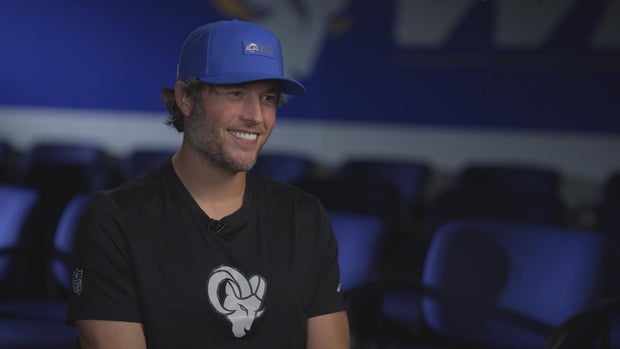
Perhaps less fun: McVay is in Stafford's ear all game, literally, radioing each playcall into the quarterback's helmet.
Jon Wertheim: What's it like hearing him in your helmet?
Matthew Stafford: (PAUSE) It's-- it's a lot. No, it's-- it's a whole lotta fun.
Jon Wertheim: No talk back button though.
Matthew Stafford: Yeah, no talk back. But sometimes I wish I had one. But--
Jon Wertheim: What-- what would you say?
Matthew Stafford: "Yeah, (LAUGH) I got it."
Jon Wertheim: We're good.
He did have it. In Stafford's first season in LA, the Rams made the super bowl.
Sean McVay: You know, four of the most powerful words that you can say are, "I believe in you."
He means it. In the days before the Super Bowl, the Rams practiced a complicated play, the jet sweep. It didn't work. Before the game, Stafford gathered teammates to rehearse and refine the play, and told McVay he could trust the team to execute it.
4th down, Super Bowl on the line, McVay didn't punt; his play call - the jet sweep.
The Rams drove down, scored, and — another first — McVay became the youngest head coach ever to win a Super Bowl. The joy was fleeting.
Sean McVay: The lies I told myself were, "Once we win a Super Bowl I'll be happy."
Jon Wertheim: The lies you told yourself--
Sean McVay: Yeah.
Jon Wertheim: --about winning a Super Bowl?
Sean McVay: And the lies I told myself were, "I won't be happy until I w-- until we win one." Or, "I win one," you know? And it was a lot more selfish. And, you know, you're embarrassed to kinda look back on how you got to where you did.
After the Super Bowl season, a losing season.
Jon Wertheim: how dark a place did you go to after that--
Sean McVay: Dark. It was-- it-- it revealed a lot of insecurities that I had. My identity was so tied up in winning and losing games, and that was where I felt like my self-worth lied. And it was-- very revealing of how fragile I was and-- and all the insecurities that I did have.
Unfulfilled by winning, and devastated by losing, McVay considered stepping away for a career in broadcasting.
Sean McVay: I was ready to run away from coaching and hide behind a convenient narrative of some media opportunities, I'll never forget. I was explaining to my wife, Veronika, it was a daunting task ahead for the '23 season. And I remember tellin' her, "Maybe I'll take a year off." and she said, "That never sounded like the kinda leader you wanted to be."
Jon Wertheim: Those are tough words from your wife.
Sean McVay: You know, I think it was the wakeup call that I needed,
Jon Wertheim: you say run away from, which is different from pivot to or turn to.
Sean McVay: Sure. Yeah, I would've been quitting, you know? That-- that would've been the truth. I would've been quitting because I couldn't handle the losses.
He didn't quit. And the Rams have made the playoffs every season since.
McVay won 100 games before turning 40. But he concedes that, like a team early in a season, he too is a work in progress.
Sean McVay: Success is never linear, you know? It's-- it-- it's always up and down. I think that's one of the biggest things is, is the awareness of when those triggers, what are the things that-- you know, that you're bein' somebody or you're getting to a point you don't wanna be? And how quickly can you snap out of that?
Jon Wertheim: Okay, so you have those moments. I'm--
Sean McVay: All the time.
Jon Wertheim: "I'm-- I'm being someone I don't wanna be right now"--
Sean McVay: Yeah, I'm-- I'm havin' one right now. I mean, like, no, that's just the truth. Like, what I think is real about it is, is, you know, I feel bad that you guys are doin' this incredible story and-- you know, and I'm not in a good place right now. I'm not happy with how practice went.
Rams culture is demanding. Still, the league can't get enough of it.
Every Sunday, other teams mirror the Rams' play designs. Every offseason, other teams raid Mcvay's staff – seven of his assistants have been poached away to become NFL head coaches. Nate Scheelhaase is likely next. He's accustomed to McVay's perfectionist ways, even at practice.
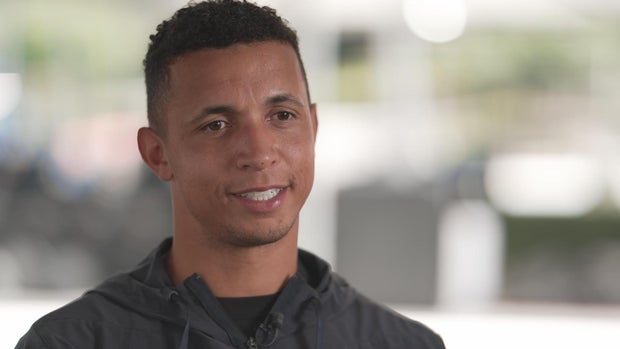
Jon Wertheim: You could tell he was pissed.
Nate Scheelhaase: Oh yeah.
Jon Wertheim: Even with starters out, second day of training camp—
Nate Scheelhaase: Yeah, it doesn't matter.
Jon Wertheim: It doesn't matter.
Nate Scheelhaase: It doesn't matter who's out there, it's-- it's Matthew Stafford, it's a, you know, third-string left guard, the standard is the standard.
Jon Wertheim: Head coach is pissed off, what's-- what's the staff (LAUGH) and the players do?
Nate Scheelhaase: (LAUGH) Put your nose down and go to work.
For the Rams, this kind of bluntness from McVay is not just expected; it's an organizing principle.
Matthew Stafford: Within our locker room, within our walls, right, we all wanna be as close as we possibly can. And a lotta times that comes with vulnerability.
Jon Wertheim: Square vulnerability with big, tough, violent football.
Matthew Stafford: You know, there's so many false narratives out there about our sport and what it needs to be and-- what men need to be and-- and all that. Being able to be close and open up with our head coach leading the way, it brings us closer as an organization, as a team.
The quarterback also explained that McVay's youth and vitality help him connect. This shot of McVay and his wife this summer made the rounds on social, and, it seems, inside the Rams locker room.
Jon Wertheim: Have you seen the viral shot of the abs on the boat?
Matthew Stafford: Oh yeah. Oh yeah--
Jon Wertheim: Thoughts-- thoughts, sir?
Matthew Stafford: I mean, we all were like, "We better hit the weight room, because this guy's (LAUGH) shredded." I mean, that's the guy-- no, he's-- he's-- he's putting the time and the effort in.
Beyond McVay, the Rams' success also hinges on its ownership, the Kroenke family, willing, as they are, to spend on coaches and players and building. At $5 billion, the Rams' SoFi Stadium is the world's most expensive sports venue.
Ownership also invests in even the smallest edges - military personality tests have helped GM Les Snead identify leaders. A basic equation guides him: character over talent.
Les Snead: This guy-- didn't meet expectations; this guy did.
Down the hall from Snead's old school whiteboard, Nicole Blake leads the Rams' new high-tech drive into AI. The Stanford MBA says it could fundamentally change NFL coaching. Never mind McVay's prodigious memory, imagine the power of AI, helping every team hack opposing defenses.
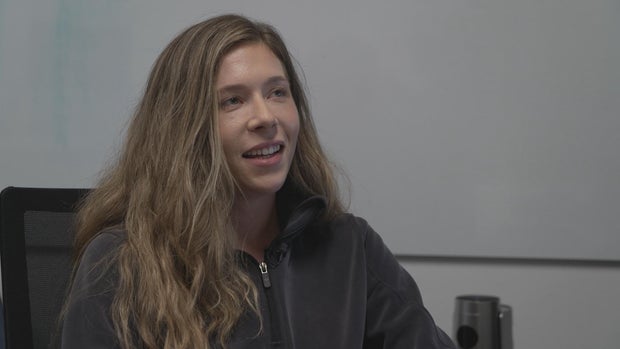
Nicole Blake: You'll have significantly more patterns identified that the human eye would never catch.
Jon Wertheim: But pattern recognition is at the essence of winning football games.
Nicole Blake: Yeah, from a game strategy perspective, that's the-- that's the whole game.
For now, football is still, at its core. a game of people, of patterns, of incremental gains.
In Snead's office we noticed a statue of Sisyphus cast in his unending push to the top. It called to mind a coach, straining ever upward against the rock of expectation.
Nearly a decade in — suddenly, the second-longest tenured coach in the NFL — Sean McVay has learned this: there's honor in the pushing itself.
Sean McVay: You're either in a storm, you're comin' outta one, or you're gettin' ready to go back into it. And it's one of those three things. But how you handle that is the separator. And so-- I wanna be proud of who we've become in the midst of the journey. And here's what I will tell you, Jon, is I think that gives you the best chance to be the best team that tries to achieve the outcomes that we're hunting up on a weekly basis when we play those games.
Produced by Aaron Weisz. Associate producers, Ian Flickinger and Mimi Lamarre. Edited by Warren Lustig and Aisha Crespo.
KioskNews shows a cleaned-up reading view extracted from the publisher’s page — the original always lives on their site, not ours.