Inside the storm: On the front line of Victoria’s stretched emergency departments

It has just gone 6pm when the barefoot man stumbles into the brightly lit hospital.
He is erratic, groaning and dishevelled with a wild, dark beard. There is dirt all over his ankles and feet and blood dripping from his right hand.
Police have escorted the man into St Vincent’s Hospital’s emergency department after he violently attacked a stranger, a woman walking down a nearby street in Fitzroy.
A doctor and team of nurses calmly assess the man, who is dressed in torn, grey tracksuit pants and chequered flannel shirt, and in the grips of psychosis.
They reassure him gently before giving him a mix of antianxiety and anti-psychotic medications. To their relief, he swallows the medication without much resistance.
Minutes later, he is attached to a drip and quietly snoring, surrounded by a sea of patients in various states of consciousness.
It is just another night inside the busy emergency department in the hospital on the edge of Melbourne’s CBD, where staff are caring for a record number of acutely unwell and injured Victorians every day.
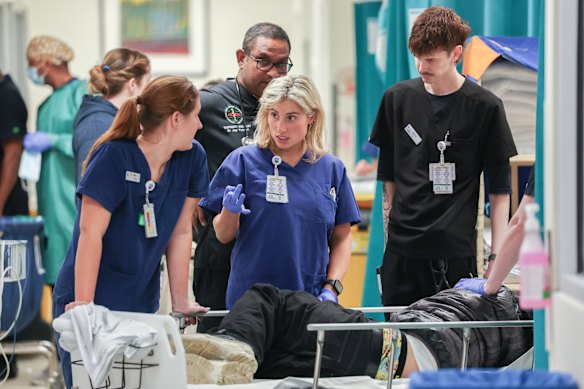
Another young man is wheeled in on stretcher by two paramedics. He has taken methylamphetamine – commonly known as ice – and the liquid party drug GHB. He was found shirtless on the side of the road.
The combination of drugs has triggered a life-threatening spike in blood toxicity known as metabolic acidosis. He is coming back to consciousness, as if he were waking from a bad dream, thrashing about and screaming incoherently.
“Just try and relax, mate,” Dr Rex Gavan reassures him.
“It’s OK. You’re all right, mate. You’re in the emergency department.”
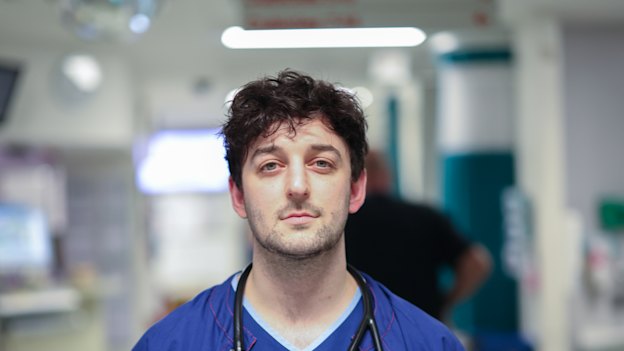
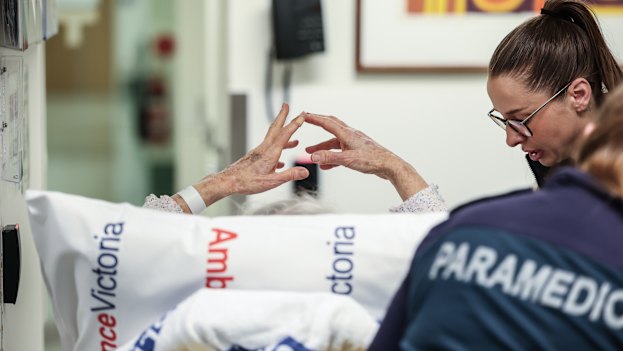
In the stretcher next to him, a woman in her 80s, with grey, clammy skin and lips that are tinged blue is sitting upright and struggling to breathe. She is being given oxygen and showing all the grim hallmarks of heart failure.
A team of nurses and doctors is working tirelessly to stabilise her before she can be taken to the intensive care unit.
A growing number of patients flooding to emergency departments across the state are gravely ill older Victorians.
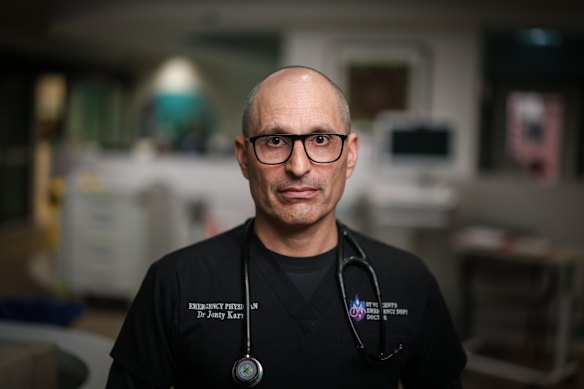
Director of emergency services at St Vincent’s Hospital Dr Jonty Karro says some older patients are coming in with catastrophic injuries, akin to being in a high-speed car crash, following falls at home or on the street.
Others have several co-existing chronic conditions, making diagnosis and treatment more complex and time consuming than ever before.
“We’ve got an increasingly ageing population,” Karro says.
“They’ve got diabetes, high blood pressure, heart failure, they may have cancer, or kidney failure. They come in with shortness of breath or delirium so we have to work out what is going on, what’s causing the symptoms and then what is the best treatment.”
Between January and October this year the hospital’s emergency department treated 43,171 patients, an increase of more than 1400 patients when compared to same period for 2024.
Earlier this month, the Australasian College of Emergency Medicine warned this exponential rise in frail, elderly patients meant patients were being left in hospital corridors to deteriorate as they waited for a bed.
The college’s Victorian branch chair Associate Professor Mark Putland warns the state’s health system is at tipping point and unless urgent action is taken now, the worst is yet to come.
New data from the Victorian Agency for Health Information shows more that half of patients are waiting more than four hours to be treated in emergency departments across the state.
On any night, acting secretary of the Victorian Ambulance Union Olga Bartasek says paramedics face a dire situation where there are at least 10 to 15 ambulances ramped outside hospitals.
“Paramedics are being told they’re not going to be able to get their patient off the stretcher for anywhere between two and eight hours,” she says.
On Sunday, the state government will unveil an ambitious $1.5 billion plan to slash emergency department wait times by up to 20 per cent.
The government said if it was re-elected it would expand 12 hospital emergency departments by 25 per cent, including the state’s major trauma centre, Melbourne’s Alfred Hospital.
It plans to hire 1500 health workers, including 750 more nurses, and delivering 250 more beds over the next four years.
But Karro believes much of the pressure on the hospital system comes not only from a lack of staffing and ED beds, but also from delays in being able to discharge people.
“The problem is manifesting at the other end of the system,” he says.
“It’s getting people out of hospital beds and into residential aged care or getting them NDIS [National Disability Insurance Scheme] supports.”
“You can’t get people out of the hospital until they have somewhere to go.”
To deal with this, St Vincent’s and the Austin hospitals both have dedicated teams of geriatricians working alongside emergency department clinicians to assess older patients and safely divert them to their homes, aged care facilities or rehabilitation services.
Health, including overcrowded emergency departments, has emerged as political flashpoint in the upcoming state election.
In September, there was public outrage after The Age revealed 20 new emergency beds at the Royal Children’s Hospital would be left empty even after a long-awaited multimillion-dollar redevelopment is completed in November because the health service lacks the staff to use them.
Weeks later, in an attempt to kill the controversy before the November election, the Victorian government committed an extra $66 million to staff 20 the beds.
Australian Medical Association Victoria president Simon Judkins says a record number of patients are languishing in the state’s emergency departments for more than 24 hours and more patients than ever before are receiving urgent medical care in hospital corridors due to a lack of beds.
“Politicians need to start being honest about the state of the healthcare system,” he says.
The most recent data available showed between April and June this year almost 3786 people were in an emergency department for longer than 24 hours, up from 3336 in the previous quarter.
Judkins says healthcare workers are arriving for night shifts with 60 patients already in waiting rooms and most cubicles in the emergency department full.
In one recent case, Judkins says a patient stayed five days in a Melbourne emergency department waiting for disability and mental support.
“There’s no time for breaks any more,” the emergency physician says. “You constantly hear the stories of staff just working through a whole shift without a break.”
Back at St Vincent’s hospital emergency department there is a purpose-built, sealed off mental health, alcohol and other drugs hub, with six short-stay beds, where people in the throes of an acute mental health crisis often withdraw from drugs or alcohol.
“The most important thing is we try to provide the least restrictive care we can,” Karro says.
Many have myriad complex circumstances, including addiction and homelessness.
On this night all the beds are full in the hub, while six ambulances are ramped outside.
In one of the rooms, a man wearing black glasses is repeatedly packing and unpacking his clothes and obsessively making his bed. He has been brought into the hospital by his family and is withdrawing from alcohol.
“He is very unwell and suffering from delirium,” Karro explains. “This is the safest place for him right now.”
People often arrive like this man in a heightened state: agitated, anxious, intoxicated.
In the main area of the mental health hub, there is an artificial skylight installation with bright blue skies and white clouds to create a calm environment outside the bright, noisy emergency department.
Karro says the first step is keeping people safe and weaning them off substances.
“Once the drugs and alcohol wear off, that’s when you can have a proper conversation and ask: ‘What’s going on? What can we do to help?’” he says.
“There are people coming to us now in absolute crisis.”

Karro’s colleague emergency physician Dr Joanne Henry is at the short stay unit, where all the beds are full.
Henry says staff see between 150 and 160 patients each shift, compared to about 100 a day in past years. “It is quite a big difference,” she says.
Among Henry’s patients is Corazon Ancayan, who arrived at the hospital with crippling abdominal pain 12 hours ago.
“The staff have been wonderful,” Ancayan says, as a code blue, an announcement for a medical emergency, rings out in the background.
“They have put me at ease while I wait to get my scans.”
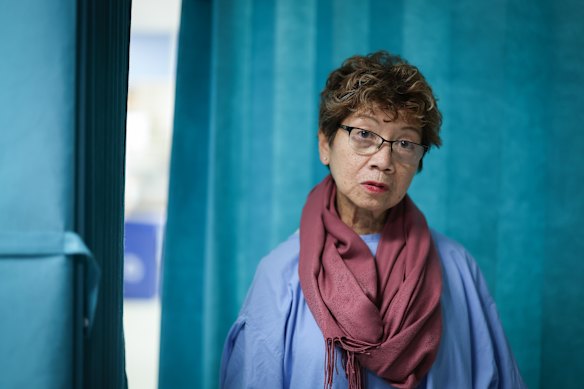
About 15 kilometres away at the Austin Hospital’s emergency department, The waiting room is overflowing and the workload unrelenting. It has just gone 3pm.
Two women in hijabs hold hands as they wait in plastic chairs. A man next to them is shivering, wrapped in a white hospital blanket.
A woman dressed in pale blue pyjamas collapses. Her daughter cries out to a nurse, who races over with a doctor. They put the woman in the recovery position while she vomits on the floor, before they wheel her away on a stretcher.
Only days before The Age visited earlier this month, staff were inundated by the highest number of patients reported in a single day since the catastrophic thunderstorm asthma event that left 10 Victorians dead a decade ago.
More than 300 sick and injured people presented to the emergency department in a day, blowing out wait times by hours as staff frantically worked to keep pace.
Some opted to go across the road to Warringal Private Hospital, paying hundreds of dollars to be seen sooner. Staff at the private hospital treated almost double the number of patients they typically see.
Victoria’s opposition health spokeswoman Georgie Crozier says the health system is at “breaking point”.
“More than 68,000 Victorians are waiting for vital surgery, graduate nurses can’t get a job, and it takes longer to get an ambulance than it did a decade ago,” she says.
If elected, the Coalition has pledged to fund more beds, upgrade hospitals including the Mildura Base Public Hospital, and put 24-hour Protective Services Officers in emergency departments.
The Coalition has also made a $1.27 billion policy pledge to halve Victoria’s public elective surgery waitlist by diverting thousands of public hospital patients to private hospitals.
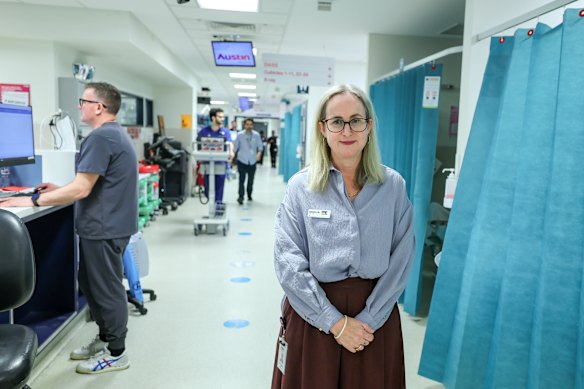
Austin Health’s director of emergency Dr Jocelyn Howell says the sudden surge in patients, which is about 20 per cent more than staff would see on a typical day, could not be attributed to any single trend.
Instead, it reflected a broader pattern of more seriously ill and complex patients arriving in emergency departments.
Howell says staff are also treating soaring numbers of frail and elderly patients who have had a fall and sustained sometimes severe, life-changing injuries.
The hospital has become known as the state’s geriatric trauma centre, as it now admits the highest number of older patients in the state.
Rib and hip fractures are increasingly common, along with dangerous bleeds on the brain, a risk amplified by common medications such as blood thinners.
Howell says that while virtual ED services and urgent care clinics are easing some of the workload, the people now coming to the hospital are sicker than she has ever treated before.
“Our patients are so much more complex, they have a much higher acuity, and they are taking us much longer to deal with,” she says.
Other troubling trends are emerging too.
There has been a worrying spike in young people coming to the hospital in severe mental distress following the coronavirus pandemic and lockdowns.
“We are seeing really high numbers of all sorts of adolescent and young adult mental health patients,” she says, adding that rates of eating disorders, depression, anxiety, self-harm and suicidality are all soaring.
Young people are being brought in by their parents or friends or making social media declarations about harming themselves before being taken to hospital by ambulance.
Inside the nearby fast-track area, emergency physician Dr Andrew Howell and a team of nurse practitioners and physiotherapists are tending to a never-ending stream of patients being assessed, treated, sent off for scans, and either discharged or admitted.
Howell lists some of his patients of the day: a 14-year-old girl with a dislocated shoulder quickly popped back into place under mild sedation; a young man with a fractured ankle that needed to be plastered; a woman unable to walk due to suspected disc degeneration.
Among them is Nicole Miller, whose nose was bleeding uncontrollably for hours before she was brought in by ambulance.
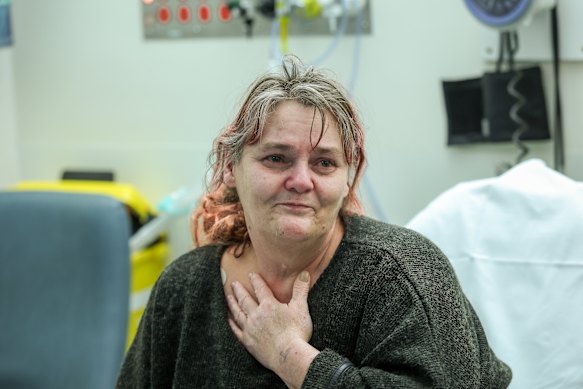
She is sitting up in the bed in the short stay unit as Howell leans over her, squinting into the dark of her nostril.
“Looks like it’s finally stopped,” he says with wide smile. “You’re finally able to eat and drink again. Let’s get you some cordial.”
Howell suspects the prolonged bleed might have been caused by the removal of an abscess, which left a hole in her septum.
“Thank God for these guys,” Miller says her voice cracking with emotion and eyes filling with tears.
“I really freaked out this morning. I had a heart attack four months ago. These guys looked after me then, too. God bless this joint.”
The Austin Hospital’s associate nurse unit manager Ellen Bradbury cannot remember a time in her 15-year career where the emergency department has been so stretched.
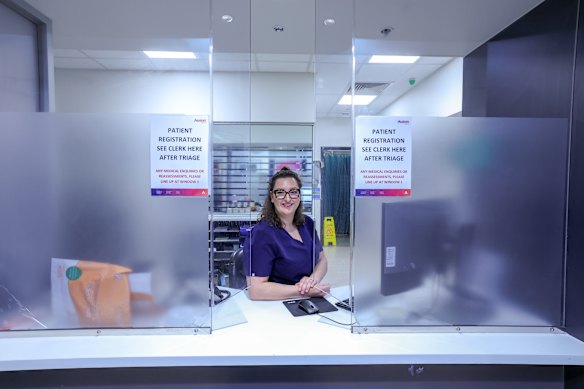
“This afternoon we are being hit with the general and never-ending onslaught of ambulances that arrive every day,” she says.
“Most days, we don’t even have time to get to the toilet or take breaks.”
Bradbury says many patients cannot afford the cost of seeing their GP, which has blown out wait times and leads to longer ED stays.
To deal with this, the Austin has come up with innovative solutions including a dedicated ambulance offload area to slash the amount of time paramedics are spending there. It is also a quieter space for patients to wait for assessment rather than being stuck on a stretcher in a noisy corridor.
Bradbury still finds her job rewarding. She loves her team and the pace of emergency medicine. But working in an emergency department has never been tougher.
“It’s a very, very hard job now, and that’s also why the ED nursing staffing cohort has such a high turnover,” she reflects says.
“The aggression and violence we are seeing now is unprecedented.”
Last month, The Age revealed healthcare workers across the state are being regularly bitten, punched, pushed, kicked, spat on and verbally abused, leading to widespread burnout, psychological harm.

Despite the relentless pressure, the violence, the never-ending flow of stretchers and patients through the doors, it is quiet sense of purpose that keeps emergency staff coming back shift after shift.
“You really see everyone, every facet of life,” St Vincent’s nurse Julia Schwarcz says.
“That’s what I like about this job. It takes you out of your bubble. You are able to help people on their worst day.”
Start the day with a summary of the day’s most important and interesting stories, analysis and insights. Sign up for our Morning Edition newsletter.
KioskNews shows a cleaned-up reading view extracted from the publisher’s page — the original always lives on their site, not ours.