The mission to quadruple the number of people living in Sydney Olympic Park
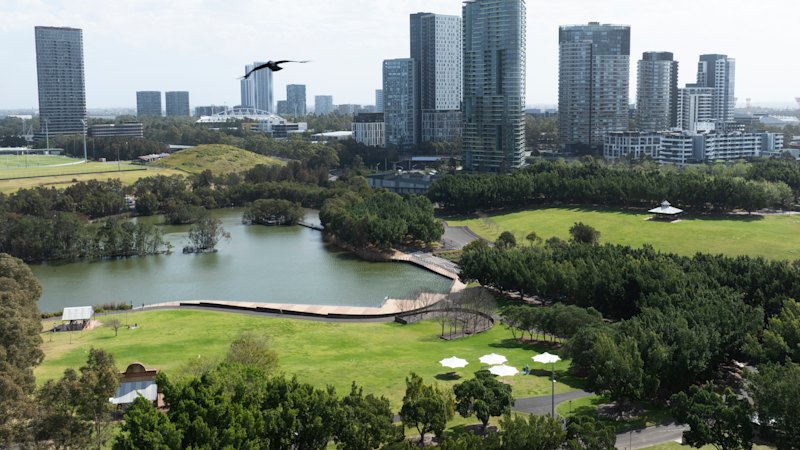
It’s a place millions have been to but only 5000 call home. Sydney Olympic Park, the precinct that put its namesake city on the world map at the turn of the century, has for the most part of its two-decade history been defined by transience: just like during the Olympic Games, people leave the precinct as quickly as they arrive.
But as the state government attempts to build housing in a model described by the top planning secretary as “everything, everywhere, all at once”, the authority leading Sydney Olympic Park is pushing to transform the suburb from an event destination to a living, breathing home to five times as many people as it currently holds.
In one of the few Sydney suburbs where mangroves, a river, and vast parklands all rub up next to huge stadiums and large apartment blocks, can Sydney Olympic Park really become something new?
The Sydney Olympic Park Authority’s masterplan, released earlier this year, aims to balance new homes “with the open spaces and walkable spaces”, said the body’s acting chief executive Chris Martin, who usually acts as the Department of Planning’s chief financial officer.
He says the suburb is essentially a “dormitory suburb” at present: if you live here, you’re likely to come home to sleep and then get out – but he said more housing would bring more jobs and more activities.
“[The goal is] to really make it that vibrant precinct that has more of a nighttime vibe, has more of a daytime vibe, and people are living and working and then relaxing and playing here as well,” he said, describing the park as an oasis.
The key to making the area vibrant is to have more people living there, Planning Minister Paul Scully said.
“I think probably the big change will be the number [of] homes and jobs that were always envisaged for there, but never really took off because there hadn’t been a push,” he told a conference on Wednesday. He said he wanted the area to be recognised as an “everyday space to live, to work, and to go out and have some fun”.
The masterplan envisages up to 15,000 homes in the area over multiple high-rise apartments, bringing the total population to about 25,000 by 2050. But the suburb will also get two new schools and at least seven new playgrounds or parks. The government says about 26,000 jobs will be created in the area with new commercial buildings, too – a decrease from the 32,000 it promised in 2024.
Grand visions of Sydney Olympic Park’s future have always been thwarted by one thing: its infrastructure. A train line does connect visitors to Lidcombe station but it runs infrequently.
An extension of the second stage of the Parramatta light rail service, which the NSW Labor government promised to build, was earlier this year broken into two parts with no timeline for its arrival into the suburb. When the Metro West line opens in 2032, 25,000 passengers every hour will be able to travel between the precinct and the Sydney CBD in about 15 minutes.
“This is project will support a vibrant community [and] match housing growth with transport and infrastructure capacity, so that people can live, work, and play close to home in a community they choose,” Scully said.
Until then, Martin has some advice for people dropping by for a game or a concert: “Find a shady spot, you can throw a Frisbee. You can frolic,” he said. “Don’t just surgical strike your visit, but do your [event], then go for a wander.”
KioskNews shows a cleaned-up reading view extracted from the publisher’s page — the original always lives on their site, not ours.