GlobalFoundries accelerating global capacity expansion, official says
By Lisa Wang / Staff reporter, in Hsinchu City


GlobalFoundries Inc yesterday said it plans to accelerate global capacity optimization and expansion to accommodate exponential growth in radio frequency (RF) and other chips driven by the artificial intelligence (AI) boom.
Singapore will pay a vital role in the company’s capacity expansion, alongside production line optimizations across its manufacturing sites, GlobalFoundries Asia Pacific head Vincent Feng (范曾文) told a news conference in Hsinchu City.
“Many might be surprised to hear that the RF market is thriving now. We are gearing up for a massive capacity expansion, and it is all being driven by AI,” Feng said.
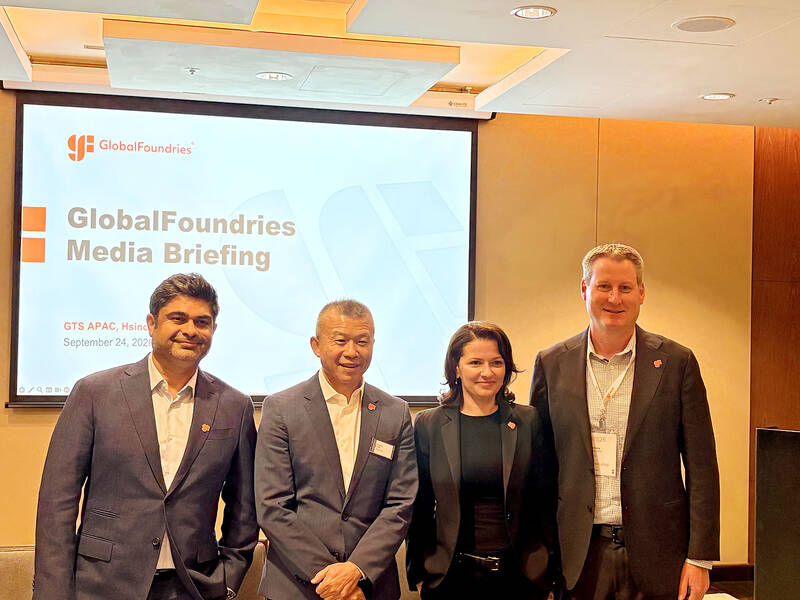
From left, MIPS CEO Sameer Wasson, GlobalFoundries Inc Asia Pacific head Vincent Feng, GlobalFoundries advanced connectivity business senior vice president Tea Williams and GlobalFoundries CMOS business senior vice president Ed Kaste attend the company’s technology summit in Hsinchu City yesterday.
Photo: Lisa Wang, Taipei Times
He declined to disclose details of the company’s capacity expansion plans, saying only that its chip fabs in the US are highly utilized.
GlobalFoundries offers technological diversification and geographical resilience, Feng said, urging Taiwanese chip designers to capitalize on the company’s Singapore facility due to its close proximity to Taiwan.
Taiwan is a vital market as it houses three of the world’s largest chip designers, he said.
Asked why GlobalFoundries has doubled down on its investment in gallium nitride (GaN) technology, despite a major Taiwanese foundry’s decision in July last year to exit the market in two years’ time, Feng said he was “happily surprised” by its competitor’s move.
GlobalFoundries became the first company to enter a licensing agreement with the Taiwanese company, he said, referring to its deal with Taiwan Semiconductor Manufacturing Co (台積電) for 650-voltage and 80-voltage GaN technology.
GlobalFoundries, headquartered in Malta, New York, had kept a quiet footprint in Taiwan, but now plans to ramp its local visibility and engagement, he said.
GlobalFoundries CMOS business senior vice president Ed Kaste said that demand from hyperscalers based in the US continues to surge, driving the need for onshore manufacturing there.
As Taiwan’s ecosystem plays a big role in both data center AI and physical AI, GlobalFoundries has always been engaged in the region, Kaste said.
Meanwhile, MIPS, an intellectual property subsidiary of GlobalFoundries, yesterday said it plans to add more than 30 research and development (R&D) engineers in Taiwan, on top of 35 currently.
The company aims to expand its local R&D team to 100 engineers in the longer term to match its R&D teams in other regions, he said.
KioskNews shows a cleaned-up reading view extracted from the publisher’s page — the original always lives on their site, not ours.