A tour around Amy Winehouse’s private junk: five free art exhibitions to see
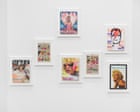
They tried to make her go to rehab and she said “no, no, no”. And she probably would’ve said no to letting the artist Alex Margo Arden mount an exhibition out of all her old junk, too, but sadly Amy Winehouse isn’t around to protest, so Arden’s gone ahead regardless.
In display cases and on shelves in a lush Chelsea flat, Arden has assembled a collection of objects and books based on what Winehouse once owned. Trawling through archive material and auction records, Arden has bought duplicates of Winehouse’s makeup, her copies of Vogue, her boardgames, her books.
So you get to snoop through her private junk, imagining her reading all these biographies of jazzers and celebs, or the Claudia Roden book of Jewish food. The thought of her reading Roy Keane’s autobiography while slurping down matzah-ball soup is beautiful.
Did Winehouse really do the 1,000-piece Cadbury jigsaw puzzle? Did she read the article on “the body we all want now” in that issue of Vogue? Arden is forcing you to ask these questions, imagine these scenarios, turning you into a celebrity stalker, someone who has become unable to separate idol from human.
There’s a pair of ballet pumps signed by fans and left on her doorstep after Winehouse’s death, a birthday card from Mark Ronson and Adele that she never got to open. Now we’re too close, now it feels like we’re intruding.
It’s a weirdly cold, unemotional display. But two things are opening at once here: there’s a portrait of an icon being created out of the objects and ephemera of their life, and there’s an uncomfortable exploration of the fetishisation of celebrity. There’s an act of love and devotion, and there’s an act of critical self-reflection. Joy and discomfort, rubbing awkwardly up against each other. It’s very smart, very critical conceptual art that makes you feel pretty grubby and intrusive.
Nicoletta Fiorucci Foundation, until 23 January 2027
Yuko Mohri: In Concert
★★★★☆
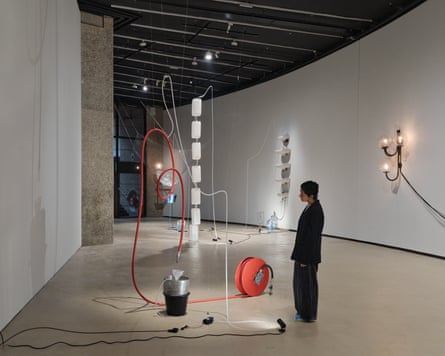
The Barbican has sprung a leak. Actually, it has sprung loads of them, which is why they’re investing so much in trying to repair this poor old brutalist beast.
But in Yuko Mohri’s installation, those leaks aren’t maintenance problems, they’re creative collaborators. Water drips out of sinks and pipes in the Curve, gathering in buckets and tarpaulins, being funnelled and pumped through tubes. Each drip triggers a little cymbal, a triangle, a mallet on a drum. The Barbican’s collapsing infrastructure is playing you a tune.
It’s surreal, cacophonous: repurposed Barbican lamps, flickering on and off, are being controlled by sensors measuring the moisture levels in rotting fruit, others by breezes blowing through the Barbican’s draughty walls – all at the will of mouldy fruit and crumbling concrete walls.
It’s the best use of the Curve for years: Mohri has turned rot and disrepair into an instrument and made the building’s frailties into a symphony of survival. When life gives you lemons, you make lemonade. When it gives you a leaky roof, you make musique concrète.
Barbican Curve, until 24 January 2027
Yuyan Wang: Pilgrims
★★★★☆
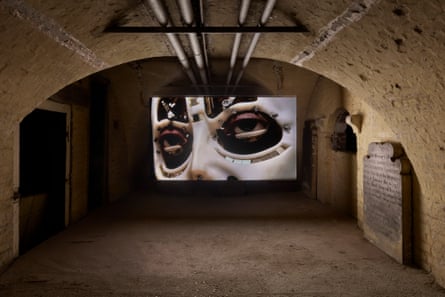
Light is a positive thing in popular culture. We call smart people bright, we say good things are “lit”, etc. But there’s a darkness to how Chinese artist Yuyan Wang approaches it in this new film work.
It takes as its starting point a 2018 initiative from the Chinese government to launch artificial moons in order to provide continuous daylight.
Moths and bugs flit across the screen downstairs, drawn to a lamp, their natural instincts duped by artificial light. Upstairs, found footage of drills and mines, LEDs, fireworks, lasers, rockets, torches and neon striplights flicker past, soundtracked by blasts of synthesiser choir chords. Wang is asking what it means to have no darkness, to be constantly productive, to have no rest or escape.
I guess we are the moths now, being fooled by the artificial lights of a world that treats us like bugs.
Over in the crypt of Shoreditch church next door, another video shows humanoid robots being constructed. You get the sense that Wang knows that our terrifying imminent future will just be more forgotten industrial detritus.
This is what art cinema does well: non-narrative, alluring, disconcerting weirdness.
Rebecca Warren: There Will Be Another You
★★★★☆
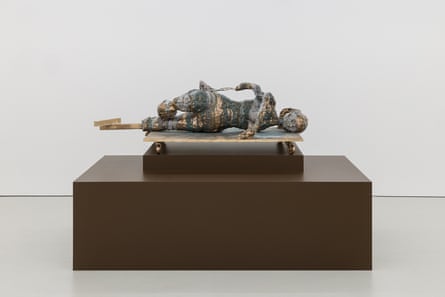
Twenty years after her nomination for the Turner prize, Rebecca Warren has lost none of her angular, gritty, rough, weird power.
The sculptor is back for her first London show in 16 years with more of her lumpy unfired clay and bronze figures, and they are still perfectly imperfect. The smaller sculptures look like a post-apocalyptic take on decorative rococo ceramics. Instead of glistening perfection and flowing, ornamental robes, we’ve got rough, gloopy, brittle nudes stretched out on rocks. They’re funny, ugly things. But you can’t help but feel like the avalanche of faux-amateurish, kindergarten-grade ceramics that are so popular these days might all be Warren’s fault.
The big bronzes in the main space are the best. Lifesize nudes with hands and feet that have grown grotesque and lumpen, they’re somewhere between Henry Moore, Alberto Giacometti and Robert Crumb, like a bawdy grotesque take on modernism. It’s like all your favourite modernists have melted together, making one big, lumpy but pretty delicious visual soup.
Maureen Paley, until 12 December
William Kentridge: A Nicely Built City
★★★☆☆
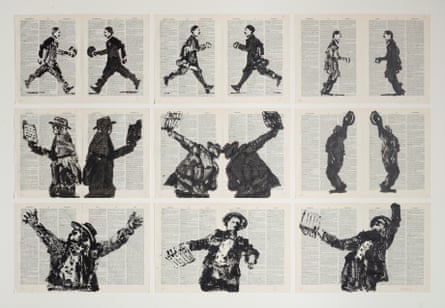
William Kentridge is in a despairing mood. For decades, the South African artist – last seen round these parts with a major show at the Royal Academy in 2022 – has been making animated films about the fate of his home city, Johannesburg. The latest iteration is on show here, and it’s a pretty miserable thing. Whatever hope could be found in the earlier works is gone. Johannesburg has fallen further into ruin. A gas explosion has gutted a building, trees are blighted by fungus, women cradle their terrified children, protesters pack the streets, all rendered in filthy charcoal. The character of Soho Eckstein, a major industrialist in a modernist house, reappears – but now he seems to stand in for the artist, an isolated older man watching it all fall apart from the safety of his mansion.
I’ve never been much of a Kentridge fan, and this all just feels a bit too whimsical for the subject matter. But it’s still classic Kentridge: experimental, theatrical art about deeply emotional issues. It’s a small, museum-quality show filled with drawings and sculptures that will make Kentridge fans very happy but probably won’t do much to get the rest of us on side.
KioskNews shows a cleaned-up reading view extracted from the publisher’s page — the original always lives on their site, not ours.