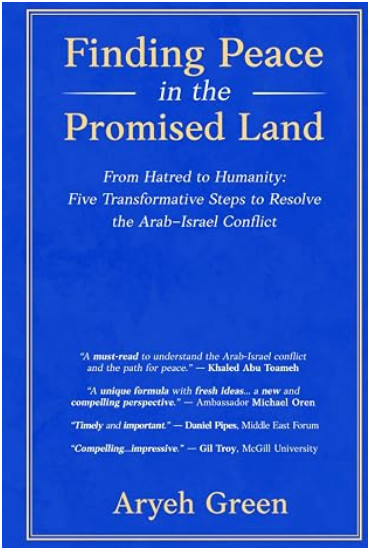
'Finding Peace in the Promised Land': From the Israel Trail to a new path for peace - review

Author Aryeh Green is passionately convinced that the answer is “Yes,” and in his latest book Finding Peace in the Promised Land, he lays out a bold and hopeful, yet deeply sensible and practical path forward, grounded in Jewish, Muslim, Christian, and universal values.
When a veteran Muslim-Arab Israeli journalist like Khaled Abu Toameh calls a book “a must-read for anyone who wants to understand the Arab-Israeli conflict and the path for peace and coexistence,” it is worth paying attention.
Green’s book earns that endorsement, as well as endorsements from others, including former ambassador Michael Oren, Middle East Forum President Daniel Pipes, Prof. Gil Troy, and Prof. Mohammed S. Dajani Daoudi, founder of the Wasatia moderate Islamic movement.
In a region long portrayed as a graveyard of peace plans, Green refuses to accept despair as our inevitable destiny and trailblazes a way forward.
A policy expert with decades of experience in Middle East affairs, including serving as senior adviser to Natan Sharansky, Green relates that he drew initial inspiration and motivation for this book from insights gained on his 1,050 km. solo trek along the entire length of the Israel Trail in 2014.
In his previous book, My Israel Trail, he recounts how the lessons learned on that grueling physical and spiritual journey – spanning the length of the country, from the Egyptian border to the Lebanese border – enabled him “to find a way out of the morass of despair and anger, resentment and sorrow,” and heal from a devastating divorce.
During that journey, Green realized that the transformative elements (humility, acceptance, gratitude, forgiveness, and purpose) that were critical to overcoming his personal challenges “can also be applied to much larger situations, such as national and international discord” – including the Arab-Israeli conflict.
The conceptual framework, “when distilled to its essence, calls for mutual respect, tolerance, understanding, love, and respect.”
This vision may sound pie-in-the-sky, but Green is actually very much a realist, taking full measure of sobering factors, such as the October 7 “murderous outrage carried out by Hamas ‘activists’ and 6,000 other Gaza civilians,” as well as the inescapable fact that many Arab and Muslim leaders, and even states “declare the obliteration of Israel as [their] central mission” and work actively with obsessive determination toward that end.
If that is the case, where does one find a basis for hope?
“There will never be real peace without a change in Arab and Muslim attitudes leading to acceptance, forgiveness, and a new sense of purpose, which includes peace and coexistence,” Green concedes. But importantly, “there exist normative and traditional Muslim thinkers/leaders who support such a change.”
A concrete 'to-do list' for both sides of the conflict
TO SUPPORT this mitigating trend, Green brings extensive proof from Muslim tradition and Arab culture and history, quoting statements from a significant sample of Arab/Muslim thought leaders throughout the Middle East who express a readiness for real peace. He cites the warm peace with the Abraham Accords countries as the most concrete and current demonstration of his thesis.
The five pillars mentioned above form the backbone and structure of this well-researched and extensively sourced book. They come with a concrete “to-do list” for both sides of the conflict – as well as for every individual interested in helping create a better future. Briefly, they are:
Humility: International diplomats and regional actors must admit their limitations. Humility begins with understanding one’s place in the universe while recognizing the deeply rooted, historical presence of the other. “Without humility, both sides fall into the trap of believing they can win everything.”
Acceptance: Accepting what it means to face the truth without denial. Jews must recognize that “Palestinian national identity, though shaped only in the last century, is now a fact.” For Arabs, this demands the unconditional acceptance of Israel’s foundational right to exist as a Jewish nation in its ancestral homeland.
Gratitude: Traditional media and political narratives focus on grievances, violence, and setbacks. Both sides need to reframe priorities, elevating appreciation of the many achievements they have already attained over resentment.
Forgiveness: “In the Middle East, forgiveness is almost absent from the political vocabulary… yet both Judaism and Islam honor forgiveness.” All parties here have wounds inflicted by wars, terrorism, massacres, and displacement. The refusal to forgive keeps the conflict simmering.
Purpose: “For Israel, purpose has long meant building a society rooted in the moral vision of the prophets while surviving in a hostile environment.” For too many in the Muslim and Arab world, however, purpose has been laser-focused on annihilating Israel. Fortunately, there are now leaders in that world working to redirect their destructive vision toward constructive goals, such as education, innovation, and growth.
The heart and soul of Finding Peace in the Promised Land is an impressively researched and meticulously documented deep dive into these five transformative steps, drawing judiciously from the region’s historical and religious sources, along with salient and often surprising statements from texts, leaders, and influencers from all streams of thought.
As just one example, Green identifies and spotlights a wide range of Islamic sources and scholars who conclusively debunk seminal harmful myths that portray Jews as interlopers and foreign intruders (European colonial implants) into the region that Arabs and Muslims consider “theirs.”
Re-examining and countering the invention of a native “Palestinian” people as indigenous, and bolstering the clear historical Arab and Muslim recognition of the connection between the land of Israel and the people of Israel as truly indigenous, naturally encourages a reduction of resentment and promotes conflict resolution.
Regarding the importance of acknowledging reality and the “acceptance” of Israel’s legitimacy, Green amasses an impressive array of supporting statements by Arab/Muslim luminaries, such as former Egyptian president Anwar Sadat, King Abdullah II of Jordan, United Arab Emirates Vice President Sheikh Mohammed bin Rashid al-Maktoum, Abu Dhabi Crown Prince Zayed Al Nahyan, Oman Foreign Affairs Minister Yusuf bin Alawi, Islamic scholar Dr. Khaleel Mohammed, American Islamic Forum for Democracy founder M. Zuhdi Jasser, and others, as well as numerous verses from the Quran (with almost no repetition).
In addition, Green brings ample evidence that mindset changes have propelled transformative steps forward, historically, in various conflict-torn regions, including post-war Germany/Europe and Japan/Asia, among other places.
A how-to guide: From vision to blueprint
FINALLY, BECAUSE the book is, at its core, a how-to guide, and not merely a treatise on political theory, the final chapter takes us from vision to blueprint by laying out practical steps toward real peace.
In the field of education, for example, the mind- and soul-poisoning demonization of the UNRWA-style propaganda can be replaced by programs such as those offered by the Peace Research Institute in the Middle East, where students see the other side’s perspective presented honestly.
Tools that embody and foster shared purpose and cooperation on the large scale can include elements such as joint economic zones and bilateral infrastructure councils. And the book also zeroes in on things that readers can do on the grassroots level, starting today.
Green calls on individuals to begin now with these concrete suggestions:
Humility: Fostering this in daily encounters, including gestures of shared humanity toward creating an environment of mutual respect.
Acceptance: Recognizing that the other side’s presence is not temporary or illegitimate – can be promoted by acts such as attending each other’s weddings, shopping at each other’s markets, and sending children to joint extracurricular activities.
Gratitude: Cultivating this by recognizing benefits that come from the other side. It can be advanced by something as small as thanking a colleague from across the divide for help.
Forgiveness: Realizing that in many ways, we are all victims of this conflict, but we can learn to reduce the thirst for revenge and not let hatred own us.
Purpose: Encouraging this by participating in initiatives such as community dialogue circles, shared public service projects, cultural exchange events, and youth mentorship programs. These can help develop joint purpose and direction.
Green closes with a balanced call for steps to be taken by both the Israeli and Arab sides, but sums up the essential stumbling block underlying it all with the following declaration:
“Reality must be recognized. The Jews are indigenous to this land. Israel has acted almost exclusively in self-defense. No nation in history has taken greater care to protect innocents, even in enemy populations, in wartime.
“Yet these truths have been buried under layers of propaganda. The primary barrier to peace has never been ‘settlements’ or borders, or Israeli policy. It has been the continuous refusal of Arab and Muslim leadership to accept Israel’s existence and the legitimacy of its founding, and the systematic radicalization of their societies. Until this fact is faced, peace cannot begin.”
Finding Peace in the Promised Land is a valuable contribution to the body of literature on the Middle East, but as Abu Toameh wisely remarked at the recent book launch event at the Menachem Begin Heritage Center, it could have even greater value and impact if it were translated and made available in Arabic.
The reviewer is the author of The Dream’s Enough. ■
FINDING PEACE
IN THE PROMISED LAND
By Aryeh Green
GreenHouse Press
215 pages; $15
KioskNews shows a cleaned-up reading view extracted from the publisher’s page — the original always lives on their site, not ours.