DMZ explosions raise questions of territorial infringement by North Korea

Defense Minister Kang Shin-chul appears before the National Assembly’s National Defense Committee on Sept. 30 to answer questions regarding the recent explosion in the DMZ. (Kim Jung-hyo/Hankyoreh)
The military is wrapping up an investigation amid the near certainty that a North Korean mine caused the Sept. 21 explosion in the western reaches of the Demilitarized Zone, with the potential repercussions from the probe's findings fueling speculation.
If the mines are confirmed to have been planted south of the Military Demarcation Line (MDL) during the North's "border fortification" work that started in April 2024, a dispute over territorial infringement is expected.
The Joint Chiefs of Staff on Tuesday said a third joint on-site inspection with the United Nations Command (UNC) found another North Korean "plastic anti-personnel mine" near the site of the explosion.
Minister of National Defense Kang Shin-chul the same day also testified at a session of the National Assembly's National Defense Committee that the mine was "planted." In an interim briefing the previous day, the Joint Chiefs also reported the discovery of an object suspected to be a North Korean mine of the same type around a meter from the explosion site.
Inter-Korean tension over violation of the armistice agreement is expected if Pyongyang planted this mine as part of its border fortification project that began over two years ago near the MDL under the North's policy of "two hostile states."
The South Korean military considers the explosion site to be south of the MDL, thus mine laying in this area could constitute a territorial incursion
.
In its joint on-site survey with the South Korean military, the UNC confirmed that the newly discovered North Korean mine and the explosion sites were found south of the MDL.
Joint Chiefs Vice Chairman Kwon Dae-won said, "The UNC acknowledges that the three locations of the mines — the fourth discovered today and the firing positions where a sergeant and a battalion commander were injured — are clearly situated south of the MDL."
On whether the mines were planted deliberately, Kang said, "[North Korean forces] are presumed to have done so in connection with border fortification work," calling the action "a clear violation" of the Armistice Agreement.
If the mines were planted by the North, determining the time of placement is crucial. The military says the newly discovered mines were laid at least a year ago.
Based on analysis by field experts, Kwon said the mines were assessed to be at least a year old.
A military source told the Hankyoreh, "The assumption is that the mines weren't planted recently since they were covered by growing grass rather than fallen leaves; they appear to have been buried at least a year ago."
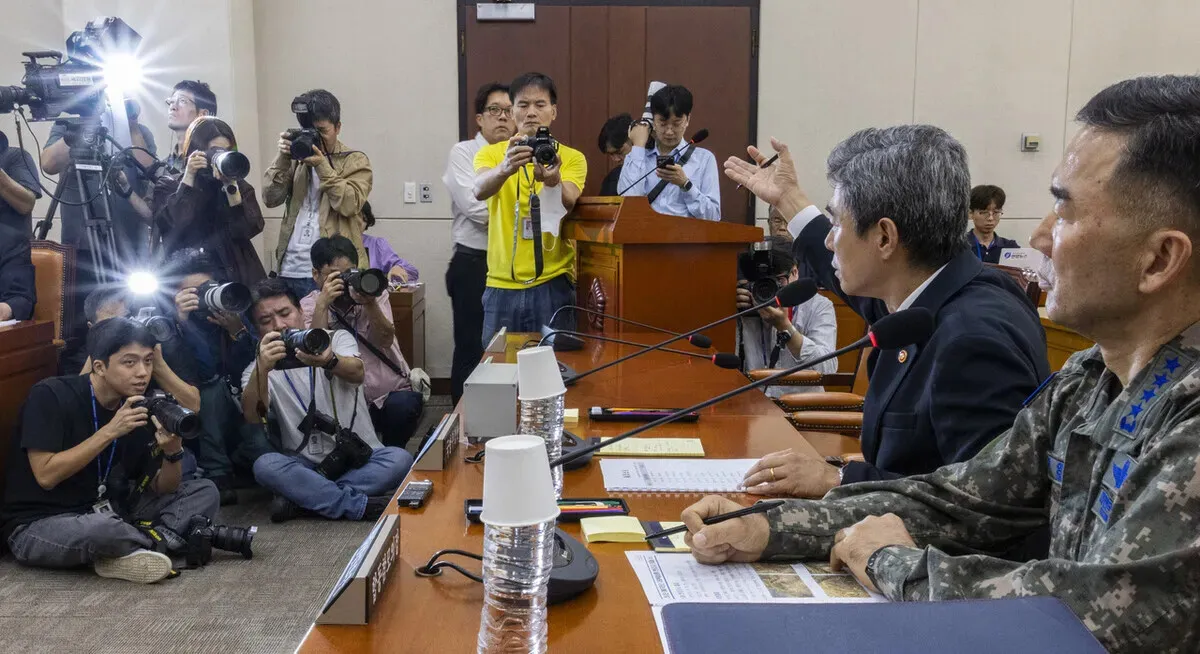
Defense Minister Kang Shin-chul appears before the National Assembly’s National Defense Committee on Sept. 30 to answer questions regarding the recent explosion in the DMZ. (Yonhap)
The military said that near the site of the explosion, it identified changes in terrain apparently showing that North Korean troops planted mines there in September last year, but that the mines in question were planted before that.
The four mines — the one just discovered, two that exploded on Sept. 21 and a wooden box anti-personnel type spotted by operational troops on the day of the incident — were all clustered within a small area. This has fueled speculation of the deliberate planting of a minefield.
The mines in this area could have been laid around the same time, but nothing can be confirmed at this stage.
"Even if the mines are clustered together, they could've been laid at different times under several tactical methods," the source said. "Determining the exact time of placement is no easy task."
And since the site of the incident was not subject to precise observation using military surveillance equipment, the movements of North Korean troops there prior to September last year have not been closely tracked.
KioskNews shows a cleaned-up reading view extracted from the publisher’s page — the original always lives on their site, not ours.