ODM leaders clash over written deal with Ruto as Oburu urges party discipline
NAIROBI, Kenya, Oct 31 – ODM leaders have issued conflicting positions on the party’s working relationship with President William Ruto’s administration, with Deputy Party Leaders Simba Arati and Abdulswamad Nassir demanding clear power-sharing terms while party leader Oburu Oginga insists negotiations must follow established structures.
While some senior officials are insisting on a negotiated agreement with the ruling United Democratic Alliance (UDA) to safeguard ODM’s interests, party leader Oburu Oginga has maintained that the broad-based government is already operating through established structures and that negotiations are ongoing.
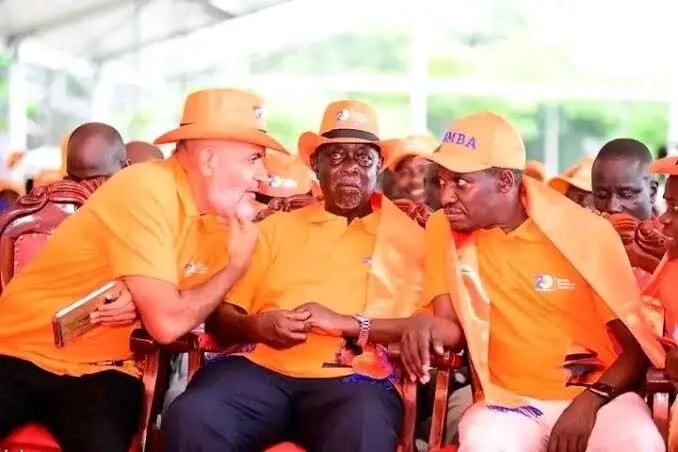
The differences emerged during celebrations marking the legacy of the late former Prime Minister Raila Odinga, with Deputy Party Leaders Simba Arati and Abdulswamad Nassir outlining demands they want addressed as ODM engages Ruto’s administration.
Kisii Governor Arati insisted that ODM must negotiate clear conditions before committing itself to working with UDA, dismissing calls for the party to cooperate without setting terms.
“As the ODM party cooperating with UDA, we must establish the conditions that will enable us to enter into government,” Arati said.
He argued that the party should not be expected to abandon its demands in the name of political cooperation, saying a formal agreement was necessary to define the relationship between the two parties.
Arati further took aim at critics who have questioned the party’s push for conditions in its dealings with Ruto, saying ODM could not enter a political arrangement without clear terms.
He also dismissed claims that the party was losing its political footing following the departure of some members, insisting that ODM remained intact and had retained its national appeal.
“I want them, wherever they are, to see that ODM is full to the point that we have locked it with a padlock. The only people we have left outside who have departed are the masangwenya,” he said.
Arati added that the party would continue championing the political ideals of its late leader Raila Odinga, arguing that the presence of its senior officials was a continuation of Baba’s political legacy.
“Baba said that when you see leaders like Oparanya, Joho, Simba here, Wanga, Junet, or Abdulswamad—when you see these ODM party leaders, Baba is inside,” he said.
Nassir, who also serves as Mombasa Governor, went further by declaring that ODM expected to secure the Deputy President’s position in any future political arrangement with UDA.
He said the party would also field candidates across all elective positions, from Members of County Assembly to governors, senators, MPs and women representatives.
“Furthermore, we are declaring that the Deputy President of the Republic of Kenya will come from ODM,” Nassir said.
The declaration reinforces ODM’s demand for a significant share of government in a possible post-2027 arrangement, with party officials previously floating a 50-50 power-sharing formula with UDA. Daily Nation+2
However, Oburu appeared to take a more measured position, cautioning party members against making public declarations that could undermine the ongoing negotiations with Ruto’s administration.
Addressing the gathering through a live link, the ODM leader said the party had not entered the broad-based government blindly but had made a deliberate decision guided by its structures and political objectives.
He drew a distinction between the current broad-based government arrangement and a formal coalition government, arguing that the two operated under different frameworks.
“We are in this broad-based government, and we did not go there blindly; we are there knowing what we are doing and working through established structures,” Oburu said.
He disclosed that ODM had appointed a five-member technical team to work on the party’s constitution and policies, adding that the process was nearing completion.
Oburu said a separate coalition negotiating team comprising representatives appointed by himself and Ruto would be constituted before February 2027.
“Before February next year, we are going to have a coalition team appointed by my team and President Ruto’s team, which will be completely different from the technical team,” he said.
He urged party members to exercise discipline and respect the leadership’s direction as the negotiations progress, warning against individuals making pronouncements outside established party structures.
“We want discipline in our party if you are a member of the party, please be disciplined and follow the policies of your party as we move towards the 2027 general election,” he said.
Oburu’s position comes against the backdrop of his recent rejection of calls by individuals he described as outsiders to dictate whether ODM should sign a written agreement with UDA.
In a statement issued on October 29, he maintained that ODM had the leadership and structures to determine its negotiating position without external interference.
The competing positions have exposed a delicate balancing act for Oburu as he seeks to maintain party unity while managing expectations among officials demanding firm guarantees from Ruto.
The disagreement is largely centred on whether ODM should commit its political support to Ruto’s re-election bid before securing a formal agreement outlining its share of government and policy commitments.
Oburu dismissed attempts by people outside the Orange Democratic Movement to dictate whether the party should sign a written pre-election agreement with UDA ahead of the 2027 General Election.
The Siaya Senator, who has been recovering from a recent hospitalisation, said ODM had established structures and experienced leadership capable of negotiating in the party’s interests without external direction.
“During my temporary absence from active political engagement, I have observed with concern attempts by certain individuals, including some non-ODM members, to exploit the situation by prescribing how our Party should negotiate with UDA, including whether or not such negotiations should culminate in a written agreement,” he said.
Oburu added that ODM was an established political institution with the capacity to determine its own negotiating position.
“Let me be unequivocal: ODM is an established political institution with legitimate structures, clear objectives and an experienced leadership capable of conducting negotiations in the Party’s and Kenyans’ best interests,” he said.
He maintained that the party’s contribution to the broad-based government was driven by its commitment to national progress and stability.
“We’ve made our contribution, made sacrifices and will continue to do so for sake of progress and stability of our nation,” he said.
On the substance of the negotiations, Oburu insisted that the 10-point agenda agreed upon by President Ruto and the late former Prime Minister Raila Odinga must remain central to the engagement between the two parties.
“Full implementation of the 10-point agenda, among other pressing national priorities, remains a fundamental, non-negotiable pillar of our engagement with UDA. Our commitment to this agenda is absolute,” he said.
He urged those outside ODM to focus on the country’s challenges rather than dictate the party’s negotiating strategy.
“I advise those outside ODM to concentrate on the many pressing challenges confronting our country and spare us their unsolicited counsel,” he added.
KioskNews shows a cleaned-up reading view extracted from the publisher’s page — the original always lives on their site, not ours.