Quentin Bell and Olivia Sterling review – two artists with a magic touch
Quentin Bell was not a great artist, but that didn’t stop him. He saw the world as a magical place. The ceramicist (son of the Bloomsbury group’s Vanessa Bell; biographer of his aunt Virginia Woolf) spent his life lost in a world of magic, myth, newts in ponds, levitating women and knights on horseback. He died in 1996, leaving behind decades of pots, plates, figurines and drawings filled with wonder and amazement.
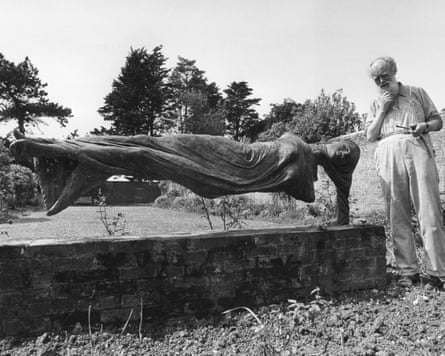
It all started when Bell was nine years old. Taken to a magic show by some relatives, he saw a jaw-dropping spectacle: a beautiful woman seeming to float in the air. It stayed with him throughout his life.
Five sculptures here show bodies caught in mid-air, raised off the ground, stiff as a board. There are rough messy works in wire and wood and plaster from the 1960s, bronze from the 80s and painted ceramics from the 90s; from modern and stark to gaudy and bright, it’s levitation that set him on his creative path and never left his side.
Most of the work here is ceramic: plates, pots and figurines. They’re humorous, brightly coloured, shiny objects. They’re like messy, rough takes on chintzy 18th-century European decorative art, rococo porcelain with its depictions of reclining ladies in voluminous dresses. The figurines aren’t great: they’re basic and poorly rendered, often malformed and pretty unremarkable, if quite funny in places.
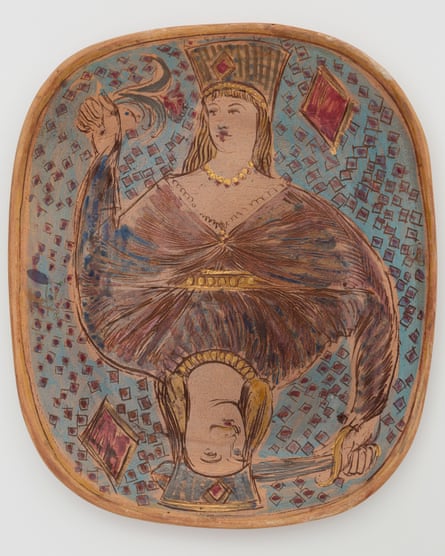
His plates and teapots fare better, especially the later cups and jugs, which are colourful and decorative. But his drawings and illustrations are where it really falls apart. He paints Greek myths and biblical scenes, he illustrates the story of Cinderella and his own imagined history of Sussex, but none of it is well executed or particularly interesting. They feel like fun creative projects meant to entertain his kids, which some of them were.
What makes it compelling is that everything here is at odds with the aesthetic trends of his era. There’s none of the austere minimalism of influential contemporary potters such as the amazing Bernard Leach, none of the abstraction or surrealism that was coursing through Europe, none of the grim interwar realism that defined so much English modernism. Instead, there’s something way more anachronistic. This is strange, charming, incredibly English, totally eccentric creativity being expressed on its own terms.
The main takeaway from this exhibition isn’t that Quentin Bell is good at art; he’s not even the best Bell. The main takeaway is that there’s something powerful, even beautiful about dedicating your life to creativity.
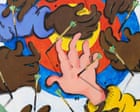
Way better is the display of new works next door by the brilliant young English painter Olivia Sterling. She’s taken the magical obsessions of Bell and pushed them to bawdier, weirder, funnier, more critical extremes. Her whole shtick is about using the language of old cartoons and comics, the symbolism of food, the representation of the human body, and twisting it all into biting critiques of race and power dynamics. This is her at her strangest, darkest and filthiest.
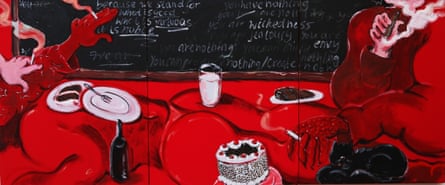
You walk into a room-sized painting of vast bodies squeezed into corsets and girdles or flopping about in dressing gowns, like you’ve stumbled into the backstage of some burlesque show. And then the performance starts. A woman has become a dirty dining table in one menacingly red painting, plates of half-eaten cake and glasses of milk strewn across her body. In another work, a pink corpse is littered with ice-creams, a magician’s rabbit scampers over her belly and milk spurts from her nipple. Smaller works show white liquid being squeezed and pulled out of teats and orifices. A huge triptych depicts a white body lying in a magician’s sword box, one black woman pressing down on top of it, another plunging a sword in.
Sterling is drawing a line between magic and power; she’s saying they’re both fundamentally the same thing: an illusion, a world maintained through artifice. It’s clever, political, incisive narrative painting. But, crucially, it’s also fun, ridiculously colourful and totally overblown. If it was miserable, serious and dour, you’d feel like you were getting lectured. Instead, you feel like you’re watching a Tom and Jerry episode about greed and racism, with all the violence and slapstick intact. Now that’s a good magic trick.
KioskNews shows a cleaned-up reading view extracted from the publisher’s page — the original always lives on their site, not ours.