Fantasy baseball 2027: Jordan Walker faces regression risk after breakout as historical trends raise concerns
I whiffed on Pete Crow-Armstrong last season. I wasn't alone in that, and he wasn't the only player I whiffed on. There will be plenty more to come in the future, too. There's no getting away from that in this job.
I'm not bothered about missing on Crow-Armstrong, but I am bothered by why I missed. In some ways, Crow-Armstrong's emergence not just as a dynamic all-around player but as one of the very best hitters in baseball was nearly impossible to see coming. Even when he was very good prior to the 2026 season, it always came with pretty poor plate discipline that left him walking a knife's edge with his production, and that changed in a big way. Improvement is one thing, but Crow-Armstrong went from having some of the very worst swing decisions in baseball to something approaching a strength in his skill set in the course of one season, and that's not the kind of improvement you should ever bet on. Sometimes, unexpected things happen!
But still, the miss on Crow-Armstrong is something I've been struggling with, at least in part, because of why I missed it. I was skeptical of Crow-Armstrong's 2025 season and his chances of succeeding in 2026, at least in part (and arguably in large part), because he was so disastrously bad in the second half of 2025. If you can't remember that far back, here's a reminder: Crow-Armstrong hit just .216/.262/.372 with a 26% strikeout rate in the second half of the 2025 season. His speed was still an asset, but even then, he was arguably dead weight on your team for several months to close the season out.
It turned out, for him at least, that didn't matter. And it didn't matter for James Wood, who might have been even worse late in 2025 after breaking out earlier in the season. Which raises a question I need to know the answer to before I really start laying down my stakes for the 2027 season: Does the shape of a player's breakout season matter?
Does the second-half slump hold ill portents for a player's future? Logically, it would make sense. Showing a new skill and level of production is great. However, if you don't have any answers after the league adjusts to you, it would stand to reason that the player's chance of sustaining their breakout is lower.
But just because a line of reasoning has some logic underpinning it doesn't mean it is true. So, today, I want to look into this question and see what it can tell us about some of 2026's biggest breakout stars. With that in mind, I went back in the archives to look at projected production from every single player dating back to 2012, via the PECOTA projections system on BaseballProspectus.com. That is a projection system I trust, but I could have chosen any other one; I'm just using it to establish a baseline expectation for every player to compare their actual performance.
I took every hitter's projection since 2012 (minus 2020, because the small sample size there always leads to funky results), looking at players who qualified for the batting title that season and in the subsequent season, which gives me 1,033 player seasons to start with. I then looked at players who overperformed their projected OPS by at least 20%, comparing their performance in the first half of the season with the second half and the subsequent season. That's the data we're working with here.
So, the first question to look at: What happens to breakouts in their following season?
79 players between 2002 and 2025 outperformed their PECOTA projection by at least 20%
- Avg Proj: .723
- Actual Avg: .910
- Avg. Next Year: .814
- Diff: -.096
That shouldn't be surprising at all! There's a reason, basically, that every projection system is based on multiple years of data rather than just the most recent one: More information is better! Sure, it might fail to capture when a player's skill set dramatically changes from one year to the next. Still, it also acknowledges that even a full season of data isn't necessarily enough to draw the kind of firm conclusions we often do.
So, now our baseline has been established. On average, our breakouts tend to give back about half of their improvement from one year to the next. You'll always be able to find outliers, but even very, very good, super-star caliber players aren't immune from this.
Take Aaron Judge, for example. In 2017, he was projected for a .757 OPS as a rookie, and instead he managed a 1.049 OPS, the second-biggest overperformance in this group. And, with the benefit of a decade of hindsight, we can certainly see that Judge's rookie season was no outlier – his career OPS is within 30 points of what he managed that season.
And yet, even Judge saw his OPS drop from 2017 to 2018 by 130 points, and it would actually remain right in that range for the next four seasons. He would eventually break out as one of the best peaks we've ever seen in his 30s, but it took a while for Judge to get back to the level he reached as a rookie.
And it's worth noting that even younger players aren't totally immune from this. Our sample includes 46 breakouts who were in their age-27 season or younger, and that group saw their OPS decline from an average of .895 to .811 the following season. That 84-point decline is less severe than the group as a whole, but the conclusion is still more or less the same: Gravity is hard to overcome. Even young players, who are presumably on the upswing when it comes to their talent level, aren't immune from regression.
Plus, there is some element of survivorship bias at play, because we're looking only at players who received enough plate appearances across both seasons in question to qualify for leaderboards. That means players who weren't able to sustain their breakouts long enough to actually lose playing time won't be included in this analysis. That won't be a huge factor in these numbers – if you were good enough to put up an OPS around .900, as this cohort collectively did, you're probably going to have a pretty long leash the next season. But these numbers could look even more pessimistic if we expanded the pool to include players with smaller sample sizes.
Which is all to say: Whether it comes from a young, top prospect or an older player with an established track record, you should expect some degree of regression after a player unexpectedly breaks out. The chances aren't the same for every player, obviously, but at a population level, your expectations should be a bit lower for the biggest breakouts than their numbers should make you think.
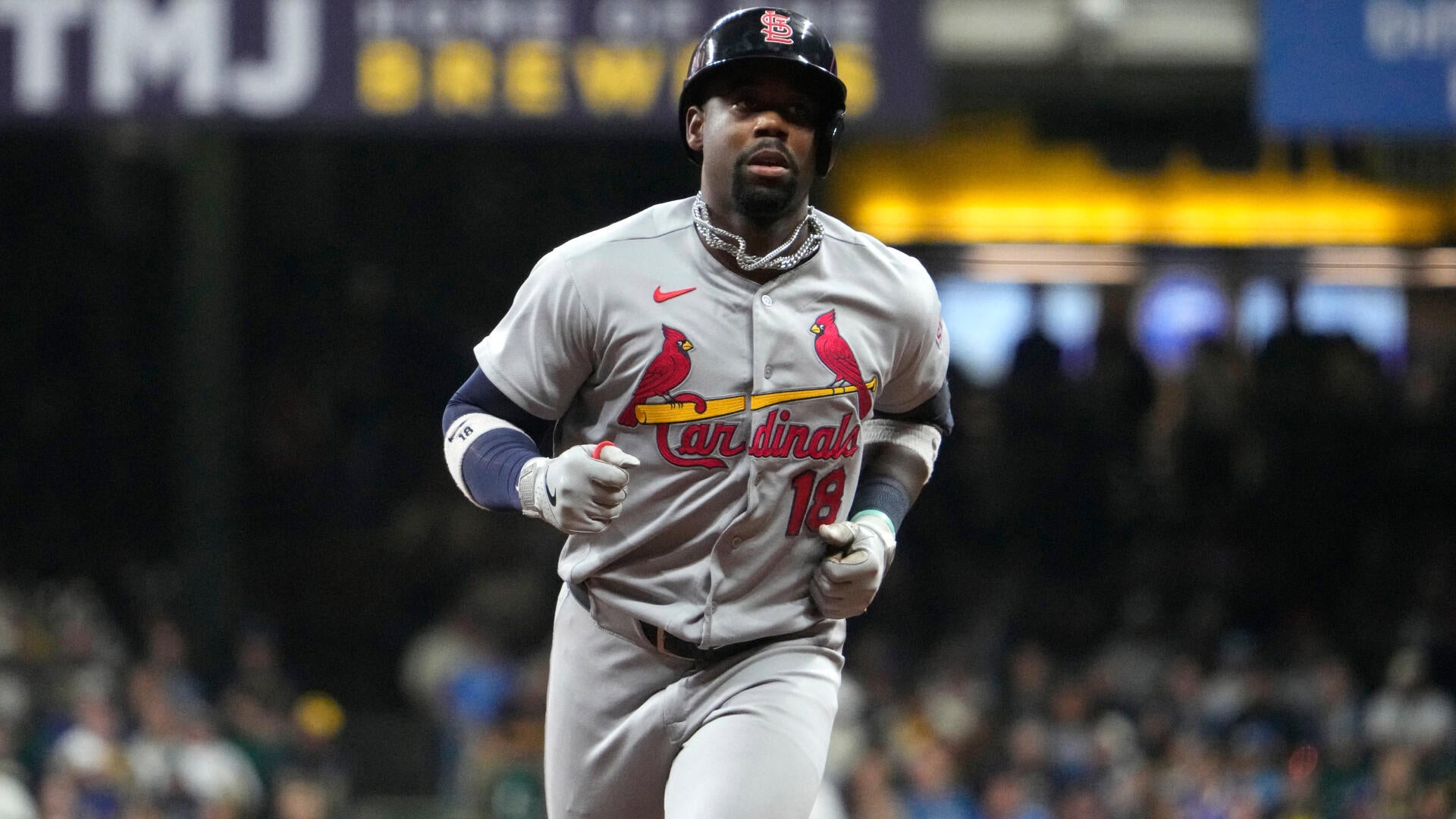
The good news is, I think at this point most Fantasy players and analysts get this. This is why Jordan Walker's way-too-early ADP is sitting at 33.4 coming off a season where he was the No. 12 player in Fantasy. Whether that's enough of a discount for the regression he might be facing is worth asking, but there's no question that the market is already baking in plenty of regression into his price.
Walker is maybe the prime example of a breakout who failed to run through the finish line last season. He put up an .887 OPS in the first half of the season, but then slumped to just a .660 mark after the break. You can play with the start and end point to tell different versions of the story – he was a sub-.750 OPS bat from June 1 on, but he also had an .839 mark through the end of August before a miserable September – but the general story is the same: Walker started off blazing hot and cooled down considerably.
Does that matter? If you look back at two of 2025's biggest breakouts, Pete Crow-Armstrong and James Wood, you might argue it doesn't matter at all. Both had disastrous second halves in their breakout seasons, and both came out in 2025 and were even better than the previous season. But a sample of two doesn't necessarily tell us much, and anecdotal evidence should never carry much weight. What can some of the bigger samples of data tell us?
Let's look first at the players, like Crow-Armstrong, Wood, and Walker, who failed to sustain their breakout through the entire season:
19 breakouts were better in 1H than 2H by at least 100 points of OPS
- Avg Proj: .710
- Actual Avg: .902
- Avg. Next Year: .765
- Diff: -.137
Okay, well … that's worse! Remember, the average of our breakouts saw their OPS dip by 96 points; the second-half crashers dropped by an additional 50 points. It worked out for Wood and Crow-Armstrong in a big way, but with the larger sample, these players regressed even harder than the overall population. That's not great news for Walker.
Of course, 19 players isn't a huge sample size. And it looks even less meaningful when you consider that the players who had the smallest gaps between their first- and second-half numbers saw their subsequent season's numbers drop by almost the same amount:
26 breakouts were within 50 points of their 1H and 2H OPS
- Avg Proj: .738
- Actual Avg: .925
- Avg. Next Year: .815
- Diff: -.110
Again, the sample size here isn't huge, but the fact that the players who didn't see the huge second-half dropoff still saw their production fall the following season by more than 100 points of OPS on average seems like a sign that there isn't a ton of signal here. This group did perform better the following season than our second-half crashers. If you were looking for a causal explanation – "performing worse in the second half makes your breakout less sustainable" – then the existence of this group of players sort of complicates that.
It still points in the same general direction, but I don't necessarily think it means we can draw a strong conclusion that says these crashers are especially bad bets. Given the sample size, it's close enough that I think your baseline expectation for a Walker-esque breakout-and-collapse shouldn't be significantly different than the group as a whole.
But you might have noticed that the overall group dropped by 96 points and each of the two subgroups we've looked into dropped by 110 or more points. So, someone has to be getting better results to make this all work out, right?
Well, as it turns out …
19 breakouts were better in 2H than 1H by at least 100 points of OPS
- Avg Proj: .723
- Actual Avg: .913
- Avg. Next Year: .876
- Diff: -.037
Well now, that's kind of interesting, isn't it? This group includes 2025 Ben Rice, who had a .791 OPS in the first half of 2025, an .894 OPS in the second half, and then went out in 2026 and put up an .897 OPS. Progress isn't always linear, but it definitely worked out for Rice!
But then there's the case of Geraldo Perdomo in 2025. He went from a .783 OPS in the first half to a .949 mark in the second half of his breakout season, only to fall back down to a .747 mark in 2026. That .747 number still dwarfs the .657 OPS he had prior to 2025, suggesting that the breakout indicated some change in skill. But anyone who had Perdomo on their roster in 2026 can attest to how disappointing he was.
Of course, anecdotal evidence, and all that. The point here is that the group who improved in the second half of their breakout seasons did, in fact, sustain a whole lot more of their new level of production than the rest of the group did.
So, what's the conclusion? For me, it's this: As a general rule, you'd rather a player sustain their breakout, or even improve on it, than not. That doesn't guarantee you'll avoid the regression monster, of course. It bit George Springer and Geraldo Perdomo pretty hard in 2026, for example, and there were more players whose subsequent season OPS dropped by 100 or more points (seven) than players whose OPS improved by even 20 points. But all other things being true, you'd rather see that.
Really, the takeaway is that most breakouts don't sustain it. And that's okay! Maybe 20 years ago, the Fantasy baseball community might have reacted to Walker's breakout by ranking him as a first-round pick, but we're all smarter than that now. We've all more or less internalized the lessons of the sabermetric movement, and we know that a one-year sample size just isn't big enough to be confident that a player has found a new baseline level. Career seasons happen, and the marketplace has priced in enough reasonable skepticism about them that it's pretty rare for players to be too overrated coming off breakouts.
Who are the breakouts this might apply to from 2026? Using that same "Outperformed their projection by at least 20%" criteria gives us the following 12 names from last season:
Player - Proj. OPS - Actual OPS
- Pete Crow-Armstrong - 0.723 - 0.943
- TJ Rumfield - 0.654 - 0.843
- Jake Bauers - 0.705 - 0.874
- Garrett Mitchell - 0.623 - 0.771
- Willson Contreras - 0.731 - 0.901
- Gabriel Moreno - 0.716 - 0.874
- Brice Turang - 0.670 - 0.816
- Randy Arozarena - 0.714 - 0.865
- Chase DeLauter - 0.678 - 0.820
- Jac Caglianone - 0.694 - 0.834
- Liam Hicks - 0.667 - 0.801
- Miguel Vargas - 0.697 - 0.837
(Funny enough, Walker actually just misses this list, as he was the 13th-biggest outperformer, beating his projected OPS by 18.4%. We'll count him spiritually, if not literally.)
It's an intriguing list of names, for sure. Some real up-and-coming stars, like Vargas, Caglianone, and DeLauter, who will be plenty popular in 2027 drafts, and some ostensibly boring veteran types like Contreras, Arozarena, and Hicks, who will probably face more skepticism about their breakouts. The young players might give less of it back – remember, our 27-and-below breakouts regressed by 84 points in OPS the following season while the older group dropped by 113 points on average – but on the whole, we should expect this group to be worse in 2027 than 2026. Regardless of the shape of their production in 2026.
That won't be true for everyone, and the data does suggest it might be less true for someone like Caglianone. He is one of those cases who just seemed to get better as the season went on, improving from a .782 OPS in the first half to a .922 mark in the second half. I would wager it is almost certainly true for Crow-Armstrong, who just put together one of the dozen or so best all-around seasons of this century, the kind of performance almost no player can match multiple seasons in a row. If he does it again, well, we might have to start calling him "Future Hall of Famer Pete Crow-Armstrong." But even if he loses 10 homers and 10 steals from 2026's numbers, he might still be worth the No. 1 pick.
In fact, in plenty of these cases, that expected regression still shouldn't be enough to scare you off of drafting them, either, as in the case with Walker and Vargas, who are already being discounted from their breakouts. They've got room to give back plenty of what they did in 2026 and still be worth drafting.
But there's risk with buying into any of these hitters. The track record of high-level success for most of them is limited to one season, and it might end up going down as the best season of each of their careers. Again, career years happen, and most of them don't prove sustainable.
That's okay. You just have to keep it in mind. Regression is likely coming for most of these hitters, but that doesn't mean they can't be good Fantasy options in spite of it. You just have to get the right discount for them in 2027 drafts. And now we have an idea of what that could look like.
KioskNews shows a cleaned-up reading view extracted from the publisher’s page — the original always lives on their site, not ours.