Sargassum seaweed levels begin to drop in Quintana Roo after record peak
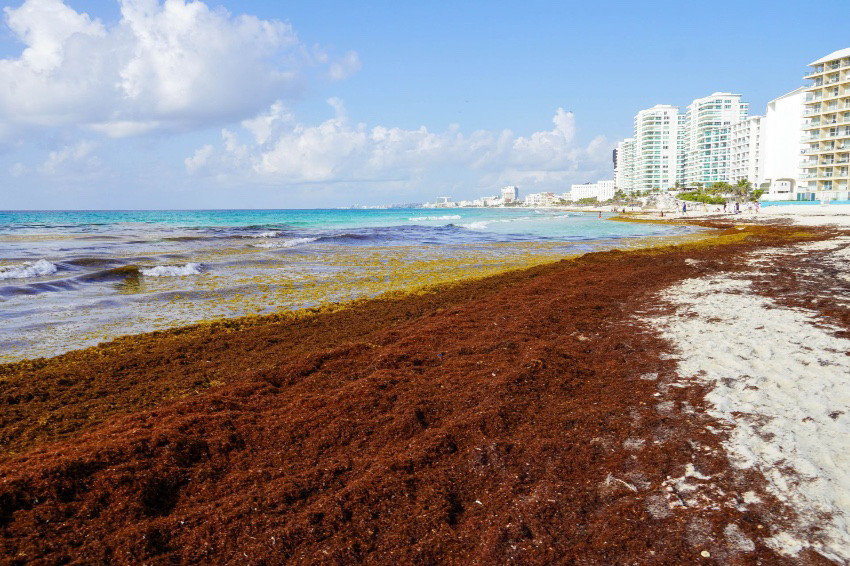
Sargassum is beginning to recede from Quintana Roo beaches after peaking in June and July, but the Mexican Caribbean remains on track for one of its worst years on record.
The decline began this month and should become more pronounced in September and October, Esteban Amaro Mauricio, hydrobiologist and director of the Quintana Roo Sargassum Monitoring Network, said this week.
The arrival of the seaweed has been erratic, however. Tulum and Mahahual still have major accumulations while Playa del Carmen has seen less. Puerto Morelos, recently clear, received a significant influx this week.
At the beginning of this month, 30 beaches in northern Quintana Roo alone were on red alert for excessive sargassum. Amaro said the network’s latest monitoring report put 22 of the state’s northern beaches in red, 17 in orange, 13 in yellow, 45 in green and three free of the algae.
Tonnes on Quintana Roo beaches
Conditions had improved less in the south, where 30 beaches remained on red alert, with two on orange, three a piece on yellow and green, and two free of sargassum entirely.
About 110,000 tonnes of sargassum have been collected statewide this year, Amaro said. He projected a total of roughly 150,000 tonnes by year’s end, well above the 94,000 tonnes collected in 2025.
Amaro said sargassum arrivals should be minimal in November and December but could resume as early as January 2027, as they did this year. In previous years, the season typically began in April or May.

The scale offshore remains enormous. Monitors at one point detected as much as 54 million tonnes of the algae floating between Africa and the Gulf of Mexico, Amaro said, including 4 million to 5 million tonnes off the Mexican Caribbean (coast?) .
Approximately 5% to 10% of the sargassum nearest the coast reaches beaches, Amaro said.
Hurricanes, tropical depressions and tropical storms could disperse the algae, he said, although officials will keep containment barriers and offshore collection vessels in service.
Tourism impact
The influx has compounded pressures on tourism. Quintana Roo Tourism Minister Bernardo Cueto Riestra said Tulum hotel occupancy had fallen to 15%, its lowest level on record, while Playa del Carmen stood at 30%.
He cited the atypical sargassum arrival and reduced airline frequencies linked to fuel costs.
The problem affects about 30 countries, Amaro added. Sargassum is a natural part of Atlantic Ocean ecosystems, but since 2011, extraordinary proliferations have affected the Caribbean region, with impacts on coastal ecosystems, fisheries and tourism.
Mexico and Japan announced last week they are working to establish a joint sargassum-response program that could include Japanese ocean-monitoring technology, specialized equipment, collection vessels, satellite monitoring and technical training. One of its goals would be turning the algae into products such as fertilizer, biofuels and construction materials.
With reports from La Jornada, Prensa IBERO, Peninsular Caribbean and Reportur.us
KioskNews shows a cleaned-up reading view extracted from the publisher’s page — the original always lives on their site, not ours.