FEATURE: Milkfish industry sinking under the horizon
AGING OUT: A graying workforce and younger generations uninterested in joining it are not the signs of positive change for the milkfish industry, or associated sectors
By Yang Yuan-ting, Tsai Tsung-hsun and William Hetherington / Staff reporters, with staff writer


Taiwan’s milkfish industry faces a shortage of skilled workers that could see boneless milkfish disappear from dinner tables within a decade, industry representatives said.
Removing the fish’s many bones requires skilled manual labor, but many seafood processing workers are in their 60s or older, while younger people show little interest in the work.
A milkfish processor in the Sinwen (新塭) area in Chiayi County’s Budai Township (布袋) said foreign spouses from Southeast Asia who helped sustain the industry have largely moved into other jobs.
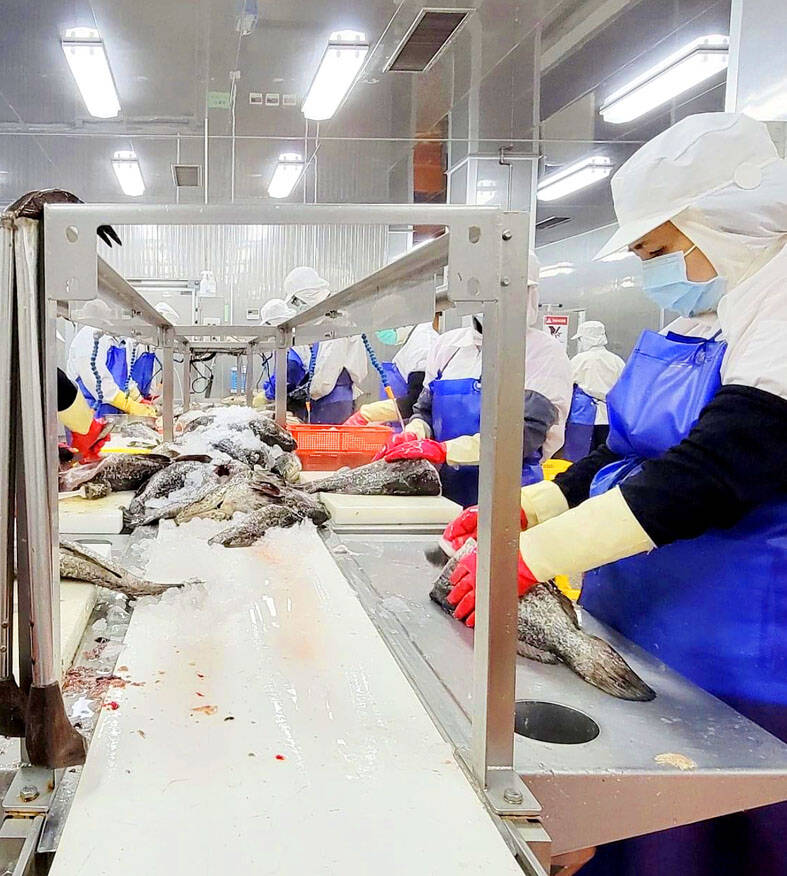
Workers process milkfish in Kaohisung in an undated photograph.
Photo courtesy of the Singda Harbor Fishermen’s Association
His plant once employed as many as 15 workers, but now has only one. Few Taiwanese workers under 60 are willing to gut and process fish, he said.
Most of his former employees were middle-aged or older housewives working part-time, with only five full-time staff. Their willingness to keep working has allowed the plant to remain operational, he said. Once they can no longer work, the business would have to hire migrant workers or shut down.
Singda Harbor Fishermen’s Association secretary-general Kuo Chan-hao (郭展豪) said the association’s seafood processing plant faces a similar problem, with most of its more than 20 employees in their 60s.
“A 40-year-old employee is considered young here,” Kuo said.
Processing plants must maintain temperatures below 15°C to ensure food safety, while workers handle fish in wet conditions. Even with monthly salaries of NT$50,000, plus meals and accommodation, employers struggle to attract younger workers, Kuo said. Some new hires quit after just one day.
Many tasks, including deboning milkfish and cutting eels, remain difficult to mechanize and must be done by hand, Kuo said. It takes at least six months for beginners to develop the skills for the job.
He once approached a leading Icelandic manufacturer about developing a machine to remove milkfish bones, but the company said it could not make one.
Without new workers, boneless milkfish and other processed seafood could become prohibitively expensive or disappear from the market, he said.
Fisheries Agency Director-General Wang Mao-cheng (王茂城) said the agency has been helping seafood processors and frontline fisheries operations introduce labor-saving equipment while seeking to increase migrant worker quotas.
However, processes such as deboning milkfish, gutting eels and salting mullet roe cannot be replaced by machinery, Wang said.
The agency plans to provide instructors, training venues and materials for courses in fish deboning, eel preparation and mullet roe processing. It hopes to train at least 100 people and establish a system to match graduates with employers.
The labor shortage extends beyond processing to fish farming and harvesting. The area devoted to milkfish farming nationwide has shrunk from a peak of 10,378 hectares to 5,000.2 hectares this year, partly because younger people are leaving fishing communities and aquaculture operations face competition from solar power development.
The combination of shrinking production areas and a lack of workers has put the industry’s future at risk. Some fish farmers jokingly describe it as a sunset industry, particularly as Taiwan Semiconductor Manufacturing Co (TSMC) competes for workers.
Processors said TSMC’s expansion at the Southern Taiwan Science Park and recruitment for a new facility at the Chiayi Science Park have made it harder to attract younger employees. The entry requirements are less demanding than some might expect, while salaries are attractive and working for TSMC carries social prestige, they said.
Hiring migrant workers is not an easy alternative as processors must have a factory registration certificate. Many businesses do not qualify and have little choice but to continue operating with their existing staff.
Milkfish farmers said the number of fishers under 60 is declining, leaving many in their 70s and 80s to keep working. With few younger people willing to take over, some fishponds are eventually leased to solar power operators.
Professional fishing crews are also struggling to recruit younger workers, with their numbers down by more than half. The decline in milkfish farming areas has so far limited the need for harvesting labor, but farmers fear shortages would worsen as older workers retire.
Without younger workers to replace them, aging fishers would eventually be unable to haul nets and harvest fish, potentially triggering a scramble for harvesting crews, they said.
A part-time worker in her 60s said removing the belly and bones from milkfish had become second nature and was not particularly tiring. Flexible hours allow her to take time off to pay respects to ancestors or care for her grandchildren.
She intends to continue working as long as she is physically able, she said, but worries about the industry’s future if no younger workers enter the trade.
KioskNews shows a cleaned-up reading view extracted from the publisher’s page — the original always lives on their site, not ours.