Tuvalu dying ecosystem on front line of climate change
When leaders visit the coral atolls that form the Pacific nation of Tuvalu on Tuesday, they will find a once-vibrant ecosystem wiped out due to climate change.
The pre-Conference of the Parties (COP) gathering, hosted by Fiji ahead of the annual UN climate conference in Turkey, has been billed as the Pacific’s chance to show the world first-hand the damage wrought by climate change in the vast ocean region.
Leaders are also set to spend a day on Tuvalu.
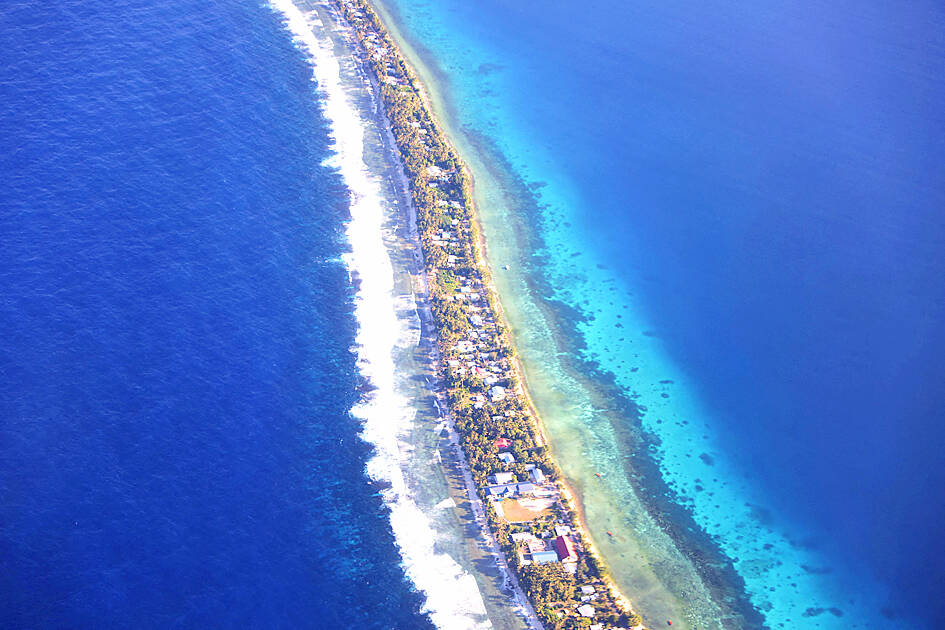
Funafuti, Tuvalu, is pictured on Sept. 6, 2024.
Photo:Reuters
There, scientists say, a marine heatwave in 2024 wiped out an estimated 99.9 percent of the coral that built the remote Tuvalu islands.
“You can swim for hours and hours along the reef in the lagoon, just skeleton after skeleton. It’s all dead,” said marine biologist Austin Bowden-Kerby, who visited last year and documented the devastation. “The very system that created the islands has died. It wasn’t pollution. It wasn’t overfishing. Just a direct result from climate change.”
Rising sea levels have largely swamped two of Tuvalu’s nine coral atolls — and scientists fear the entire archipelago could be unliveable by the end of the century.
Speaking at the UN last week, Tuvaluan Prime Minister Feleti Teo warned “sea-level rise is not a future threat, it is a present reality.”
Scientist Rajneel Singh said climate change was already impacting the waters that have long sustained Tuvalu’s population of 10,600.
“Elders used to fish for red snappers and other things,” he said. “It’s no longer frequent in the catch. And the sizes of the fish has been reduced as well.”
Bowden-Kerby said the lack of fish and the reduction in size is a serious concern for a country that lives off the sea.
“There are certain groups of fish that are dependent upon live corals,” he said. “Those fish are basically gone, and that’s the foundation of the food chain.”
A coral nursery is providing a faint glimmer of hope and has even seen the return of plankton-feeding fish.
They cannot replant all the lost reefs of Tuvalu, but they can protect some heat-resistant corals, Bowden-Kerby said.
That is if they have the money, which ran out at the end of last year.
“We need more funds just to sustain these things,” Singh said.
Bleaching events since 2018 have caused widespread coral mortality, with the UN World Ocean Assessment warning that 90 percent of reefs could disappear if global warming tops 1.5°C above pre-industrial levels.
What has happened to Tuvalu should serve as a lesson to others, scientists said.
Vanuatu and Samoa have moved to protect their corals from imminent bleaching.
Australia is being urged to take urgent action to protect its Great Barrier Reef.
Bowden-Kerby urged visiting Australians to see the dead reefs for themselves.
“You want to see what it looks like 10 years in the future? Tuvalu is a time machine for Australia.”
Only a handful of world leaders are expected to come to the pre-COP gathering in Fiji, let alone make the extra trip to Tuvalu.
“It does make you think nobody cares,” Singh said. “It’s very, very sad.”
And those that do come will likely stay for a quick photo-op before jumping back on their planes.
“No one is actually going out getting their feet wet and seeing what’s going on,” Singh said. “There’s a 10-minute flyover of the lagoon and that’s about it. There’s no awareness of what’s happening.”
KioskNews shows a cleaned-up reading view extracted from the publisher’s page — the original always lives on their site, not ours.