The pager at the pulpit — Abbi Kanthasamy
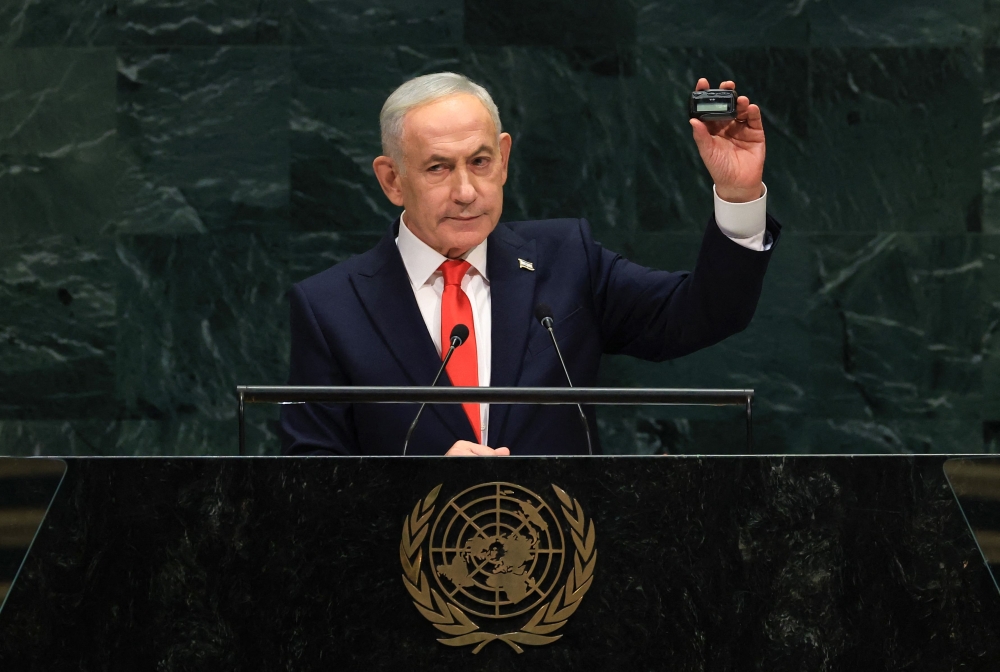
SEPTEMBER 26 — Benjamin Netanyahu went to the United Nations to explain why Israel is fighting on seven fronts, why its army is the most moral in the world, why its critics are cowards, and why the people walking out of the room are the real problem.
Then he held up a pager.
“Remember the beepers?” he asked, smiling like a man producing the rabbit at the end of a magic trick.
The trick, of course, was that the rabbit had been wired with explosives.
In September 2024, thousands of pagers and walkie-talkies exploded across Lebanon and Syria in an operation widely attributed to Israel. At least 37 people were killed and more than 3,000 injured. Children were among the dead. So were civilians. The blasts tore through homes, shops and streets. UN human-rights experts warned the attacks could constitute war crimes, including indiscriminate attacks. That is not a final court judgment. It is a warning that should have made any leader think twice before turning the device into a prop. Netanyahu looked at it and saw a punchline.
“Remember the beepers?”
Yes, Prime Minister. People remember the blood, too.
Israel’s Prime Minister Benjamin Netanyahu holds up a pager while addressing the 81st United Nations General Assembly in New York on September 24, 2026. — AFP pic
There is something grotesque about bringing a weapon associated with civilian deaths into the world’s diplomatic chamber and treating it like a championship belt. Imagine an accused arsonist arriving at a fire-safety conference, twirling the match and asking the audience if it remembers the flames. Imagine a pickpocket addressing a room of victims with, “Remember the wallets?” That isn’t wit. It’s a man so pleased with the performance that he has forgotten what the performance is about.
The United Nations is not a showroom for clever weapons. It is not a comedy club where the dead are the setup and the surviving families are expected to laugh at the punchline. It is supposed to be a place where leaders make the case for peace, or at least pretend to have read the menu.
No wonder delegates walked out. Netanyahu called them “moral cowards”. Perhaps it was easier than asking why so many chose the corridor over his speech. A walkout is not an argument, but neither is a pager held aloft like a party favour. Sometimes an empty chair is the most honest thing in the room.
His speech was a masterclass in changing the subject. Seven fronts. Seven enemies. Seven reasons the world should stop asking questions and start applauding. Israel, he said, was fighting everyone else’s fight. Hamas, Hezbollah, Iran, the Houthis, militias, terrorists: all packed into one vast, convenient silhouette called the enemy. Any Israeli action could then be placed beneath the same enormous umbrella labelled self-defence.
Hamas’s murder and kidnapping of Israeli civilians on October 7 was horrific. Israeli families deserve to grieve, and hostages deserved to come home. Saying so should not require a footnote. But grief is not a government’s lifetime licence to act without scrutiny. One atrocity does not turn every later decision into a moral blank cheque.
Netanyahu called criticism an “eighth front”, a war for truth. It is an elegant device: disagree with the government and you are no longer a critic; you are an enemy combatant in the information war. He said Israel sent millions of warnings to civilians. Those warnings matter. So do the dead, the displaced, the shattered neighbourhoods and the people who had nowhere safe to run. A leaflet is not a force field. A phone call telling a family to flee does not make the road out safe, or create a safe place at the other end.
Here is the arithmetic the speech cannot make disappear. Gaza’s Health Ministry reported 73,910 Palestinians killed by September 20, 2026. The total does not distinguish combatants from civilians. Unicef reported at least 21,700 children killed by June 30. And on September 24, after reviewing its records, the Committee to Protect Journalists documented 189 Palestinian journalists and media workers killed in Gaza. These figures have different cut-off dates and definitions; CPJ’s count does not mean every journalist was deliberately targeted. They are still numbers too large to hide behind a podium.
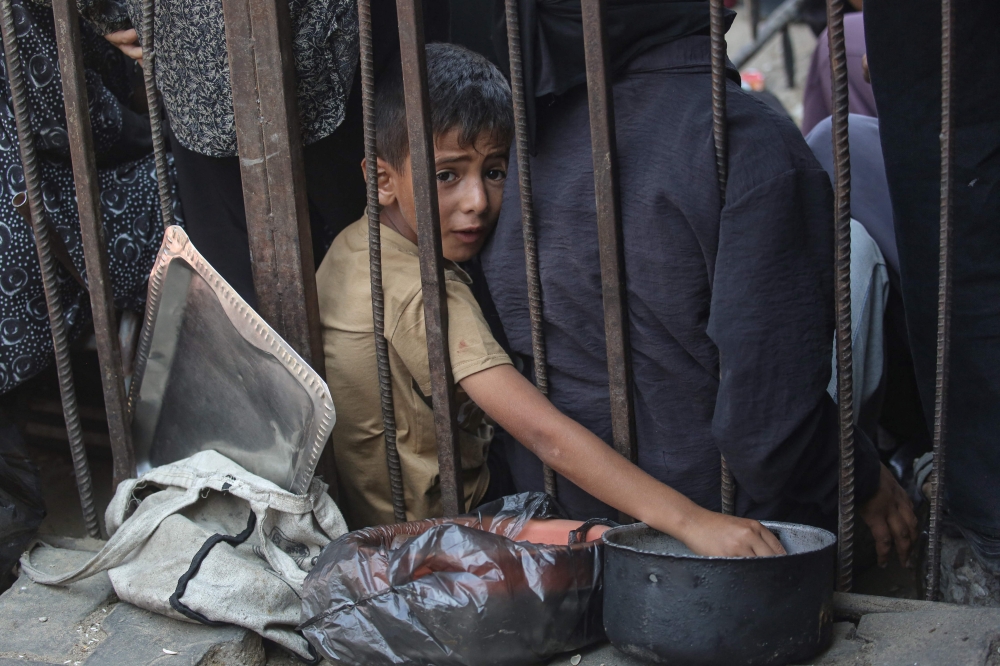
A displaced Palestinian boy waits with others to receive hot meals distributed by a charity kitchen in Khan Yunis in the southern Gaza Strip on September 25, 2026. — AFP pic
Twenty-one thousand seven hundred children: say it slowly. These are not units in a briefing. They are names someone called at dinner. Shoes left by a door. A school uniform with no child left to wear it. One child dead is a family’s entire world ending. Multiply that by tens of thousands and you have not made the grief smaller. You have only made it harder to look at.
And the journalists? CPJ’s revised Gaza count is 189. That does not establish that everyone was targeted for their work; it does tell you how many reporters and media workers are no longer there to describe what they saw. When the people with cameras keep dying, and foreign journalists cannot freely enter Gaza, the world is left arguing over the pictures while the witnesses disappear. The facts need investigation. The journalists deserved protection. Their deaths should not be waved away as another hostile talking point.
Then there is NAZA, the documentary by Israeli filmmakers examining civilian deaths and Israeli military targeting in Gaza. The film wins an award at Venice; the government’s response is to threaten the filmmakers’ citizenship. Netanyahu says he wants laws that could strip citizenship from people who “smear” Israeli soldiers. Imagine the confidence required to claim your army has nothing to hide while threatening the people who made a film about what it does. If the filmmakers are wrong, answer them. Bring evidence. Make the case. A passport is not a rebuttal.
Defence Minister Israel Katz has been less subtle. He described the government’s language in Gaza and Lebanon as “evacuating the population, destroying the infrastructure and taking the territory.” He has also threatened to evacuate Gaza City’s million residents and destroy its buildings if one Israeli is kidnapped. There is no need to write a satirical version of that statement. The official version is already a black joke with the laughter removed.
Let’s be clear about what is being criticised here. This is not an indictment of Jews. Jewish people are not a single political bloc, and many Jews — including Israelis — criticise Netanyahu and oppose his government’s actions. Antisemitism is real and vicious; it must be confronted wherever it appears. But criticism of a government, its military conduct or the political ideology used to justify domination is not automatically hatred of Jews. Turn every criticism into antisemitism and the accusation becomes a shield for power instead of protection for people.
The Iran passage had its own curious little problem. Israel and the United States opened this latest round with strikes on Iran, described by Israel as “pre-emptive”, as Washington and Tehran were again negotiating over the nuclear dispute. Iran’s threats and actions do not vanish from the record. But if you strike first, then stand at the UN describing yourself as the civilisation-saving victim of aggression, you should expect a few people to check the timeline.
And the nuclear question: Israel is widely believed to possess nuclear weapons, though it officially confirms neither their existence nor its arsenal. The British House of Commons Library says Israel’s capability was developed outside the Non-Proliferation Treaty. Iran, for all the serious concerns about its nuclear programme, is a party to that treaty. The region’s only widely believed nuclear-armed state outside the NPT does not get to lecture its neighbours as if only their secrets count.
Britain has its own ghost in this room. The Balfour Declaration and the British Mandate helped shape the road to Israel’s creation; Britain did not create Israel single-handedly, but it played a pivotal and deeply contradictory role in Palestine’s fate. Now London objects, Netanyahu ignores it, and the former imperial midwife looks like a retired landlord arriving with a clipboard after the locks have been changed. The empire that helped write the prologue has discovered it no longer controls the plot.
That is the speech’s real spectacle: the man with the pager tells the world he is the only one brave enough to defend civilisation; the man threatening citizenship for filmmakers calls everyone else dishonest; the man whose country’s actions draw grave legal scrutiny insists the problem is the people asking questions.
The delegates walked out. Netanyahu called them cowards. He may prefer that story. It puts him at the centre, where he likes to stand, and turns the empty seats into props for his next scene.
But the pager remains. So do the dead. So do the children, the reporters, the families, the people beneath the rubble and the people still trying to tell their stories.
“Remember the beepers?” he asked.
We will remember the beepers.
We will also remember who held one up, who made it a joke, and who was missing from the punchline.
* This is the personal opinion of the writers or publication and does not necessarily represent the views of Malay Mail.
KioskNews shows a cleaned-up reading view extracted from the publisher’s page — the original always lives on their site, not ours.