Ministry to test impact of carbon capture schemes
By Esme Yeh / Staff reporter


The Ministry of Environment has launched a carbon capture and storage (CCS) site development scheme and subjected it to strategic environment assessments (SEA) to prevent spatial use conflicts, ensure storage safety and reduce environmental impact.
The ministry on Wednesday held an expert advisory meeting on the CCS site development scheme formulated by the ministry’s Climate Change Administration last year.
The scheme would delineate zones with CCS potential — mainly within deep saline aquifers in waters off western Taiwan — the drafted assessment statement said.
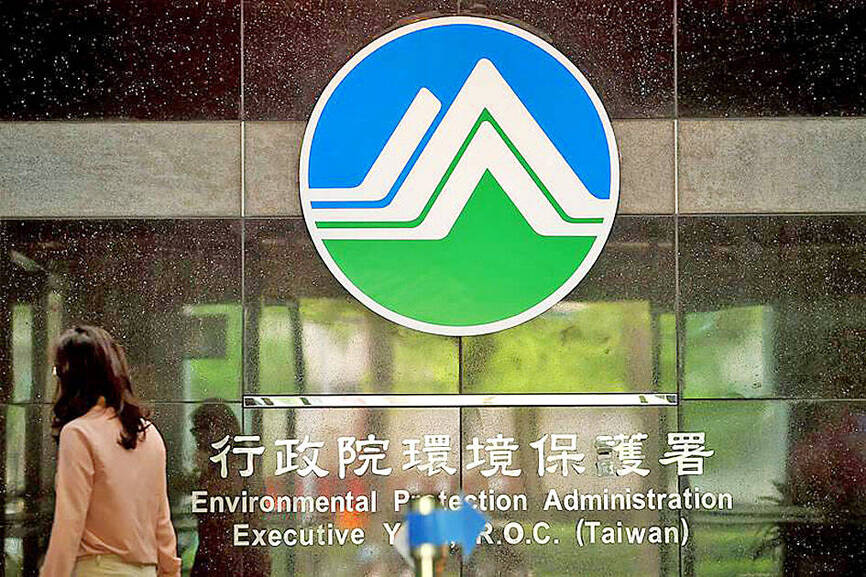
A person walks past the name and logo of the Ministry of Environment at its headquarters in Taipei in an undated photograph.
Photo: CNA
Areas listed as protected, environmentally sensitive or restricted for development would be excluded as required by law, the statement said.
Administration Director-General Tsai Ling-yi (蔡玲儀) said Taiwan first included CCS in climate regulations when the Climate Change Adaptation Act (氣候變遷因應法) was promulgated on Feb. 15, 2023.
The ministry is the responsible agency for CCS development and environmental protection, she said.
“We understand that CCS activity could result in adverse environmental impacts,” Tsai said.
Thus, despite not being legally bound to do so, the ministry voluntarily conducted an SEA of CCS sites based on Article 4 of the Regulations Governing Strategic Environmental Assessments (政府政策環境影響評估作業辦法), she said.
The climate agency commissioned a research team from National Taiwan University’s Graduate Institute of Environmental Engineering to conduct the assessments two years ago, Tsai said.
CCS site selection is closely related to the project’s environmental impact assessment results, she said, adding that the ministry in February mandated SEA for all CCS development.
The scheme is expected to establish the guiding principles for future development of CCS sites, Tsai said.
It is also expected to prevent spatial use conflicts, ensure long-term storage safety, and reduce environmental impacts and leakage risks, she said.
The central government last year launched the Carbon Capture, Utilization and Storage Flagship Carbon Reduction Action Plan in line with Taiwan’s nationally determined contribution targets, with the goal of reducing 6 million tonnes of carbon dioxide equivalent by 2035, Tsai said.
Experts said that they recognized the ministry’s efforts in conducting the scheme’s SEA.
They also said that any risk of carbon dioxide leakage must be strictly controlled.
Carbon dioxide leaks into water and affects groundwater quality, while leaks into the air can cause breathing difficulties, they said.
Experts also suggested that in its SEA, the ministry estimate how many CCS sites are required to meet the 2035 reduction goal of 6 million tonnes of carbon dioxide equivalents.
Miaoli County Environmental Protection Association president Chen Chi-chung (陳祺忠) said zones with CCS potential should be more explicitly delineated in the scheme’s SEA.
The technical methods adopted by the CCS demonstration site in Miaoli County and their implementation status should be fully disclosed for public scrutiny, he said.
Taiwan has relatively few statutory environmentally sensitive, restricted development or protected areas, as it is small and densely populated, Chen said.
Using the scheme to delineate a geographic scope for potential CCS use might overlook ecological issues that are not legally specified but are of concern, he said.
Chen also called on the ministry to establish a mechanism that can publicize proposed development projects early, as well as help convey dissenting opinions to those at the top, thereby ensuring local residents’ rights and welfare.
KioskNews shows a cleaned-up reading view extracted from the publisher’s page — the original always lives on their site, not ours.