The 10 Most Hopeless War Movies, Ranked


Diego Pineda has been a devout storyteller his whole life. He has self-published a fantasy novel and a book of short stories, and is actively working on publishing his second novel.
A lifelong fan of watching movies and talking about them endlessly, he writes reviews and analyses on his Instagram page dedicated to cinema, and occasionally on his blog. His favorite filmmakers are Andrei Tarkovsky and Charlie Chaplin. He loves modern Mexican cinema and thinks it's tragically underappreciated.
Other interests of Diego's include reading, gaming, roller coasters, writing reviews on his Letterboxd account (username: DPP_reviews), and going down rabbit holes of whatever topic he's interested in at any given point.
Sign in to your Collider account
War cinema has been around since the late 19th century, but it was around the mid-to-late 1920s that the genre really started to pick up major commercial steam and become a cornerstone of worldwide filmmaking. Around the 1940s, right at the peak of World War II, it reached its absolute peak production around the globe. Since then, it hasn't ceased to be one of the most prolific and powerful movie genres out there, producer of several of the greatest feature films of all time.
War is, of course, an inherently senseless, violent, and irredeemable concept. As such, even though many of the best war movies in history offer some semblance of hope for their characters and humanity at large, other films don't deliver such comforts. From foundational classics like Paths of Glory to more modern gems like 2022's All Quiet on the Western Front, the most hopeless war movies in history understand that there is no true solace to be found in military conflict.
There are spoilers ahead for each entry mentioned!
10 'Paths of Glory' (1957)
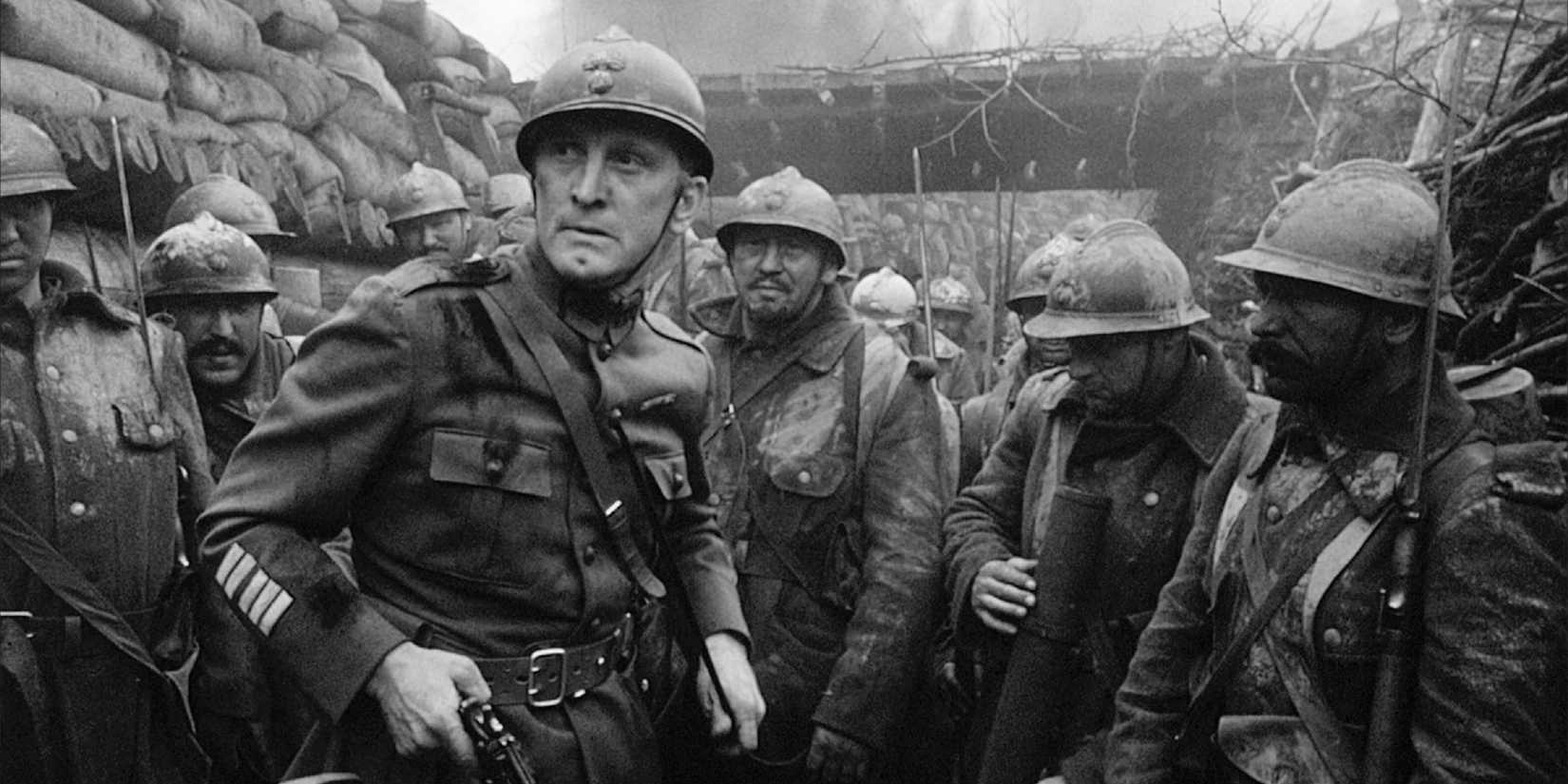
Stanley Kubrick was not yet well established by the time he made Paths of Glory, a war drama based on the 1935 novel of the same name by Humphrey Cobb. It was this masterpiece that served as his artistic breakthrough and his first true major critical success, boosting the trajectory of an auteur that many today would confidently recognize as the greatest filmmaker in history.
Indeed, Paths of Glory is one of those war movies without any substantial flaws, led by Kirk Douglas at the very top of his game. It's also, however, one of the bleakest anti-war statements in the history of cinema, and that's without the need for the kind of brutal combat that characterizes many of history's most hopeless war films. The true enemy faced by the story's characters is not the German army, but the cold cruelty of the institutional hierarchy of the military establishment.

As if any more proof were needed that Stanley Kubrick was capable of making the greatest—and most hopeless—war movies imaginable, there's also Full Metal Jacket, based on the autobiographical novel The Short-Timers by Gustav Hasford. It was Kubrick's penultimate movie and the last to be released during his lifetime, and it's still widely remembered as one of the best Vietnam War films of all time.
At its core, Full Metal Jacket is a story about how, in transforming young men into instruments of war, the military establishment crushes and erases their soul and individuality. It's a bleak enough concept on paper, and Kubrick executes it with merciless realism, resulting in one of the best psychological war movies of all time. From the tragedy of Private Pyle's death to the nihilistic brutality of the movie's second half, the whole thing remains irreparably pessimistic.
8 'Johnny Mad Dog' (2008)

Africa has produced several of history's greatest war movies, including some of the most criminally underappreciated war films of the 21st century. Case in point: Johnny Mad Dog, a Franco-Liberian movie based on the 2002 novel Johnny chien méchant by Congolese author Emmanuel Dongala. The plot follows a teenage Liberian child soldier, who leads a ruthless rebellion across his war-torn country.
Directed by Jean-Stéphane Sauvaire, Johnny Mad Dog takes the corruption of childhood innocence—one of the most frequent themes found across all of war cinema—and approaches it with absolutely terrifying hopelessness. Our 15-year-old protagonist and his teenage militia squad treat the atrocities of war like basic playground play, and the fact that Sauvaire decided to cast real former child soldiers lends the movie a further air of raw, gut-wrenching authenticity.
7 'All Quiet on the Western Front' (2022)

The 1929 Erich Maria Remarque novel All Quiet on the Western Front is one of the bleakest and most hopeless war novels ever published. Its Oscar-winning 1930 film adaptation is almost every bit as dark, but it's the 2022 Netflix adaptation by Edward Berger that's perhaps the most hopeless rendition of the story to date, as well as one of the most powerful anti-war movies of all time.
Berger understands war as a whole, and World War I in particular, as a sort of unsentimental assembly line where young men are treated as empty pieces of flesh to be recycled in the name of victory, all while the men with the actual power to solve the conflict sit down and talk with fancy cigars in hand. What really makes the hopelessness of the story feel so visceral in this version is the pure gory carnage of the action sequences, which are too violent and realistic to possess any kind of genuine thrill or entertainment value.
6 'The Painted Bird' (2019)

Jerzy Kosińsky's The Painted Bird is one of the most gut-wrenching novels ever written about World War II, and the Czech drama based on the book (the first film ever to feature the Interslavic language) is just as powerful. The story follows Joska, a young Jewish boy undergoing a harrowing journey of survival as he wanders alone through the rural villages of Eastern Europe during World War II.
From the abuse that he directly suffers to the many acts of the utmost cruelty that he witnesses, Joska witnesses such a complete breakdown of human morality across all of civilization that it becomes hard to even continue watching. Where other films show much clearer lines between "the good guys" and "the bad guys," The Painted Bird is more so concerned with studying the primal cruelty that war brings out of ordinary people.
Collider Exclusive · Oscar Best Picture Quiz
Which Oscar Best Picture
Is Your Perfect Movie?
Parasite · Everything Everywhere · Oppenheimer · Birdman · No Country
Five Oscar Best Picture winners. Five completely different visions of what cinema can be — and what it can do to you. One of them is the film that was made for the way your mind works. Ten questions will figure out which one.
🪜Parasite
🌀Everything Everywhere
☢️Oppenheimer
🐦Birdman
🪙No Country for Old Men
01
What kind of film experience do you actually want? The best movies don't just entertain — they leave something behind.
02
Which idea grabs you most in a film? Great films are driven by a central obsession. What's yours?
03
How do you like your story told? Form is content. The way a story is shaped changes what it means.
04
What makes a truly great antagonist? The opposition defines the protagonist. What kind of opposition fascinates you?
05
What do you want from a film's ending? The final note is the one that lingers. What do you want it to sound like?
06
Which setting pulls you in most? Where a film takes place shapes everything — mood, stakes, what's even possible.
07
What cinematic craft impresses you most? Every great film has a signature — a technical or artistic element that makes it unmistakable.
08
What kind of main character do you root for? The protagonist is the lens. Who you choose to follow says something about you.
09
How do you feel about a film that takes its time? Pace is a choice. Some films sprint; others let tension accumulate slowly, deliberately.
10
What do you want to feel walking out of the cinema? The best films leave a mark. What kind of mark do you want?
The Academy Has Decided Your Perfect Film Is…
Your answers have pointed to one Oscar Best Picture winner above all others. This is the film that was made for the way your mind works.
Parasite
You are drawn to films that operate on multiple levels simultaneously — that begin in one genre and quietly, brilliantly migrate into another. Bong Joon-ho's Parasite is a film about class, desire, and the architecture of inequality that manages to be darkly funny, deeply suspenseful, and genuinely shocking across a single extraordinary running time. Your instinct is for cinema that hides its true intentions until the moment it's ready to reveal them. Parasite is exactly that — a film that rewards close attention and punishes assumptions, right up to its devastating final image.
Everything Everywhere All at Once
You want it all — and this film gives you all of it. The Daniels' Everything Everywhere All at Once is one of the most maximalist films ever made: action comedy, multiverse sci-fi, family drama, existential crisis, and a genuinely earned emotional core that sneaks up on you amid the chaos. You are someone who responds to ambition, who doesn't want cinema to choose between being entertaining and being meaningful. This film refuses that choice entirely. It is overwhelming by design, and its overwhelming nature is precisely the point — because the feeling of being crushed by infinite possibility is exactly what it's about.
Oppenheimer
You are drawn to cinema on a grand scale — films that understand history not as a backdrop but as a force, and that place their characters inside that force and watch what happens. Christopher Nolan's Oppenheimer is a film about the terrifying gap between what we can do and what we should do, told with the full weight of one of the most consequential moments in human history behind it. You want your films to feel important without feeling self-important — to earn their ambition through sheer craft and the gravity of their subject. Oppenheimer does exactly that. It is enormous, complicated, and refuses easy comfort.
Birdman
You are drawn to films that foreground their own construction — that make the how of the filmmaking part of the what it's about. Alejandro González Iñárritu's Birdman, shot to appear as a single continuous take, is cinema examining itself through the cracked mirror of a fading actor's ego. You respond to formal daring, to the feeling that a film is doing something that probably shouldn't be possible. Michael Keaton's performance and Emmanuel Lubezki's restless camera create something genuinely unlike anything else — a film that is simultaneously about creativity, relevance, self-destruction, and the impossibility of ever truly knowing if your work means anything at all.
No Country for Old Men
You are drawn to cinema that trusts silence, that refuses to explain itself, and that treats dread as a form of meaning. The Coen Brothers' No Country for Old Men is a film about the arrival of a new kind of evil — implacable, arbitrary, and utterly indifferent to the moral frameworks we use to make sense of the world. It is one of the most formally controlled films ever made, and its controlled restraint is what makes it so terrifying. You want your films to haunt you, not comfort you. You are not interested in resolution if resolution would be dishonest. No Country for Old Men is honest in a way that most cinema never dares to be.
5 'Fires on the Plain' (1959)

Yet another awfully underappreciated international war movie, the Japanese drama Fires on the Plain is based on Shōhei Ōoka's 1951 novel Nobi. This is one of those forgotten war movies that are actually great, following a Japanese soldier struggling to endure starvation, disease, and the breakdown of civilization in the Philippine jungle during the final days of World War II.
Western critics initially dismissed Fires on the Plain as gratuitously dark upon release.
Though many Western critics initially dismissed Fires on the Plain as gratuitously dark upon release, time has allowed cinephiles to come to appreciate just how powerful of an anti-war statement it is. That doesn't detract, however, from the fact that it's utterly hopeless from start to finish. Taboo subjects are treated so matter-of-factly, and the degradation of any ideas of duty or nationalism are treated with such cold indifference in the face of such suffering, that one can't help but feel the characters' pain.
4 'Johnny Got His Gun' (1971)

Legendary Hollywood screenwriter Dalton Trumbo published the anti-war novel Johnny Got His Gun all the way back in 1939. Shortly after the dissolution of the Hollywood blacklist that he was placed on for over a decade, Trumbo started working on a Johnny Got His Gun screenplay with Luis Buñuel, who was initially attached to direct. In the end, it was Trumbo who made this his only directorial effort. Though the film was only a minor success upon release, the years have transformed it into a true cult classic.
Just like the book it's based on, Johnny Got His Gun presents a young American soldier who has lost his arms, legs, eyes, ears, nose, and mouth to an artillery shell during World War I. The symbolism is evident: war is a living grave that strips its soldiers of every human faculty, treating them instead like disposable cannon fodder. Alas, it's all-too-timeless of a theme, which has allowed Johnny Got His Gun to age like fine wine.
3 'Threads' (1984)
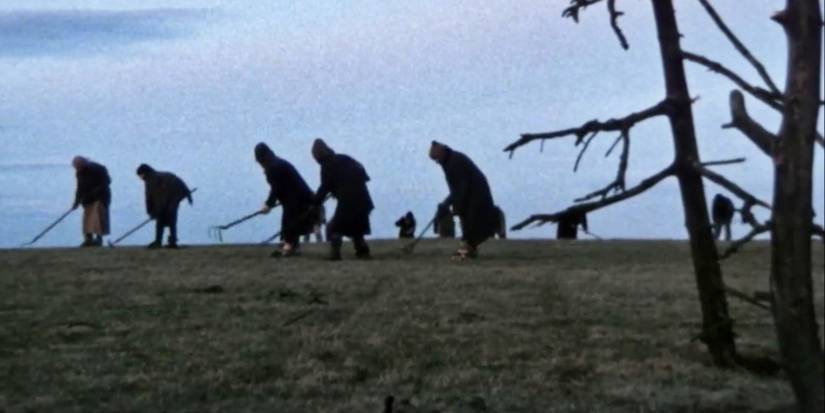
Television films are cinema, too. For proof, one needn't look any further than the BBC masterpiece Threads, arguably the single greatest television fiction film of all time. It's one of the best movies about the end of the world ever made, following two Sheffield families struggling to survive as a nuclear war between the United States and the Soviet Union erupts.
It's an absolutely relentless and utterly hopeless piece of anti-war filmmaking, leaving zero room for any sort of heroic survival or moral redemption. In Threads, war represents the irreversible unraveling of human civilization, portraying the nuclear paranoia of the Cold War era to absolute perfection. Crafted with a clinical sense of documentary-like emotional detachment, it really is one of the darkest films ever made.
2 'Grave of the Fireflies' (1988)

Directed by Isao Takahata, Studio Ghibli's Grave of the Fireflies is not only one of the heaviest animated movies ever made, but also one of the very best. Based on Akiyuki Nosaka's heartbreaking semi-autobiographical short story of the same name, it has long been regarded as one of the most powerful anti-war movies of all time.
Takahata himself, however, didn't consider the movie anti-war, since he argued that no cinematic depiction of the horrors of civilian suffering could truly prevent political leaders (present or future) from starting new conflicts. That sense of hopelessness and futility permeates the entire movie, the slow and quiet death of two children being captured with such cold, unceremonious bleakness that it's impossible not to cry.
1 'Come And See' (1985)

Letterboxd's second-highest-rated war movie and fourth-highest-rated movie overall is Elem Klimov's Soviet masterpiece Come And See, hailed by critics and cinephiles alike as the ultimate anti-war film. Following a young Belarusian boy as he witnesses and experiences the heart-rending horrors of World War II, it's a movie so brutal and cruel that it practically counts as a horror film.
Indeed, Come And See is one of the most subversive war movies of all time. Its being hopeless in and of itself would be cold enough, but what really makes the film so unforgettable is that it dangles the idea of hope in front of the audience's eyes and violently takes it away every single time. Never has the big screen seen war be depicted as a more surreal, hallucinatory descent straight into Hell.

Come And See
- Release Date
- October 17, 1985
- Runtime
- 142 Minutes
- Director
- Elem Klimov
- Writers
- Elem Klimov, Ales Adamovich
KioskNews shows a cleaned-up reading view extracted from the publisher’s page — the original always lives on their site, not ours.